Southern Serengeti Safari: The Ndutu Calving Guide
Summary: A southern Serengeti safari means the short-grass plains and the Ndutu basin between January and March, the heart of the wildebeest calving season. Half a million calves drop on these mineral-rich volcanic plains in a few weeks, and every big cat and hyena for miles closes in. Because Ndutu sits in the Ngorongoro Conservation Area rather than the national park, your guide can drive off-road to follow the action, which you can’t do further north. For an 8-day double-occupancy circuit covering Tarangire, Manyara, the Ngorongoro Crater and the south, with a fly-back to Arusha, non-resident peak-season rates run from about USD 5,675 to USD 17,475 per person sharing.
From January to March the short-grass plains around Ndutu fill with hundreds of thousands of wildebeest dropping their calves, the bleating of mothers and newborns running off toward the horizon. This is the calving season, and for those few months the southern plains are about as busy and chaotic as the Serengeti gets.
Alongside the newborns come the predators, in real numbers: lions off the kopjes, cheetah on the open plains, hyenas at every edge. It’s loud and it stinks, and nobody comes to Ndutu in February for peace and quiet. The ground is tricky too, the black-cotton and volcanic soils turning to mud or fine dust depending on the day, so of all the regions of the park, this is one where your choice of base and guide counts for a lot.
Calving Season Package Comparisons
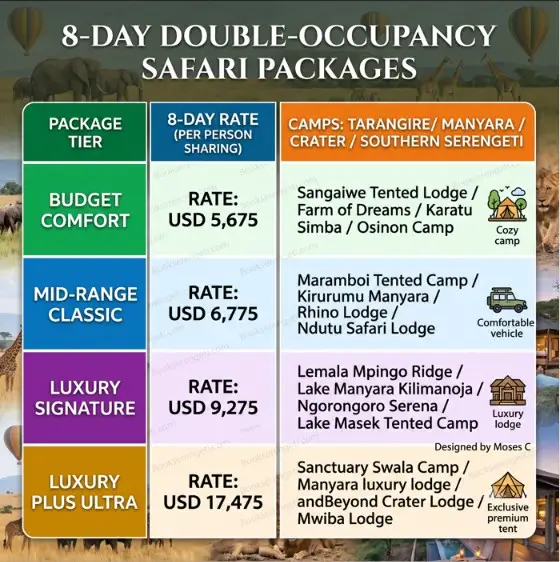
Here’s a real 8-Day/7-Night multi-destination route for two sharing a private 4×4: single nights near Tarangire, Lake Manyara and the Ngorongoro Crater on the way in, then four nights down on the calving plains. Non-resident USD per person.
8-Day Double-Occupancy Safari Packages
Package Tier | 8-Day Rate (Per Person Sharing) | Camps: Tarangire / Manyara / Crater / Southern Serengeti |
USD 5,675 | Sangaiwe Tented Lodge / Farm of Dreams / Karatu Simba / Osinon Camp | |
Mid-Range Classic | USD 6,775 | Maramboi Tented Camp / Kirurumu Manyara / Rhino Lodge / Ndutu Safari Lodge |
USD 9,275 | Lemala Mpingo Ridge / Lake Manyara Kilimamoja / Ngorongoro Serena / Lake Masek Tented Camp | |
Luxury Plus Ultra | USD 17,475 | Sanctuary Swala Camp / Manyara luxury lodge / andBeyond Crater Lodge / Mwiba Lodge |
Optional add-on: a sunrise hot air balloon flight over the calving plains, USD 600 per person, including the TANAPA permit, the launch and a champagne breakfast on landing.
We’ll price your calving trip against your own dates and group size.
What Fees Are Included
Our rates are all-in for the safari itself. What’s covered, and what isn’t:
What’s covered
- All daily conservation permits and destination taxes, collected by TANAPA.
- Private use of a fitted 4×4 cruiser with heavy-duty suspension, large windows and an open roof hatch.
- Fuel, and a professional driver-guide.
- Concession fees for every night you sleep inside the park boundaries.
- All meals, cold water in the vehicle fridge, and your room on a shared-double basis.
- The one-way bush flight from the Ndutu airstrip back to Arusha, taxes and luggage handling included.
What’s not
- International flights and your tourist visa ($100 for US citizens).
- Tips for your guide and the camp teams.
- Laundry, premium drinks at the bar, and personal travel insurance.
The park fees behind the price
The government charges baked into every rate, per adult per day with the 18% VAT already in. Ndutu straddles the Ngorongoro Conservation Area, run by the NCAA, so its crater fees can apply on this circuit too:
- Serengeti entry: USD 82.60 per adult / day.
- Inner-park lodge concession: USD 59 to 60 per adult / night.
- Ngorongoro Crater entry: USD 70.80 per adult / day.
- Ngorongoro Crater vehicle descent: USD 295 per vehicle / descent.
The wider park system is overseen by the MNRT.
The True Pacing of Birth
The pull is the grass. When the short rains green these plains, the volcanic soil pushes up grass unusually rich in calcium, phosphorus and magnesium, which is just what a heavily pregnant or nursing wildebeest needs. That mineral content is why they return to the same plains year after year, even when the rains are erratic; it’s the chemistry of the ground that fixes the calving here.
At the February peak, around 500,000 calves are born in roughly three weeks. That’s close to 8,000 a day, and you don’t really take the number in until you’re sitting in the middle of it. A newborn is on its feet within minutes and running with the herd inside the hour, which it has to be, because the birth glut pulls in some of the densest predator action anywhere: lion prides off the granite kopjes, cheetah hunting the open plains in the morning light, and spotted hyena clans working every fringe. Wild dogs turn up now and then, but they’re a rare bonus down here, not the calving predator some guides talk them up to be.
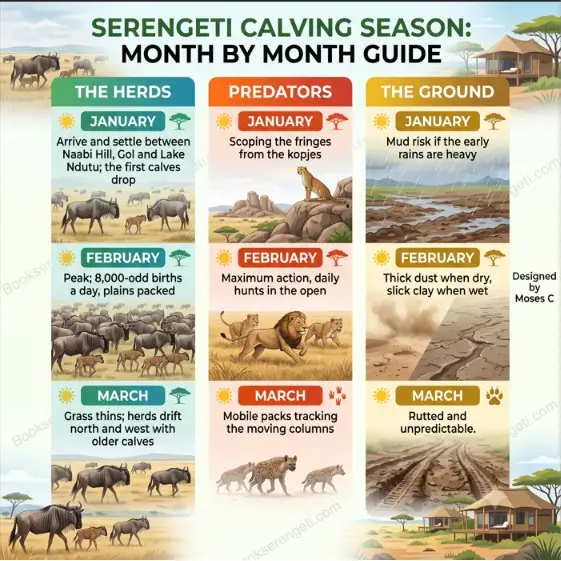
Month by month through calving
Month | The herds | Predators | The ground |
January | Arrive and settle between Naabi Hill, Gol and Lake Ndutu; the first calves drop | Scoping the fringes from the kopjes | Mud risk if the early rains are heavy |
February | Peak; 8,000-odd births a day, plains packed | Maximum action, daily hunts in the open | Thick dust when dry, slick clay when wet |
March | Grass thins; herds drift north and west with older calves | Mobile packs tracking the moving columns | Rutted and unpredictable |
The full migration timeline sets the calving against the rest of the Great Migration year, and Matiti and the Twin Hills are the plains most guides aim for when the births are at their height.
Bypassing the Invisible Border Fine
There’s an administrative quirk to Ndutu worth understanding before you go: it sits across two jurisdictions at once. The calving plains lie right on the line between the Serengeti National Park, run by TANAPA, and the Ngorongoro Conservation Area, run by the NCAA. There’s no fence, just the odd weathered concrete beacon in the grass, and the herds wander across it all day as the rain shifts the grazing.
That split cuts both ways. On the good side, the Ndutu plains lie in the conservation area, where guides are allowed to drive off-road to follow a cheetah or a hunt, something that’s banned in the national park proper, and it’s a big part of why the close sightings here are so good. The downside is the permits: your vehicle needs valid clearance for both zones, because a cheetah you’re tracking can slip across that invisible line without either of you noticing. A licensed operator sorts both before you arrive; leave it to chance and a wrong turn can land you at a checkpoint instead of the action.
The February peak books out a year ahead, and the camps in the calving zone are few. If those weeks are your aim, get your dates in early. Tell us your calving dates.
Alkaline Dust and Brake Squeal
Lake Ndutu and Lake Masek are soda lakes, and the old volcanic ash around them leaves a fine alkaline dust over everything. It bakes onto brake drums and sets off a piercing squeal that can clear a sighting of skittish game in seconds, so a good driver rinses the drums at the gate posts after a run across the dry pans. The dust itself is as fine as flour and gets into everything.
A short Ndutu packing list
The open plains and clean backgrounds make the south some of the finest photographic country in the park, though it’s harder on kit and skin than the central plains, so a few specifics beyond the usual bag:
- A simple camera rain-and-dust sleeve rather than only a dry bag; the alkaline dust works into focus rings and zoom barrels, and a sleeve lets you keep shooting through it.
- A handful of sealable zip bags for lenses, plus a blower brush for the end of the day.
- High-SPF lip balm and a heavier moisturiser than you’d carry for the central Serengeti; the dry wind and alkaline dust chap lips and skin fast down here.
- A buff or light scarf to pull over your nose on dusty transfers, and proper sunglasses for the glare off the white soda pans.
Out on the flats, the public campsites are basic and named after the local residents, Pimbi (hyrax), Tumbili (vervet), Nyani (baboon) and Nguchiro (mongoose), and can sit a long way from the herds, so most people use the Naabi gate facilities when they pass.
Southern Plains Planning FAQ
How far is it from Arusha to the southern plains?
About 335 km (208 miles) to Naabi Hill, then on into the Ndutu tracks, 5.5 to 6 hours over gravel if you go straight through. Most trips break the drive near Tarangire or Karatu, or fly a leg into the Ndutu airstrip.
Can you drive it in one afternoon?
No, it’s too far and rough for an afternoon. Splitting the nights over a few days, with stops on the way, is far better.
How strict are the baggage limits on the local flights?
A 15 kg limit in a soft duffel; rigid roller cases won’t fit the Cessna’s cargo pod and get left on the tarmac. Pack soft.
What if the green-season rains arrive late?
Then the herds stall further north and calve a few weeks later than usual; it comes down to when the grass is ready. So treat the calving guide as a rough guide, and lean on an operator who stays in radio contact with pilots and other guides to find the herds wherever they’ve actually settled.
Plan Your Southern Serengeti Safari
The Ndutu camps are seasonal, with most only open from November to March, and the good ones fill twelve to eighteen months ahead for the February peak, so it pays to book early. While you’re down here, it’s also worth a spare half-day for Olduvai Gorge, the “Cradle of Mankind” where the Leakeys uncovered two-million-year-old hominin fossils, and the strange Shifting Sands nearby, a crescent dune of black volcanic ash that genuinely creeps across the plain a few metres a year.
Send your dates and group size to our Arusha team on the quote page and we’ll build the calving leg around the herds and the camps that sit closest to them. If you’re still planning, how to plan a Serengeti safari and the cost breakdown are good places to start.
Editorial & Fact Check Validation Reviewed by Moses C. – Veteran Wildlife Safari Guide & Operations Manager at BookSerengeti.com.
Welcome to bookserengeti.com
Thank you for visiting us! We're excited to help you plan an unforgettable safari adventure across Kenya.
Latest Safari Posts
Serengeti Migration Safari Packages: 2026/2027 Cost & Itinerary Guide
Serengeti Wildlife Safari Packages: 2026/2027 Price, Big Five & Routes
Serengeti Group Joining Safari Package: 2026/2027 Price & Route Guide