Tanzania Safari Safety Tips: What Actually Keeps You Safe
Summary: The honest version of tanzania safari safety tips starts with a reframe: the lion is not what’s likely to hurt you. Far more travellers are undone by a mosquito, a rough road, or a city pickpocket than by anything with claws. Sort your malaria pills, your vaccines, your transport, and a few camp habits, and a safari is one of the safest trips you can take. This guide walks through the health, town, road, and wildlife precautions that actually matter, in that order.
People arrive braced for predators and leave having never been in the slightest danger from one. On a guided game drive, with a driver who knows the ground, big animals are a spectacle, not a threat. The things that actually catch travellers out are quieter: a skipped malaria tablet, a hailed street taxi, a phone held loosely at a market. Get those unglamorous things right and you remove almost all the real risk. Here’s how, starting with the one that matters most.
Health Comes First
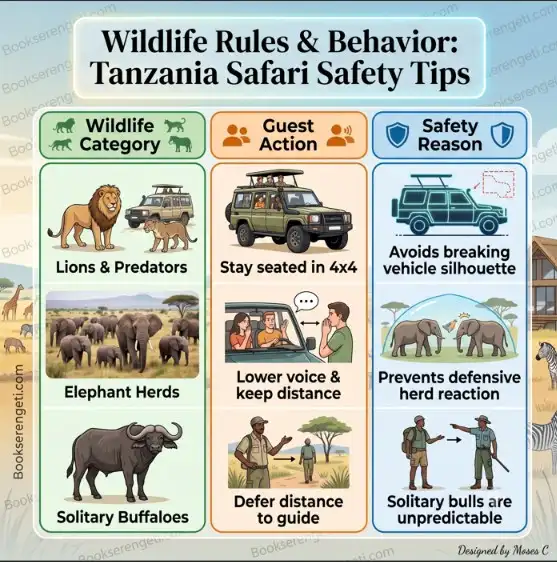
Medication | Dosing Frequency | Start Timing |
Malarone | Daily pill | 1–2 days before trip |
Doxycycline | Daily pill | 1–2 days before trip |
Mefloquine | Weekly pill | 2–3 weeks before trip |
Health is the part worth spending real time on, because it’s the genuine risk and it’s almost entirely preventable.
Tanzania is a malaria zone, safari areas and Zanzibar included, so antimalarial tablets aren’t optional. There are three common options, and the choice is your clinic’s to make, not a blog’s: Malarone (taken daily, started a day or two before you arrive and continued a week after you leave), doxycycline (daily, started a day or two before and continued four weeks after), and mefloquine (weekly, started two to three weeks ahead so any side effects show up early). See a travel clinic four to eight weeks before you fly, because some vaccines need more than one dose. On top of the pills, use a DEET repellent at dawn and dusk, cover your arms and legs in the evening, and sleep under the treated net every camp provides.
On vaccines, the two names to remember are hepatitis A and typhoid, on top of your routine boosters. The one that confuses everyone is yellow fever. You only need a certificate if you’re arriving from, or spending more than 12 hours in transit through, a yellow-fever country, and Kenya is on that list. Fly direct from the US, UK or Europe and you don’t need it at all. Route through Nairobi with a long layover, or chain your safari onto a Kenya trip, and the rule switches on. Check your whole routing, not just the last flight, and the CDC’s Tanzania page is the authority to confirm against.
Food and water is simpler than people fear. Don’t drink the tap water and don’t brush your teeth with it; bottled is cheap and everywhere, just check the seal. Skip ice at budget or street places, give raw salads and unpeeled street fruit a miss, and stick to food that’s been properly cooked. Good lodges handle all of this for you, but the day you’re passing through a town is the day to be careful.
Getting There and Around Town
Nobody expects the danger to be a car park in Arusha, but town is where the petty crime is. A few habits cover most of it:
- Use Bolt or a hotel taxi, never a hailed street one. Bolt works in both Arusha and Dar es Salaam, and a driver your lodge vouches for is safer still. The touts steering you toward an “unofficial” cab are the same fly-catchers who sell fake safaris.
- Keep valuables out of sight. Don’t walk with your phone in your hand, use a cross-body bag that zips, and watch for bag-snatchers on motorbikes who ride past and grab.
- Don’t walk alone after dark in the cities. Take a taxi even for a short hop at night. Inside hotel or camp grounds you’re fine; on a Dar or Stone Town street at midnight you’re not.
- Carry copies of your passport, digital and paper, and use the room safe. Get your visa sorted online before you fly rather than queuing at the airport.
Two local quirks worth knowing: single-use plastic bags are banned nationwide and get confiscated at the airport, so pack with that in mind, and only newer US dollar notes (2006 or later) are reliably accepted, since worn or old bills get refused. And if a driver suddenly claims his car has “broken down” and tries to move you into a friend’s vehicle, that’s a known scam; just get out.
The Real Risk Is the Road
Here’s the statistic that surprises people: road crashes, not wildlife, are the single biggest danger to travellers in East Africa. The highways linking Arusha to the parks are rough, standards vary, and the sensible defences are dull but real, a seatbelt on, no night driving, and a professional driver rather than a rental you’re steering yourself.
Off the highway, the hazard changes shape. The low plains are black-cotton soil, which turns to axle-deep grease within twenty minutes of a storm, and every season someone pulls off the firm track chasing a photo and buries their vehicle to the chassis. Down in those dips a radio often can’t reach the ranger posts, so a bad decision becomes a five-hour wait. This is a big part of why I’d steer you away from self-driving the Serengeti: a guide isn’t just for finding animals, it’s for knowing which ground will swallow a truck.
Around the Animals
Wildlife Category | Guest Action | Safety Reason |
Lions & Predators | Stay seated in 4×4 | Avoids breaking vehicle silhouette |
Elephant Herds | Lower voice & keep distance | Prevents defensive herd reaction |
Solitary Buffaloes | Defer distance to guide | Solitary bulls are unpredictable |
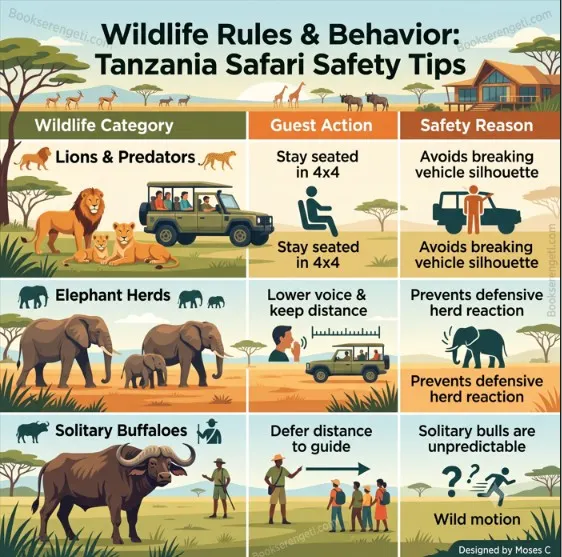
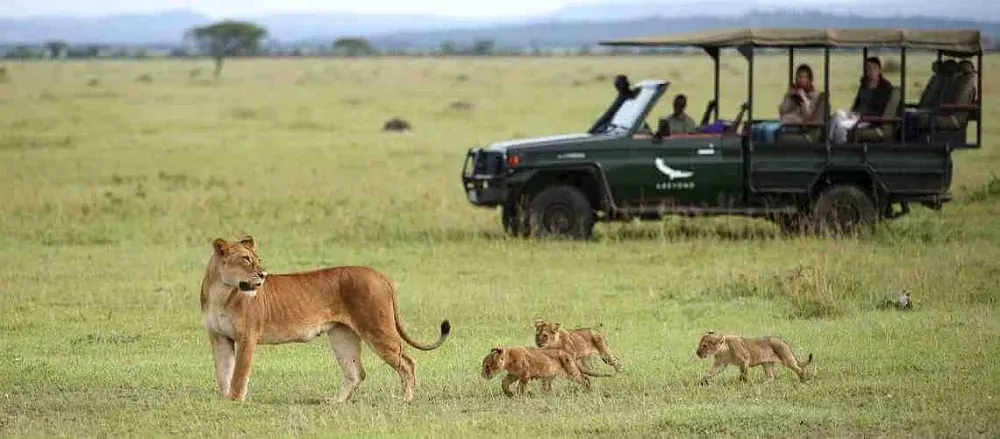
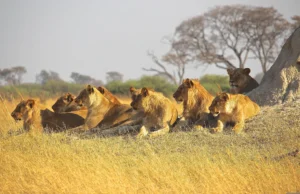
The core rule on a game drive is simple: stay in the vehicle (unless you’re on a walking safari with an armed ranger), and stay seated. Lions and leopards don’t read a parked 4×4 as a collection of edible humans; they read it as one large, uninteresting shape. Stand up through the roof hatch or wave your arms and you break that outline, and suddenly you’re a separate thing worth a second look. So keep low, keep still, and don’t reach out.
Around elephants, especially a breeding herd with calves, drop your voice right down and let the guide manage the distance. A lone old buffalo deserves the same respect, because solitary bulls are unpredictable and can turn in an instant. None of this is cause for nerves. It just means the person who reads these animals for a living, your guide, is the one who calls the shots at a sighting, not the group with the cameras.
Bugs, Baboons, and Camp Raiders
The most persistent nuisance on the trail isn’t a predator, it’s the tsetse fly. They live in the woodland belts, thickest around the western and northern tree lines, and their bite is a sharp needle of a thing that goes straight through thin fabric. Here’s the trick most people learn too late: tsetse are drawn hard to dark blue and black, which is the exact colour of the traps used to catch them. Wear a navy shirt in an open vehicle and you’ll pull a swarm onto your seat. Stick to khaki, tan and olive, and keep the DEET handy.
The camp raiders are cheekier than they are dangerous. Olive baboons patrol lodge walkways and will slide open an unlatched door and ransack your room for fruit, shredding a day-pack to get at a snack, so latch the door and never leave food in the tent. The little rock hyraxes sunning on the terrace walls, the ones locals call pimbi, look like fat guinea pigs and are bold enough to hop onto your table for a sugar packet. Don’t feed any of them. It makes them aggressive with the next guests and it’s bad for the animals.
After Dark at Camp
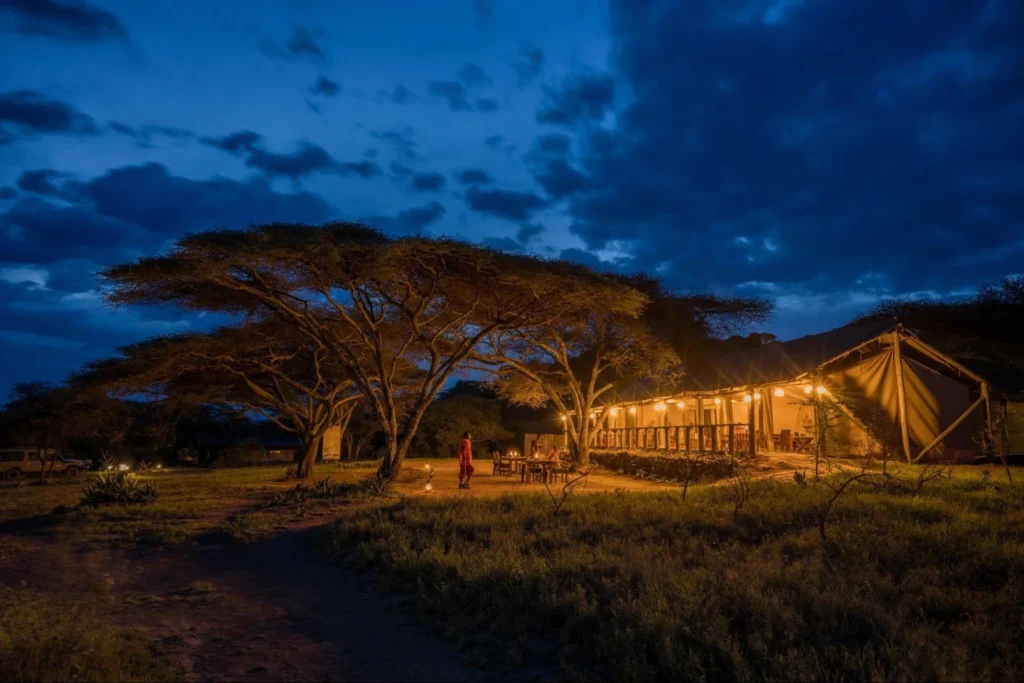
Most safari camps are completely unfenced, and that’s the point, but it changes how you move at night. Wildlife walks through: hippos come out of the water to graze on land, and hyenas and the odd leopard use the same paths you do.
So after dark, you don’t walk between your tent and the mess on your own. You call the camp on the radio and an askari, the night guard, walks you there and back. Zip your tent fully closed when you leave it and when you sleep. It sounds dramatic written down; in practice it’s a two-minute wait and a torch-lit stroll, and it’s simply how the unfenced camps have always worked.
What to Pack for Safety
Beyond the usual packing list, a few items earn their place purely on safety:
- A headlamp or good torch, for those walks between tent and dining under an unlit sky.
- A small first-aid kit: rehydration salts for an upset stomach, antihistamines, antiseptic cream, and any personal medication in its original packaging.
- High-SPF sunscreen, a hat, and polarised sunglasses, because equatorial sun is fierce even on a cool, overcast morning.
- Sturdy closed-toe shoes and thick socks for stepping out at picnic sites, where scorpions and the occasional snake shelter in the grass.
- A DEET repellent, plus newer US dollar notes and those passport copies.
The Park Rules You Must Follow
A handful of rules aren’t guidelines, they’re enforced, and breaking them can end your day at a gate. Drones are banned across the national parks; a ranger who finds one in your luggage will confiscate it and fine you. Driving is dawn to dusk only, off-road driving is illegal, and there’s a speed limit inside the parks. On the small flights between airstrips, luggage is capped near 15 kg and has to be a soft duffel that squashes into the hold, so a hard suitcase gets left behind. And you don’t feed animals, ever. If you want the fee and permit detail, it lives on its own page; the TANAPA site is the official source for the rules themselves.
Common Questions
Is it safe to walk around camp at night?
Not on your own. The camps are unfenced and predators genuinely pass through, so you wait for an askari to escort you between your tent and the dining area after dark. During the day it’s fine.
Do I really need malaria tablets?
Yes. Every safari area is a malaria zone, and prophylaxis is strongly recommended. Which tablet suits you depends on your health and history, so that’s a conversation for a travel clinic a month or so before you fly, not something to wing.
What happens in a medical emergency out in the bush?
The good operators cover you through AMREF Flying Doctors, the region’s air-ambulance service, which can land a plane on a bush strip and lift you back to a proper hospital in Arusha or Nairobi within hours. Confirm that your trip or your travel insurance includes evacuation cover before you go; it’s the one thing you don’t want to be without.
Can I bring a drone?
No. Drones are banned in the national parks, and one found at a gate will be confiscated and fined. Leave it at home.
Before You Go
None of this should put you off. A Tanzania safari is, for all the wildness, a remarkably safe trip once the boring boxes are ticked: pills, jabs, sensible taxis, and a licensed operator running a sound vehicle. Do that and the only thing left to worry about is running out of memory card.
If you’d like the rest of the trip built around those same standards, work out roughly how many days you have, when to go, and what it might cost, and the quote page is a good place to start. Every vehicle we send out is licensed, insured, and radio-equipped, which is safety you don’t have to think about.
When you’re ready, send us your rough dates and we’ll build it around the health and timing notes above. Karibu.
Editorial & Fact Check Validation Written by Moses C., who has spent 15 years driving the Serengeti dirt and running logistics behind the scenes at BookSerengeti.com.
Welcome to bookserengeti.com
Thank you for visiting us! We're excited to help you plan an unforgettable safari adventure across Kenya.
Latest Safari Posts
Serengeti Migration Safari Packages: 2026/2027 Cost & Itinerary Guide
Serengeti Wildlife Safari Packages: 2026/2027 Price, Big Five & Routes
Serengeti Group Joining Safari Package: 2026/2027 Price & Route Guide