Predator Hunting Action in the Serengeti: How to Be There When It Happens
Summary: Catching real predator hunting action in the Serengeti is about being in the right place at the quiet end of the day and reading the signs before the chase starts, not chasing radio calls with thirty other trucks. Lions, leopards, cheetahs and hyenas each hunt their own way across different sectors of the park. For an 8-day multi-park trip built around the active zones, with the flight back to Arusha included, peak-season rates run from about USD 5,960 to USD 18,900 per person sharing.
The question I get most, before we’ve even left the gate, is some version of “are we going to see a kill today?” My honest answer is that I can’t script the wild. Anyone who promises you a guaranteed hunt on a given afternoon is selling you something, because the savanna doesn’t run on a timetable.
Seeing real predator hunting action in the Serengeti takes patience, a driver who knows when to cut the engine, and a feel for how the cats move. The thing that ruins it most often is the radio. The moment a lion chase crackles over the VHF, thirty trucks gun toward the coordinates and throw up a wall of dust, and by the time that convoy lands the cats are rattled, the impala have scattered and the moment’s gone. To catch the drama you do the opposite. Read the birds. Watch the wind. Keep well clear of the crowd.
National Park Entry Fees
The daily permits are set by the MNRT and collected by TANAPA, with the NCAA running Ngorongoro, charged per adult for each 24-hour stretch inside a park and cashless at the gate. A trip that crosses several parks picks up several gates: the Serengeti is $82.60 a day ($70 plus 18% VAT), Ngorongoro $70.80, and both Tarangire and Lake Manyara $59 each, with a $295-per-vehicle permit if you drop into the crater. The full fee breakdown has the detail.
High Season Safari Packages
This 8-Day/7-Night route is built for two travelling together in peak season: single nights near Tarangire, Lake Manyara and the Ngorongoro Crater rim on the way in, then four nights in the core Serengeti where the hunting is. Non-resident USD per person, valid across 2026/2027.
8-Day Double-Occupancy Safari Packages
Package Tier | 8-Day Rate (Per Person) | Camps: Tarangire / Manyara / Crater / Serengeti |
USD 5,960 | Sangaiwe Tented Lodge / Farm of Dreams / Karatu Simba / Osinon Camp | |
Mid-Range Classic | USD 7,150 | Maramboi Tented Camp / Kirurumu Manyara / Rhino Lodge / Nyikani Migration Camp |
USD 11,000 | Lemala Mpingo Ridge / Lake Manyara Kilimamoja / Ngorongoro Serena / Melia Serengeti | |
Ultra-Luxury | USD 18,900 | Sanctuary Swala Camp / Manyara luxury lodge / andBeyond Crater Lodge / Four Seasons |
To shift the camps or aim the route at the active predator zones, tell me your dates and I’ll build it around them.
What the price covers
The price takes care of all the park permits and conservation taxes, the private 4×4 (pop-up roof, large windows, heavy-duty suspension), the fuel, and my time as your guide. It also covers the concession fees for every night inside the park, your meals and bottled water, the double-occupancy lodging, and the one-way flight from the Seronera airstrip back to Arusha on a domestic carrier like Coastal Aviation, bags and taxes included.
What it doesn’t cover is the short, predictable list: your international flights and tourist visa ($100 on a US passport), tips for me and the camp teams, and the personal extras, laundry, drinks at the bar, and your own travel insurance.
Reading the Signs
Predator | Stalking Behavior | Visual Cue / Tell |
Lioness | Crawls close in tall grass | Ears pinned flat to skull |
Cheetah | Uses height (mounds) | Drops into drainage dips |
Spotted Hyena | Shadows other cats | Trotting head-down at mid-morning |
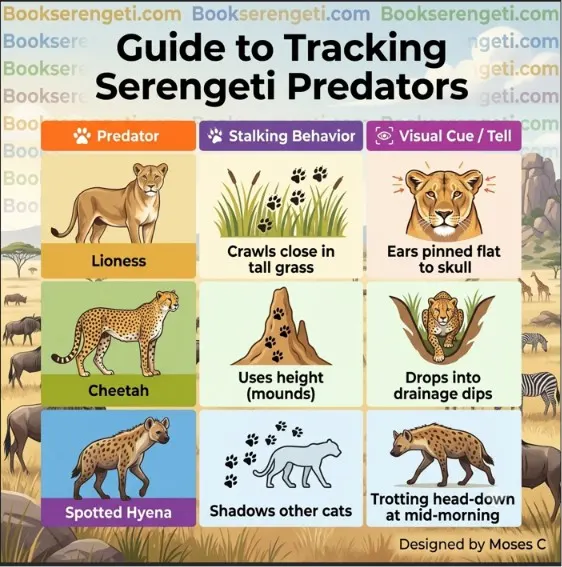
Each predator hunts its own way, and once you know what you’re looking at, the hunt usually shows itself well before the run.
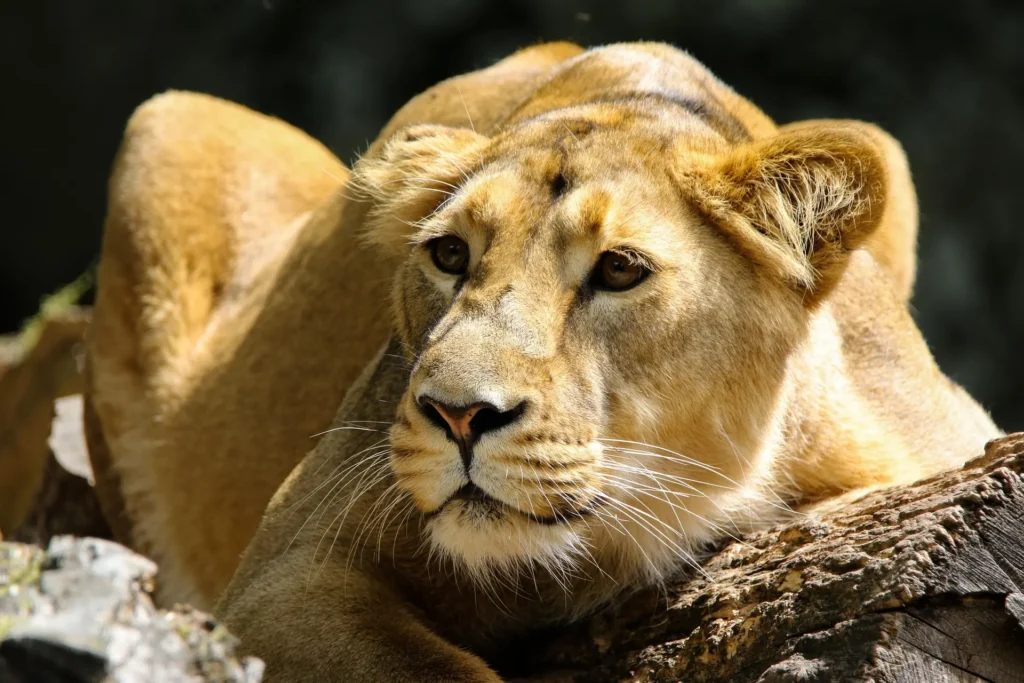
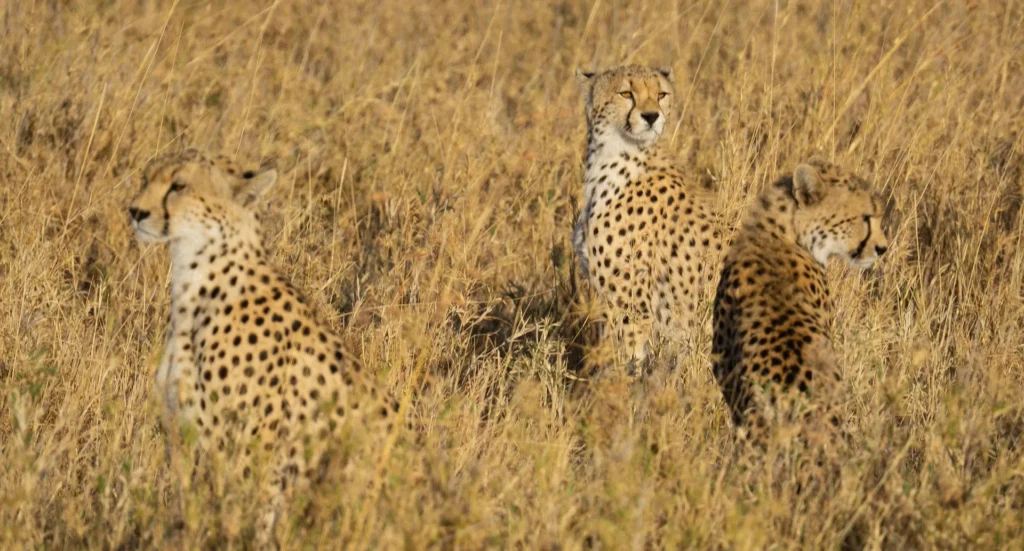
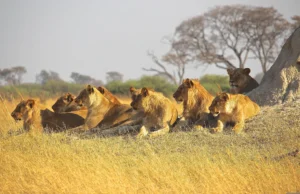
Lions are heavy and run out of breath fast, so they have to crawl within about thirty feet before they launch. They use the tall oat grass for cover and move only when the wind stirs the stalks to hide the sound, and a stalking lioness pins her ears flat to her skull to hide the dark fur on the back of them. Cheetahs do the opposite, hunting by sight from a height, a termite mound or a fallen trunk, then dropping into a drainage dip to close the gap on a herd of gazelle unseen.
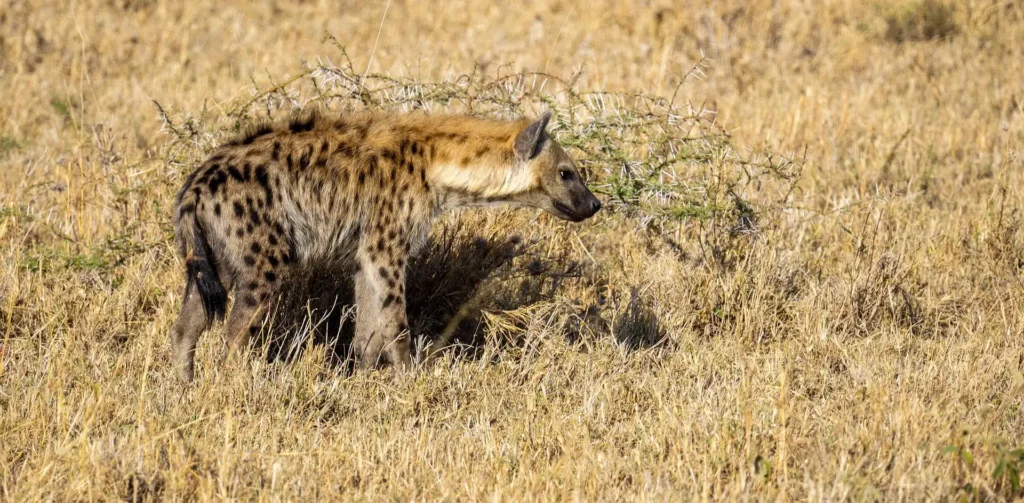
The animal I watch most, though, is the spotted hyena. People write hyenas off as scavengers. Wrong. They’re sharp tacticians, and on a good morning the cleverest thing on the plain. A single hyena trotting head-down at mid-morning, holding the same line as a hunting cheetah, knows exactly when that cat is going to run and is shadowing it to rob the carcass the second the sprint ends. Sit back behind the hyena and it’ll often take you straight to the kill.
The other tell is the prey itself, and the birds. Giraffes frozen in a loose semicircle, all staring down at one patch of low brush and flicking their tails, have a cat in their sights from a height you don’t have. So do the birds: a white-bellied go-away-bird rasping its nasal alarm from a bare branch, or a yellow-necked spurfowl breaking into a sudden clatter, is tracking a predator’s movement through cover that’s invisible from your seat.
Getting Away from the Convoy
The central Seronera valley holds water through the dry months, so it’s thick with resident cats and with vehicles. Let a leopard drag a kill into a sausage tree near the main loop and you’ll be one of thirty trucks in an idling, exhaust-filled scrum within minutes.
My way around it is to run the quieter eastern circuits, out toward the Sametu kopjes or the tracks along the Wandamu, which see a fraction of the traffic but hold strong resident prides and hunting cheetahs. The kopjes are worth reading closely, too: lionesses tuck newborn cubs deep into the shaded granite crevices to keep them away from wandering hyenas while the pride is out hunting, so a quiet rock cluster is often busier than it looks. Get clear of the radio chatter, park under an umbrella thorn with a coffee from the thermos, and you can watch a predator work the plain on your own.
Wind and the Off-Road Rule
Factor | Expert Strategy | Sighting Impact |
Wind | Park downwind of cat | Prevents scent scaring prey |
Radio | Track independently | Avoids scrums that ruin hunts |
Off-Road | Stay on tracks | Prevents erosion & vehicle trapping |
Predators hunt into the wind, keeping the breeze in their faces so their scent blows away from the herd. That matters for where your driver parks: sit downwind of a stalking lioness and the zebra will catch the engine on the air and bolt, and you’ve cost the cat the hunt and yourself the sighting.
The off-road rule is the other one to hold to. The low plains are black-cotton clay, and one afternoon storm turns a dry track into a trap that will sink a cruiser to its axles, so leaving the track to chase a chase is both illegal and a fast way to lose your whole afternoon to a winch. The fine dust is hard on optics, so keep gear bagged and lean on the packing list; for the chase itself you’ll want a long lens braced on a beanbag against the hatch rail rather than handheld.
One more thing, and it’s the part that separates watching a hunt from wrecking it: a good guide never puts the vehicle between a stalking cat and its prey, keeps well back with the engine off, and pulls out to find another angle when a sighting gets crowded. Drones are banned outright in the parks, so leave them at home.
Common Questions
A few questions come up on every trip built around the hunt.
When’s the best month for predator action?
July through October, the dry season. The waterholes shrink, so predators and prey concentrate around the permanent rivers, and the migration is pushing across the northern river crossings, which is the most concentrated hunting of the year.
Can we avoid the radio crowd?
Yes, and it’s the single best thing you can ask for. Tell your guide on the first morning that you’d rather keep the VHF turned down and track independently. The people who see the most hunts are the ones who back themselves to read the ground rather than race to shared coordinates, so you end up the only vehicle at a live stalk instead of the thirty-first at a ruined one.
How far is the drive from Arusha?
About 335 km to Naabi Hill Gate, and more again to reach the central Seronera lodges most predator routes run from. It’s a long day on unpaved road, so I’d break it rather than push straight through.
Will we actually see a kill?
Maybe, and it’s worth being honest about the odds: even a prime lion pride or a dominant cheetah fails most of the time, with a hunting success rate that leaves roughly 70 to 80 percent of chases ending in an escape. The stalk, the tension and the explosive burst are the real show, and they’re thrilling whether or not the prey gets away.
What’s the luggage limit on the small planes?
15 kg, in a soft bag. The Cessna’s cargo holds have narrow doors a hard-shell case won’t fit through, and the pilot will leave it on the tarmac, so pack soft and light.
Plan Your Predator Safari
Being there for a hunt comes down to timing, the right quiet sectors, and a guide who’ll back his own eyes over the radio. Pick the dry months for the highest odds, think about where you’d like to stay, and what the trip costs run to.
When you have rough dates and a group size, the quote page is the place to start, and the vehicle and route get shaped from there. Still working it out? The regional overview and how many days to set aside are good next reads.
Editorial & Fact Check Validation Written by Moses C. – Veteran Wildlife Safari Guide & Operations Manager at BookSerengeti.com.
Welcome to bookserengeti.com
Thank you for visiting us! We're excited to help you plan an unforgettable safari adventure across Kenya.
Latest Safari Posts
Serengeti Migration Safari Packages: 2026/2027 Cost & Itinerary Guide
Serengeti Wildlife Safari Packages: 2026/2027 Price, Big Five & Routes
Serengeti Group Joining Safari Package: 2026/2027 Price & Route Guide