 Skip to content
Serengeti Safari Booking: Book Your Safari with Us
Summary: Most of planning a Serengeti trip is really just answering a handful of questions in the right order: when to go, which depends entirely on where the migration will be that month; whether you want a private vehicle, a shared one, or to fly in; how many days you have; and what standard of camp suits you. Peak windows fill up fast. The crossing camps in the north (July to October) and the calving-season camps in the south (December to March) are often gone 8 to 12 months out, so this is a trip you plan early or miss. This guide covers each of those in turn, with real 2026/2027 costs.
Jump to Section
Planning a first Serengeti trip can feel like a lot, mostly because the park is enormous (14,763 square kilometres) and the wildlife moves with the seasons, so “when” and “where” are tied together. This guide lays out the booking process the way we actually walk guests through it, so you can plan with confidence and lock in the right camps before they fill.
Ready to start? Tell us your dates and we’ll build the itinerary around them. Otherwise, read on.
Featured Packages & Most Booked Itineraries
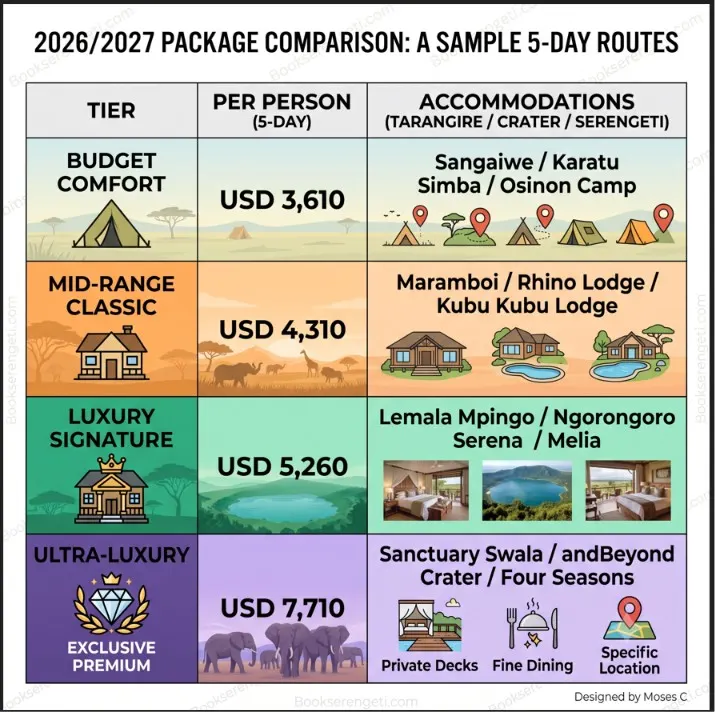
2026/2027 Package Comparison: A Sample 5-Day Route
Here is a realistic 5-day, 4-night multi-destination safari for two people sharing. It follows the local rules that keep a trip from feeling rushed: a single night each in the smaller areas (Tarangire and the Ngorongoro Crater), and two nights on the prime Serengeti tracks. All rates are non-resident totals in USD, valid for the 2026/2027 windows.
Tier | Per Person (5-Day) | Accommodations (Tarangire / Crater / Serengeti) |
Budget Comfort | USD 3,610 | Sangaiwe / Karatu Simba / Osinon Camp |
Mid-Range Classic | USD 4,310 | Maramboi / Rhino Lodge / Kubu Kubu Lodge |
Luxury Signature | USD 5,260 | Lemala Mpingo / Ngorongoro Serena / Melia |
Ultra-Luxury | USD 7,710 | Sanctuary Swala / andBeyond Crater / Four Seasons |
Every tier includes the private 4×4 Cruiser, peak-season park fees, and the Seronera-to-Arusha fly-back on the final morning. You can add a sunrise hot-air balloon flight over the central plains to any tier for about USD 600 per person, which covers the TANAPA flight permit, the launch, and a champagne bush breakfast on landing.
To adjust any tier to your dates, request a custom quote. Related reading: the 3-day and 4-day packages, or all packages.
Our Most-Requested Itineraries
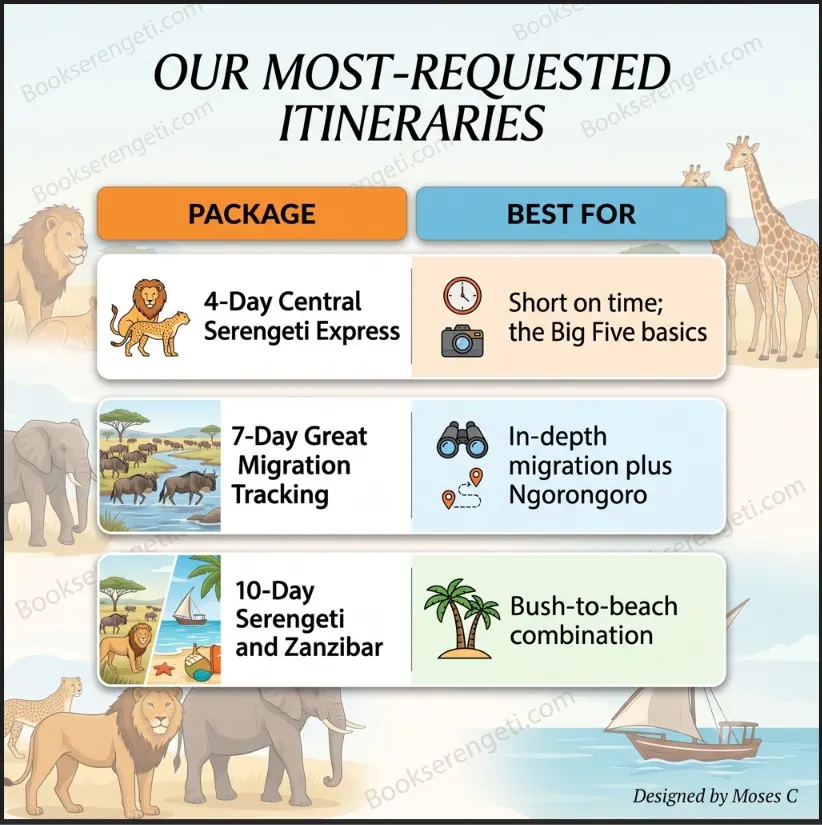
Each of these is fully customizable:
Package | Best For |
4-Day Central Serengeti Express | Short on time; the Big Five basics |
7-Day Great Migration Tracking | In-depth migration plus Ngorongoro |
10-Day Serengeti and Zanzibar | Bush-to-beach combination |
4-Day Central Serengeti Express. For short stays and first-timers. Most of your time in the Seronera valley, which is thick with leopard, lion, and cheetah all year. Three nights mid-range or luxury tented camp, all meals, private guide.
7-Day Great Migration Tracking. For wildlife enthusiasts wanting full immersion. Four nights inside the Serengeti tailored to the current herd position, plus the Ngorongoro Crater and Tarangire. Fly-in option and migration-focused game drives. See the migration packages page.
10-Day Bush and Beach. For honeymooners and anyone wanting variety. Five days of game drives across the Serengeti and Ngorongoro, then five days on the beaches of Zanzibar, with the domestic flight between them included.
What’s Included and Excluded
Here’s what your quote covers, and what to budget for on top, before you read any further.
What’s included in the price:
- All TANAPA park fees, transit fees, and concession fees, cleared through the official park authority.
- A private 4×4 Land Cruiser with a pop-up roof and a licensed driver-guide.
- Full-board accommodation and drinking water throughout.
- Airport transfers on arrival and departure.
What you pay separately:
- International flights into Tanzania.
- The tourist visa: USD 100 for US citizens, USD 50 for most other nationalities.
- Tips: around USD 20 to 30 a day for your guide, USD 10 to 15 for camp staff.
- Optional add-ons, such as a balloon flight (around USD 550 to 600).
- Comprehensive travel and medical insurance, which is mandatory.
Our full cost breakdown has the detail.
Quick Safari Finder
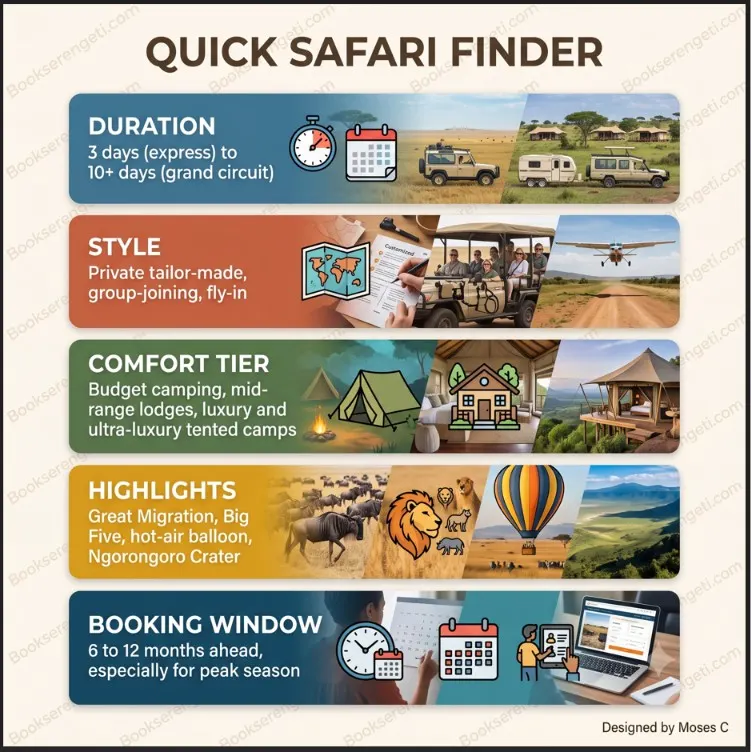
The shape of a Serengeti trip, at a glance:
Parameter | Options |
Duration | 3 days (express) to 10+ days (grand circuit) |
Style | Private tailor-made, group-joining, fly-in |
Comfort tier | Budget camping, mid-range lodges, luxury and ultra-luxury tented camps |
Highlights | Great Migration, Big Five, hot-air balloon, Ngorongoro Crater |
Booking window | 6 to 12 months ahead, especially for peak season |
How to Book, Step by Step
Step 1: Time it around the wildlife
The herds shift with the rain, so decide your priority first. River crossings in the north run July to October; the calving season in the south runs December to March. Get this one wrong and nothing else you plan can fix it. If you’re still deciding, the month-by-month timing page breaks down what each season actually looks like.
Step 2: Pick your travel style
Private safaris give you a dedicated 4×4 and guide on your own schedule, best for families, couples, and photographers. Group-joining safaris share a vehicle and a fixed route, the budget-friendly choice for solo travellers. Fly-in safaris skip the long drives from Arusha and put you straight into the bush by light aircraft. The private vs group comparison digs into the real trade-offs if you’re torn between those two.
Step 3: Choose your length
Three to four days suits an express trip focused on central Seronera. Five to seven days is the sweet range for properly tracking the migration across sectors. Eight to ten days or more covers the full northern circuit: Serengeti, Ngorongoro, Tarangire, and Lake Manyara. There’s a whole page on how many days you actually need if you want to think it through.
Step 4: Lock dates and deposit
Once the itinerary is set, a deposit secures your camps. The migration camps fill fastest, so confirming early is what guarantees the lodges you actually want rather than whatever is left.
Costs and Budget
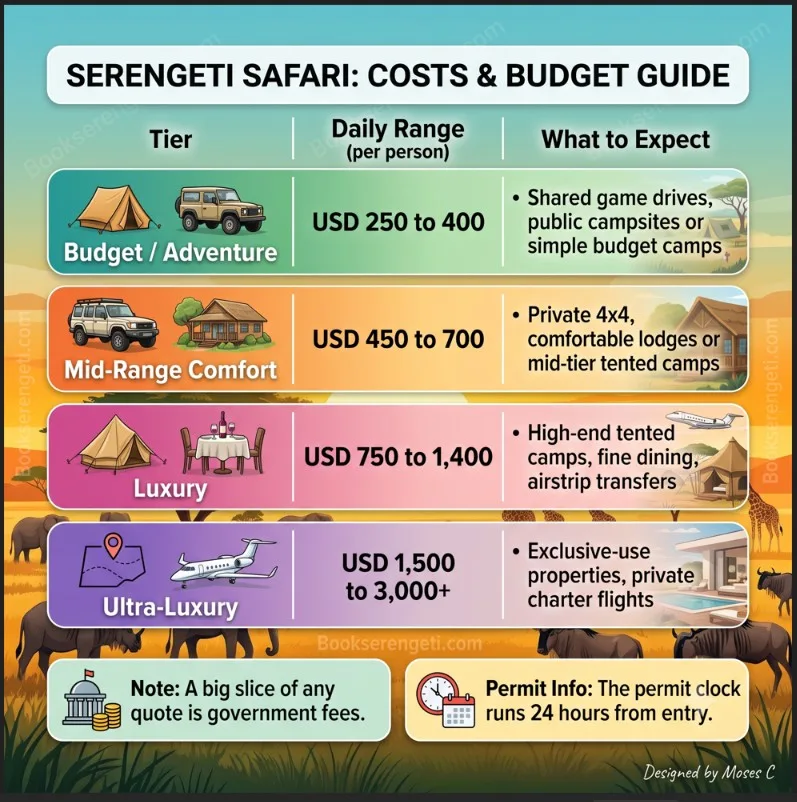
A Serengeti safari is an all-inclusive product: it covers park fees, accommodation, full-board meals, the vehicle, and your guide. Daily cost per person, sharing:
Tier | Daily Range (per person) | What to Expect |
Budget / Adventure | USD 250 to 400 | Shared game drives, public campsites or simple budget camps |
Mid-Range Comfort | USD 450 to 700 | Private 4×4, comfortable lodges or mid-tier tented camps |
Luxury | USD 750 to 1,400 | High-end tented camps, fine dining, airstrip transfers |
Ultra-Luxury | USD 1,500 to 3,000+ | Exclusive-use properties, private charter flights |
Where the park fees actually go. A big slice of any quote is government fees, and it helps to see them itemized so you know they aren’t markup:
- Serengeti entry: about USD 82.60 per adult per 24 hours (children 5 to 15 pay roughly USD 15 to 20; under 5 free), VAT included.
- In-park concession (bed-night) fee: about USD 59 per adult per night at a lodge or camp inside the park.
- Ngorongoro Conservation Area entry: about USD 70.80 per adult, charged even in transit, since the Crater sits on the route (the NCAA runs separately from TANAPA).
- Ngorongoro Crater service fee: about USD 295 per vehicle per descent.
- All of the above already include Tanzania’s 18 percent VAT.
Those are fixed, non-negotiable, and identical whether you book with us or anyone else. The permit clock runs 24 hours from entry, so a late exit can cost a whole extra day.
The Reality of a Game Drive
A safari is not a non-stop parade of animals, and first-timers who expect one leave disappointed. A lot of a game drive is driving, sometimes through what looks like empty grass, while your guide reads tracks, scans the treeline, and listens for alarm calls. Then, suddenly, it all happens at once: a hunt, a crossing, a leopard dropping out of a tree.
Call it 70 percent looking, 30 percent seeing. The people who love their safari are the ones who lean into the quiet stretches, asking the guide about tracks, birds, dung, the plants, how he knows a lion passed through. The ones who expect a zoo get bored by mid-morning. Bring patience. The payoff is worth it.
On a busy day, ten or fifteen vehicles can pile up around one sleepy lion, because every guide is on the same VHF radio channel calling in sightings. You do not have to join that scrum. Tell your guide plainly that you would rather have a herd of elephants to yourselves than fight for a glimpse of a leopard’s tail, and a good one will happily work the quieter corners instead of chasing every radio call. It makes for a far better day.
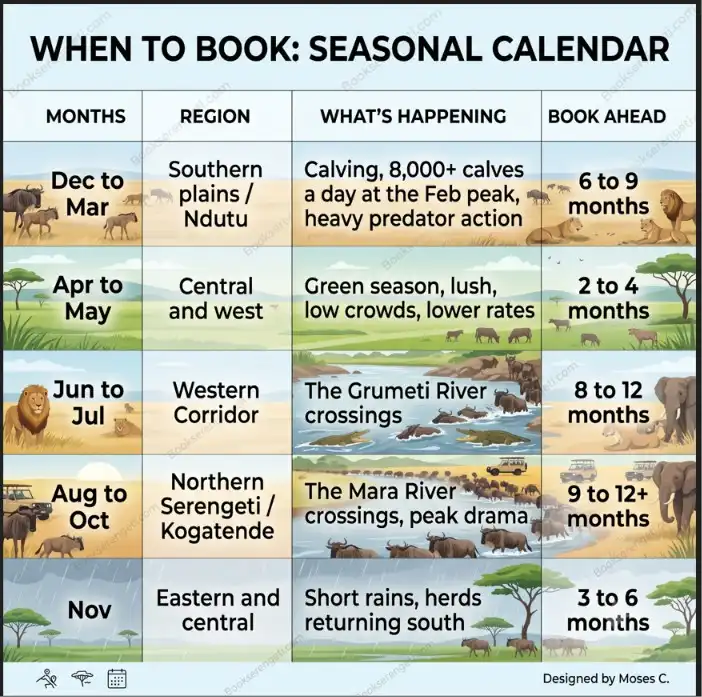
When to Book: Seasonal Calendar
Timing your booking to the herds is the whole game. Where they sit through the year:
Months | Region | What’s Happening | Book Ahead |
Dec to Mar | Southern plains / Ndutu | Calving, 8,000+ calves a day at the Feb peak, heavy predator action | 6 to 9 months |
Apr to May | Central and west | Green season, lush, low crowds, lower rates | 2 to 4 months |
Jun to Jul | The Grumeti River crossings | 8 to 12 months | |
Aug to Oct | Northern Serengeti / Kogatende | The Mara River crossings, peak drama | 9 to 12+ months |
Nov | Eastern and central | Short rains, herds returning south | 3 to 6 months |
Peak season (the crossings and the calving) sells out first and fills the earliest, so if your dates are fixed to those windows, treat the booking as urgent rather than something to circle back to.
Where to Stay
Where you sleep shapes the whole trip. Four broad categories:
Luxury mobile tented camps move two or three times a year to follow the migration, with flush toilets, hot safari showers, and unbeatable proximity to the herds. See our mobile camps guide.
Permanent luxury lodges like Four Seasons, Singita, or Serena offer solid buildings, pools, spas, and decks over the waterholes.
Mid-range tented lodges give you comfortable beds, en-suite bathrooms, canvas walls, and solar power, the balance most people want. Our tented camps page covers these.
Public and adventure campsites are basic, shared facilities for budget and mobile-camping trips. Be honest with yourself here: the public campsites mean shared long-drop or often-clogged toilets, no toilet paper unless you bring it, cold showers, and hyenas circling the cooking area at night. Plenty of budget travellers regret the choice once they arrive. If there’s one upgrade worth the money on the whole trip, it’s the jump from public camping to a mid-range tented camp with an en-suite flush toilet and a hot bucket shower. See where to stay for the full picture.
Getting to the Serengeti
Transport Option | Time & Route | Best For |
Fly-in Safari | 45–90 min flight from Arusha (JRO) to bush airstrips | Travelers short on time or seeking maximum comfort |
Drive Safari (4×4) | 7–8 hr scenic drive from Arusha via Ngorongoro | Scenery lovers & budget-conscious travelers |
Fly-Drive Combo | Drive in for scenery; fly out from Serengeti | Ideal balance of sightseeing & time saving |
Flying in. Your international flight lands at Kilimanjaro International Airport (JRO) near Arusha. You can also route through Dar es Salaam (DAR) or Zanzibar (ZNZ) with a connection. From Arusha, a light aircraft reaches the bush airstrips (Seronera, Kogatende, Ndutu, Grumeti) in roughly 45 to 90 minutes. See the airstrips guide.
Driving in. A scenic 7 to 8-hour drive from Arusha through the Ngorongoro Conservation Area in a 4×4, best broken with a stop at Lake Manyara or Tarangire. The Arusha to Serengeti page has the full route and timings.
One honest warning about that drive: the stretch of road between the Ngorongoro gate and the Naabi Hill entrance is brutally corrugated and dusty, with cruisers speeding both ways. Guests only half-joke about the “African massage.” If you have back problems, this is a real reason to consider flying in one direction and driving the other. Everyone else: wear a supportive sports bra, expect to be rattled for a couple of hours, and know it’s normal. Most trips drive in for the scenery and fly back to skip the return leg.

Packing and Entry
Health and entry. A yellow fever certificate is required if you arrive from or transit an endemic zone. Check the CDC’s Tanzania travel-health page and consult a travel doctor about malaria prophylaxis. Apply for the Tanzania eVisa online before you travel.
Packing, with the bits people learn the hard way. Internal bush flights enforce a strict 15 kg (33 lb) soft-bag limit per person, duffels only. Bring neutral clothing (khaki, beige, olive) and skip blue and black, which draw tsetse flies. A few specifics the generic lists skip:
- Dress for the 6:00 AM windchill. Nobody warns you how cold dawn is. Standing up through the pop-up roof at 40 mph before sunrise is genuinely biting, and by 11:30 you’ll be in a t-shirt. Bring a tight-fitting fleece or windbreaker and a hat with a chin strap, or it’s gone into the savannah on the first fast stretch.
- Beat the dust properly. The fine red earth gets into everything, including your nose. Pack a neck gaiter or buff you can pull over your face on dry-season transit days, and carry Ziploc or dry bags for your camera between sightings, because that dust works straight into a lens.
- Bring a thick stack of small bills. Go to your bank at home and get a wad of clean USD 1 and 5 notes for porters, gate attendants, and small tips. Camps almost never have change to break a USD 50, and you’ll want small money constantly.
- The 2009 rule. Tanzania only accepts USD notes printed in 2009 or later, and they must be crisp and unmarked. Torn, scribbled, or older bills get refused at banks and bureaux, so check your cash before you fly.
Otherwise: binoculars (8×42 or 10×42), a camera with a 300mm+ lens, sun protection, a personal medical kit, and a power bank for off-grid camps. The full packing list has the rest.
How and Who to Book With
Booking Channel | Cost & Value | Ground Support |
Direct Local Operator | Best value (direct rates, no middleman markup) | 24/7 direct field support with local guides |
Overseas Agent | 15%–30% higher cost for home-country agency | Subcontracts ground operations to local teams |
Online Aggregators | Standard rates with variable commission | Functions as booking middleman to local outfits |
“Booking” often means deciding who to buy from, not just when to go. Three broad routes:
Direct local operator (best value). You book with the Tanzanian company that actually runs the safari. No middleman markup, money stays in-country, and if anything needs fixing on the ground, you’re talking to the people who can fix it. The trade is that you’re dealing across time zones.
Overseas travel agent (convenience). A US, UK, or European agent handles everything in your own time zone and language, which some travellers value, but they subcontract to a local operator anyway and add roughly 15 to 30 percent for the service.
Online aggregator platforms (comparison). Handy for browsing and comparing itineraries side by side, but once you enquire you’re routed to a local operator behind the scenes regardless, so you often end up where you’d have started by going direct.
We’re the first kind: a local operator, so what you pay goes into the actual safari rather than a layer of markup.

Booking Protections and Peace of Mind
A few things that make paying a deposit to a company across the world feel safer.
Staged payments, not one big transfer. Reputable operators split payment into stages tied to confirmations rather than taking the whole sum up front, so you’re getting booking references and vouchers as you pay, not just a receipt. Ask us for our current deposit and balance schedule, and the accepted methods (card, wire, or a secure payment link), when you enquire, and we’ll send it in writing.
Medical evacuation cover. For the remote parks, an AMREF Flying Doctors tourist membership (around USD 40 for two weeks) buys air-ambulance evacuation from a bush airstrip to a Nairobi hospital. It’s cheap insurance for the one thing you can’t drive out of, and we recommend it on top of your normal travel insurance.
Flexible on dates. We don’t penalise you for postponing a safari to later dates. Cancellation is the one area we can’t set a blanket rule on, because each lodge sets its own policy, and a booking is really a stack of individual lodge reservations. We’ll always tell you the specific terms of the camps in your itinerary before you pay.
Why Book With Us
Booking direct with a local operator keeps the trip authentic and accountable.
We run TALA-licensed vehicles and work under the Tanzanian Ministry of Natural Resources and Tourism framework. Our guides are Tanzanian, with years of tracking experience and real knowledge of wildlife behaviour and the park. Pricing is transparent with no hidden fees, and because we operate on the ground, we can position your camps where the wildlife will actually be, not where a distant call centre guesses.
FAQs
How far ahead should I book?
For peak periods (July to October and December to March), 8 to 12 months to secure the top camps. For green season (April to May), 2 to 4 months is usually enough.
Is a Serengeti safari safe for families with children?
Yes. Many lodges have family suites and junior-ranger activities, and a private vehicle lets you set the pace. We suggest children be around 6 or older to manage full game drives comfortably. See our family packages.
Can I do it on a budget?
Yes. Group-joining safaris, public camping, or travelling in the green season (April to May) cut costs significantly while still delivering excellent game viewing. Our budget packages show how.
What’s the difference between the Serengeti and the Masai Mara?
They’re one continuous ecosystem across the Tanzania-Kenya border. The Serengeti is roughly ten times larger than the Kenyan Masai Mara, with vaster landscapes and lower crowding in many sectors, and it holds the herds for about 8 to 9 months of the year.
Do I need special insurance?
Yes. You must carry comprehensive travel insurance covering cancellation, lost luggage, and emergency medical evacuation, including air ambulance from remote airstrips.
Plan Your Serengeti Safari
Tell us your rough dates and what you most want to see, and we’ll turn it into a proper costed itinerary, with the camps positioned where the wildlife should be.
Request your custom itinerary and one of our specialists will map it out with you. Karibu.
About the Author I’m Moses C.. I’ve spent fifteen years driving the Serengeti and running the booking and field logistics behind the scenes at BookSerengeti.com. Tell me your month and your must-sees, and I’ll tell you exactly how to build the trip.
