A Guide to Serengeti Walking Safari Packages, From Someone Who Runs Them
Summary: Walking is the part of a safari most people don’t book, and the part they talk about for years afterward. You leave the vehicle and follow an armed ranger on foot, and the whole scale of the place changes. It is not a way to rack up big-cat sightings, and it is tightly controlled by the park, so it works best as one piece of a wider trip. Priced with a private 4×4 for the transfers, the mandatory ranger, lodging, and a fly-back, a walking-focused circuit from Arusha runs roughly USD 3,550 to USD 9,200 per person sharing. See how that compares on the safari cost page.
I have been guiding in the Serengeti for fifteen years, and I still think most visitors miss the best of it. They stay in the Land Cruiser the whole trip. The vehicle is brilliant for covering ground and getting you to a lion pride before the light goes, but it also puts a metal wall between you and everything out there. Step down onto the dirt and that wall comes off. You start noticing what the drive skips: the tracks pressed into the dust overnight, a francolin going off somewhere to your left, the smell of the grass, dung that tells you what came through camp while you slept.
That is what a walking safari gives you. Just understand going in that it is slower, it covers a fraction of the distance, and the park regulates it heavily, so it belongs inside a larger trip rather than as a standalone week. Below is how it works, what it costs, and what an actual morning on foot feels like.
When you want to check open dates for the 2026/2027 season, send yours to my team through the quote page.
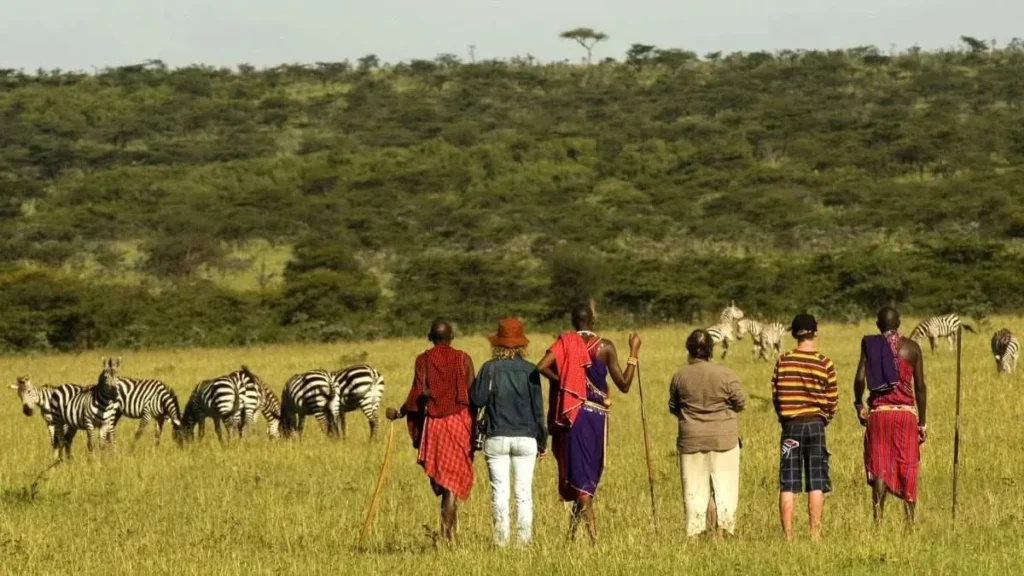
How the Walking Actually Works
Tanzania is strict about walking in the parks, and once you have seen why, it makes sense.
You cannot simply stroll off with your lodge guide. Inside the national park an armed ranger from TANAPA has to lead every single walk. That means on a walking morning your guide first drives to the nearest ranger post, at Seronera or Klein’s Gate, and collects one, which eats a little time. The walking permit is also charged on top of your normal park entry: roughly USD 23.60 per person, plus another USD 23.60 for the ranger, each walk. It is all folded into your package price, but that is the line item you are paying.
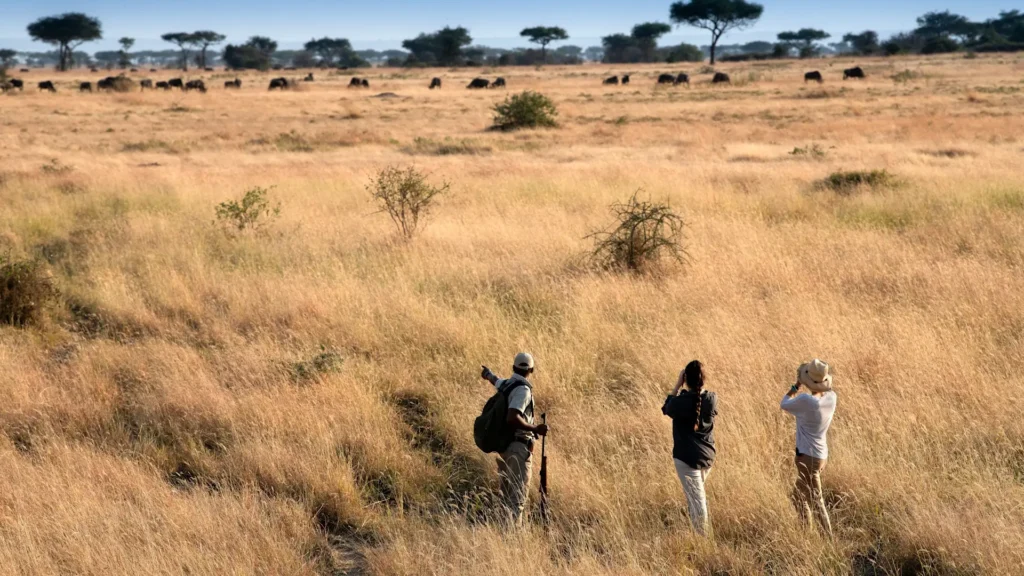
Walks happen in set zones, usually at the quieter edges of the park or in the private concessions where the rules loosen up a bit. You go in single file behind the ranger, first thing in the morning when it is cool and the big cats are moving, and a walk usually runs two to four hours rather than all day. It sits alongside your game drives rather than replacing them. You drive to cover the country and reach the big sightings, then walk to slow everything down and read the ground. It slots neatly into a classic driving circuit.
What It Costs
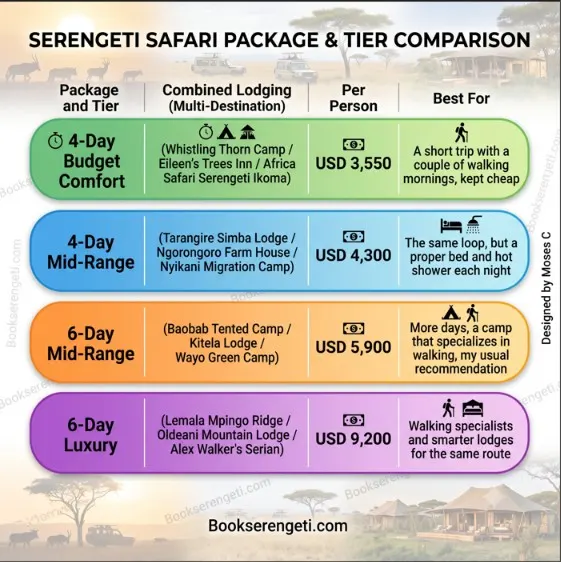
These are realistic private walking-focused loops for two people sharing, out of Arusha, driving in and flying back on the final morning. Non-resident rates in USD, per person, for 2026/2027.
Package and Tier | Combined Lodging (Multi-Destination) | Per Person | Best For |
4-Day Budget Comfort | Whistling Thorn Camp / Eileen’s Trees Inn / Africa Safari Serengeti Ikoma | USD 3,550 | A short trip with a couple of walking mornings, kept cheap |
4-Day Mid-Range | Tarangire Simba Lodge / Ngorongoro Farm House / Nyikani Migration Camp | USD 4,300 | The same loop, but a proper bed and hot shower each night |
6-Day Mid-Range | Baobab Tented Camp / Kitela Lodge / Wayo Green Camp | USD 5,900 | More days, a camp that specializes in walking, my usual recommendation |
6-Day Luxury | Lemala Mpingo Ridge / Oldeani Mountain Lodge / Alex Walker’s Serian | USD 9,200 | Walking specialists and smarter lodges for the same route |
You will notice there is no five-figure ultra-luxury tier here, and that is deliberate. The very top lodges mostly sell private-vehicle and fly-in game viewing, not scheduled walking, so a “walking” package at that price would be selling you something those camps don’t really do. Walking lives in the budget-to-upper-mid range, run out of camps like Wayo and Alex Walker’s Serian that genuinely build their operation around it.
Honest word on the 4-day budget option: it is a hard drive. A big share of those four days goes to getting to and from the walking zones, and the walking itself gets squeezed. If you can stretch to six days, do. You will get the walking you actually came for, and your back will thank you.
You can hold a date and a licensed vehicle by sending us your travel window.
Covered Package Features
A quick note on what the base price does and doesn’t cover, so nothing surprises you at the ranger post.
In the package:
- A private extended 4×4 Land Cruiser for the driving legs between walking zones, pop-up roof, fridge, the lot.
- Your driver-guide, licensed and local, with you throughout.
- An armed TANAPA ranger for every walk. This is not optional and I’ll explain why below.
- Park entry, conservation fees, and the daily walking permit, all with the 18% VAT built in.
- In-park lodging vouchers, meals, and cold water in the vehicle.
- The fly-back from Seronera to Arusha on your last morning, taxes included.
Not in the package:
- Your international flights into Kilimanjaro.
- The tourist visa, which is USD 100 on a US passport.
- Tips. Budget around USD 20 to 30 a day from the vehicle for your driver, and something separate for the ranger and camp crew.
- Insurance, and your own boots. Bring boots you have already broken in. New ones will wreck your feet by the second morning.
- Anything imported at the bar.
What to Expect on Foot
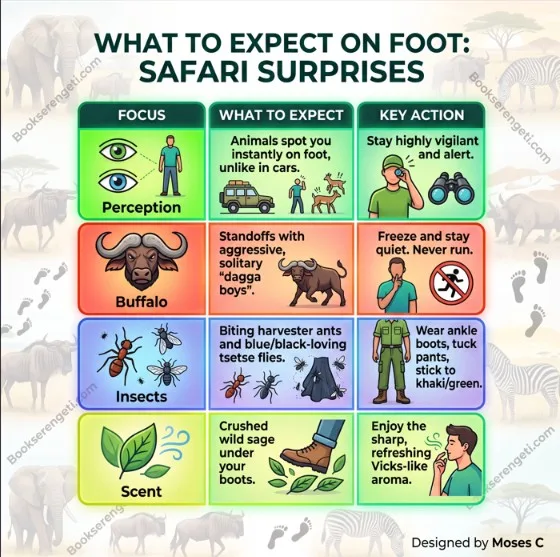
Focus | What to Expect | Key Action |
Perception | Animals spot you instantly on foot, unlike in cars. | Stay highly vigilant and alert. |
Buffalo | Standoffs with aggressive, solitary “dagga boys.” | Freeze and stay quiet. Never run. |
Insects | Biting harvester ants and blue/black-loving tsetse flies. | Wear ankle boots, tuck pants, stick to khaki/green. |
Scent | Crushed wild sage under your boots. | Enjoy the sharp, refreshing Vicks-like aroma. |
Here is the thing about walking that the vehicle hides. From inside a cruiser, animals read you as one big harmless shape. The second you are on the ground, that shape breaks apart and they see a person, and they behave differently.
The animal to respect out here is not the lion. It is the buffalo, and in particular the solitary old bulls we call dagga boys. A dagga boy will not run from you. He plants his feet, lifts his snout to read your scent, and stamps a front hoof. When he does that, he has run out of patience. The rule the ranger will drill into you feels backwards the first time you hear it: you freeze, you keep quiet, and whatever you do, you do not run. Running is what turns a standoff into a charge. Stand still and, nine times out of ten, he loses interest and drifts back into the scrub. That single moment is the reason the ranger carries a heavy rifle, and it is not for show.
Then there is what is under your boots. The sandy trails, especially around Klein’s Gate, are full of harvester-ant nests, and if you scuff one open in thin trainers you are in for a genuinely miserable morning. Wear ankle boots and tuck your trousers into your socks before you leave camp. Keep to khaki, tan, or green as well, and stay away from dark blue and black, because those are the exact colours the tsetse flies home in on. If you crush a wild sage leaf underfoot, the whole group will smell it at once. It comes up sharp and green, almost exactly like Vicks, which nobody ever expects on the plains.
A Morning on Foot, Hour by Hour
The best day of a walking trip is usually a full one on foot, and it goes something like this.
I get everyone up around 5:40, which feels cruel in the cold and is worth it every time, and we set off in single file behind the ranger, out toward the central plains, while the overnight tracks are still crisp. We move slowly. I stop you constantly, because there is always something: which way a lion was heading from the drag of its pugmarks, a hyena den dug out under a termite mound, fresh dung against old, a twig snapped clean at shoulder height where only an elephant could have reached. By nine the red dust is already in your teeth and gritting up the zip on your camera bag, and you stop bothering to wipe it.
We break through the hot middle of the day, back at camp or under a tree with a packed lunch if we are following a herd, then head out again in the softer afternoon light for the birds and the sunset. It is more tiring than any day of driving. Most people are asleep before the generator cuts at ten.
If your route runs near the Moru Kopjes, there is a rare treat: Gong Rock, a set of granite boulders with old Maasai rock paintings and stones that actually ring like a bell when you tap them. It is one of the very few places you are allowed to explore properly on foot, and it lands well with kids and adults alike.
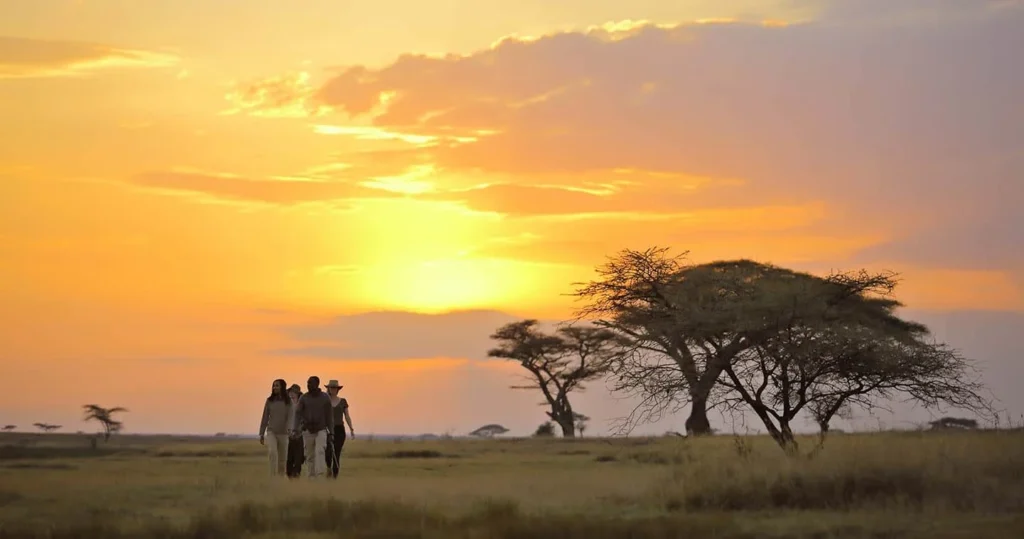
Who Can Walk, and Who Can’t
Walking has firm limits, so check these before you build a trip around it.
Children under twelve are not allowed on walking safaris in the park, for the group’s safety. Teenagers of twelve to fifteen can come but need a signed parental consent form, cleared at the ranger station before you set off. Younger kids can still do all the game-drive parts of the trip, so a family usually splits the walking mornings between parents.
You also need to be reasonably steady on your feet. A walk is not a hard hike, but you are on uneven ground for a couple of hours and you have to be able to hold still and stay quiet if the ranger signals it. If anyone in your group has mobility or heart concerns, tell us honestly when you book and we will be straight about whether it suits.
Common Questions
What is the minimum age, exactly?
Twelve to walk inside the park. Twelve to fifteen need written parental consent cleared at the ranger post. Under twelve can do the game drives but not the walks.
What is the luggage limit on the fly-back?
15 kg per person, in a soft duffel. The Cessna Caravans on the fly-back have narrow cargo pods under the floor, so a hard-shell case with a frame or wheels won’t fit and gets left on the tarmac. Pack in something you can squash.
What if the morning is too misty to walk?
Then we wait. The ranger will not step into thick brush until he can see a buffalo coming, and honestly nor should you. There is no refund or extension for weather, so the day simply starts later once it clears.
Can we do a whole safari on foot?
No, and you would not want to. Walking covers little ground and the big sightings mostly come from driving to them. The trips that work mix the two: drive to reach the wildlife, walk to slow down and get close to the detail.
Do the camps have power for a CPAP or camera charging?
Most walking camps run on solar and cut tent power around 10:00 PM. Tell us in advance if you need continuous power for a medical device and the crew will rig an independent battery in your tent. For cameras, charge in the evening and carry a power bank.
Ready When You Are
A walking safari comes down to the right season, a camp that genuinely runs walking, and a ranger who knows the ground. Get those three right and the hours on foot become the part of the trip you remember longest.
Book through us and your vehicle carries a valid TALA licence and your ranger permits are cleared ahead of time, so no walking morning falls through. Send your dates and group on the quote page and we will build the route around the walks. Karibu.
About the Author I’m Moses C.. I have spent fifteen years driving and walking the Serengeti and running the field logistics behind the scenes at BookSerengeti.com. The walking days are still my favourite part of the job, and the buffalo rule above is not theory. I have stood in that dry grass keeping very still more than once.
Welcome to bookserengeti.com
Thank you for visiting us! We're excited to help you plan an unforgettable safari adventure across Kenya.
Latest Safari Posts
Serengeti Migration Safari Packages: 2026/2027 Cost & Itinerary Guide
Serengeti Wildlife Safari Packages: 2026/2027 Price, Big Five & Routes
Serengeti Group Joining Safari Package: 2026/2027 Price & Route Guide