Booking a Serengeti Safari: Cost, Route, and the Traps to Avoid
Summary: Get booking a Serengeti safari right and it’s the trip of your life; get it wrong and you spend a fortune stuck in a convoy watching other people’s dust. It comes down to a handful of decisions: a private vehicle with a guide who knows the ground, a camp sitting where the herds actually are that month, an operator you can trust, and booking early enough to get any of it. This guide walks through all of that, maps a sample route day by day, breaks down where the money really goes, and flags the traps.
Booking this trip looks easy from your laptop. Pick a truck, pick a room, done. It isn’t, and the gap between an easy booking and a good one is where most of the regret lives. I’ve watched couples land after a year of saving, only to spend day one grinding across empty plains because their camp was three hours from anything moving. The park is huge, the animals never sit still, and where you sleep decides what you see.
So before you put money down, it’s worth understanding what you’re actually paying for. I’ll get to our own inquiry page in a minute, but let me first walk you through why the booking itself, not the brochure photos, makes or breaks the whole thing.
What Makes or Breaks the Booking
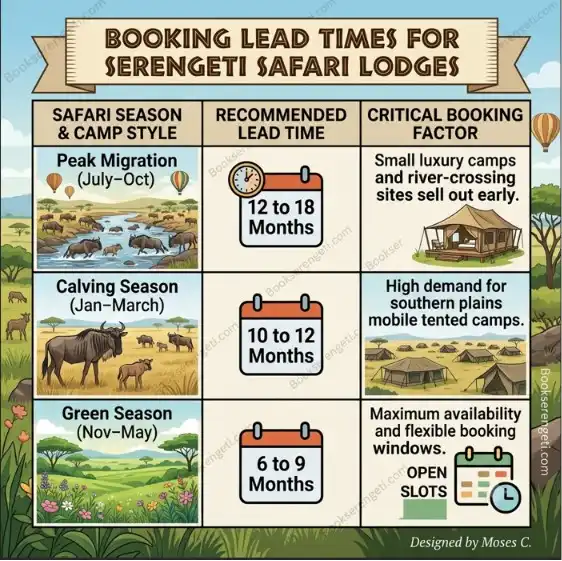
Safari Season & Camp Style | Recommended Lead Time | Critical Booking Factor |
Peak Migration (July–Oct) | 12 to 18 Months | Small luxury camps and river-crossing sites sell out early. |
Calving Season (Jan–March) | 10 to 12 Months | High demand for southern plains mobile tented camps. |
Green Season (Nov–May) | 6 to 9 Months | Maximum availability and flexible booking windows. |
A few calls matter far more than the rest.
Get your own vehicle, and pin down who’s in it. This is the one people underestimate. On a cheap “group joining” trip you often have no say over how many bodies end up in the rig, and operators pack them to save money, which means you’re stuck in a middle seat with no window when the leopard finally shows. Before you pay, get it in writing: how many guests, maximum, in the vehicle. I’d not go above four unless they’re your own family. Two is the dream. A private trip also means you decide when to head out, when to sit with a sighting, and when to chase a rumour of the migration.
The guide matters more than the lodge. A sharp guide reads the grass, kills the engine, and knows where a cheetah is likely to move. A weak one parks where every other truck parks. You’re paying for that judgement as much as the bed.
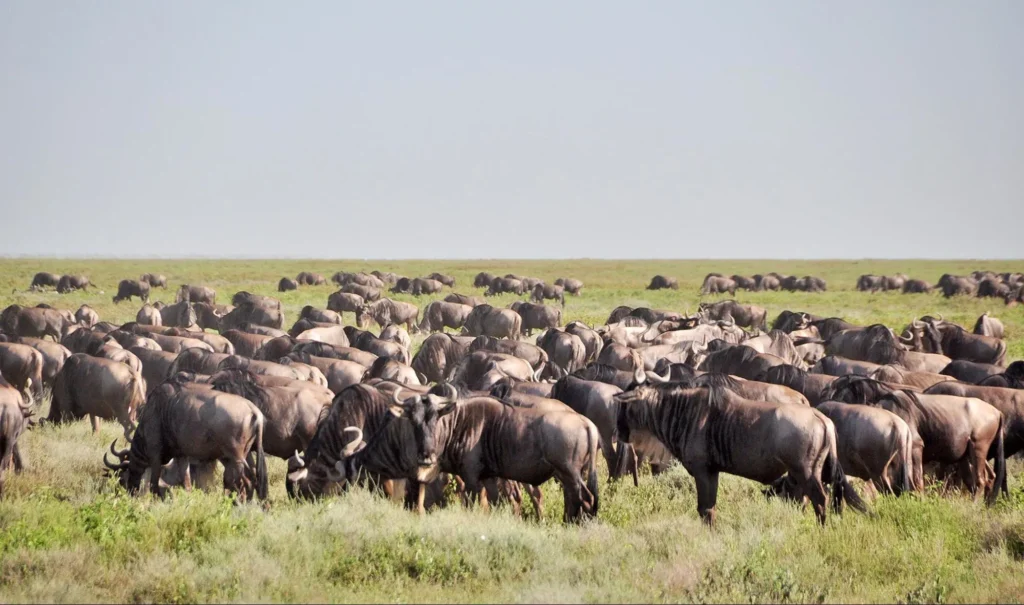
Pick the camp for where the herds will be. The migration is somewhere different each month, so a five-star lodge in the wrong region for your dates is a waste. Match the camp to the calendar, not the other way around.
Vet the operator, hard. Karibu to the part nobody enjoys. Tanzania has scammers who copy a real company’s name almost letter for letter, take a deposit, and vanish. So: check the operator is properly registered and TALA-licensed, ask for a dated, itemised quote on letterhead, and never, ever pay by Western Union. Card or a bank transfer to an account matching the company name, nothing else. A normal deposit is around 20 to 30 percent; if someone wants far more up front, be wary.
Book earlier than feels sane. The good small camps sell out. For peak migration months, July to October, the tiny ones like Dunia and Nomad, and the northern crossing camps like Sayari, go 12 to 18 months ahead, and some Singita cottages are block-booked by returning guests further out than that. Calving season wants 10 to 12 months. Only the green-season shoulder months give you 6 to 9 months of breathing room. The rule is simple: the smaller and more famous the camp, the earlier you commit.
A Day-by-Day Route
Most people can’t picture what eight days actually looks like, so here’s the classic northern-circuit flow we build from. We tune it to your dates and wherever the herds are:
- Day 1. Land at Kilimanjaro (JRO) and overnight in Arusha, the gateway town, to shake off the flight.
- Day 2. Drive to Tarangire for an afternoon among the baobabs and big elephant herds.
- Day 3. On toward the Ngorongoro highlands, with a stop at Lake Manyara.
- Day 4. Down onto the Crater floor at first light, then climb up and into the Serengeti.
- Days 5-7. The central and northern plains, tracking the migration, with a dawn balloon on one morning.
- Day 8. Fly back to Arusha from the nearest airstrip, or carry straight on to Zanzibar.
Prefer to skip the long drives? You can fly in instead and trade road time for more hours in the park.
What It Costs, and Where the Money Goes
This 8-Day/7-Night route is priced for two sharing, with single nights near Tarangire, Manyara and the Ngorongoro rim, then four in the Serengeti. Non-resident USD per person, across 2026/2027.
An 8-day trip, two sharing
Option | 8-day rate (per person) | Camps: Tarangire / Crater / Serengeti |
USD 5,950 | Sangaiwe Tented Lodge / Karatu Simba / Osinon Camp | |
Mid-Range Classic | USD 7,200 | Maramboi Tented Camp / Rhino Lodge / Nyikani Migration Camp |
USD 10,800 | Lemala Mpingo Ridge / Ngorongoro Serena / Melia Serengeti | |
Ultra-Luxury | USD 21,500 | Sanctuary Swala Camp / andBeyond Crater Lodge / Singita Sasakwa |
A big chunk of any quote is fixed government fees, the same for everyone, and a good operator itemises them rather than burying them. Here’s roughly where that money goes:
Mandatory fee | What it runs |
Serengeti park entry, adult, per 24 hours | USD 70.80 low season, 82.60 peak |
Serengeti park entry, child 5-15 | USD 23.60 (under 5 free) |
Ngorongoro Crater, adult, per 24 hours | USD 70.80 |
Ngorongoro Crater descent, per vehicle | USD 295 |
Special campsite, per adult, per night | USD 59 |
One honest heads-up: whatever your headline quote, budget another 40 to 60 percent on top for the things that live outside it, mostly tips, drinks, visas and any balloon or walking add-ons. It sounds steep, but it’s the real number, and the full picture lives on the cost and park-fees pages. Here’s what a package rate does cover:
- The private 4×4, pop-up roof, high clearance, fridge, fuel, and a licensed driver-guide.
- All park permits, set by the MNRT and collected by TANAPA, with the NCAA covering Ngorongoro.
- Every night’s lodging, meals, and drinking water.
- The one-way flight from the Seronera airstrip back to Arusha on a carrier like Coastal Aviation.
And what it doesn’t: international flights, the $100 visa, tips (there’s a what-to-tip guide), drinks and laundry. One small thing worth knowing before you travel: the park gates are card-only now, so nobody’s paying entry fees in cash at the barrier.
The Bits That Trip People Up
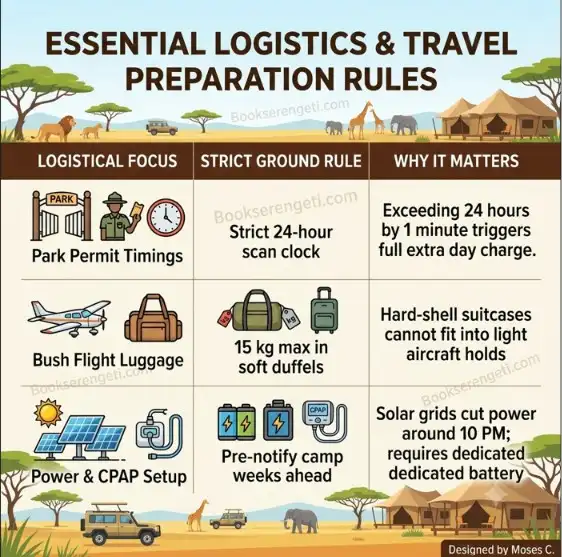
Logistical Focus | Strict Ground Rule | Why It Matters |
Park Permit Timings | Strict 24-hour scan clock | Exceeding 24 hours by 1 minute triggers full extra day charge. |
Bush Flight Luggage | 15 kg max in soft duffels | Hard-shell suitcases cannot fit into light aircraft holds. |
Power & CPAP Setup | Pre-notify camp weeks ahead | Solar grids cut power around 10 PM; requires dedicated battery. |
The booking’s done. These are the details that catch people out on the ground:
- The 24-hour permit clock. A park permit runs exactly 24 hours from the moment you scan in. Enter at 10am on day one and you’re billed a whole extra day if you’re still inside at 10:01am on the way out. A good guide plans your entry and exit around it, but it’s why the timing on your itinerary isn’t random.
- Black-cotton soil after rain. The low plains turn to axle-deep grease within twenty minutes of an afternoon storm, which is exactly why self-driving here is a bad idea unless you really know the ground. Pole pole, and stay on the firm track.
- The 15 kg soft-bag rule. The little caravans that fly you around cap luggage near 15 kg, and it has to be a soft duffel that squashes into the hold. Turn up with a hard shell and it gets left on the tarmac. Pack soft and light.
- Medical kit and CPAP. If you use a CPAP machine, tell your operator weeks ahead. Remote camps run on generators and solar, and they’ll need to rig a dedicated battery to your tent to keep it running all night.
- Insurance with evacuation cover. Not optional in my book. A medical evacuation from deep bush can run tens of thousands, so get a policy with proper evacuation cover, and buy it soon after your first deposit. More on staying safe and sorted.
Common Questions
Can I just do a self-drive?
You can rent a self-drive vehicle, but I’d steer you away from it for the Serengeti. The tracks are unmarked, the black-cotton mud is unforgiving, rangers fine off-road driving heavily, and a breakdown far from help is genuinely dangerous. A guide isn’t just a luxury here, it’s how you actually find animals and stay safe.
How much should I tip?
Budget around USD 20 a day for your guide, handed over on the last morning from the whole vehicle, and roughly USD 15 a night into the camp’s shared tip box at checkout, which the staff split. Don’t try to tip individual waiters at full-board camps.
Where do we stop for the loo?
You can’t just step out anywhere, it’s unfenced wild country. Guides plan the day’s loop around the gates, visitor centres and picnic sites, which have proper facilities, so you’re never far from one.
What if bad weather delays our fly-back?
The small planes fly on sight, so morning mist can push a takeoff back an hour or two. That’s why we schedule your fly-out early, leaving a comfortable buffer in Arusha before any international connection. It takes the stress out of the last day.
How far ahead do I really need to book?
For peak season and the famous small camps, 12 to 18 months, sometimes more. Calving season, 10 to 12. Green-season shoulder months are far more forgiving at 6 to 9 months. If your heart is set on a specific tiny camp, treat those numbers as firm.
Plan Your Trip
Strip it all back and booking well comes down to four things: a private vehicle with the numbers agreed, a guide worth their salt, a camp that matches the month, and a licensed operator you’ve actually checked. Line those up and the trip mostly runs itself. Work out roughly how many days you have and which packages fit, and the rest is detail.
When you’ve got rough dates and a group size, the quote page is the place to start, and we’ll build the route around where the animals will actually be. Karibu.
Editorial & Fact Check Validation Written by Moses C. – Veteran Wildlife Safari Guide & Operations Manager at BookSerengeti.com.
Welcome to bookserengeti.com
Thank you for visiting us! We're excited to help you plan an unforgettable safari adventure across Kenya.
Latest Safari Posts
Serengeti Migration Safari Packages: 2026/2027 Cost & Itinerary Guide
Serengeti Wildlife Safari Packages: 2026/2027 Price, Big Five & Routes
Serengeti Group Joining Safari Package: 2026/2027 Price & Route Guide