Serengeti Public Campsites: The Budget Camper's Guide
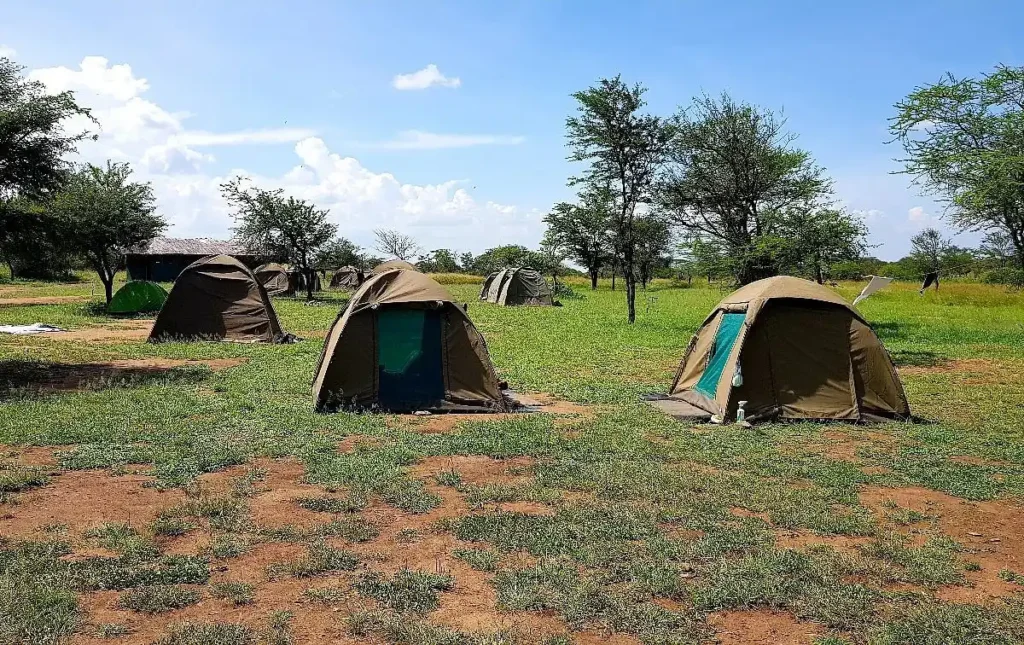
Summary: Serengeti public campsites are the cheapest way to sleep inside the park, and they’re aimed squarely at self-drivers, overlanders and backpackers rather than lodge guests. You pitch on open, unfenced ground where wildlife walks through at night, with basic shared facilities, for a fraction of a tented-camp bed. A public site runs $35.40 per adult a night; add park entry and a vehicle fee and a DIY camping day inside the Serengeti still comes in well under a hundred dollars a person before food and fuel.
The Campsites, and What They’re Like
Most of the public sites cluster in the central Seronera area, close to the airstrip and the main game-drive tracks, with a few more out in the other sectors:
- Pimbi is the popular one, near the Seronera airstrip and handy for the central routes.
- Tumbili and Nyani are also central and easy to reach, if a bit more basic.
- Nguchiro and Ngiri are quieter, with Ngiri known for scenery and frequent animal sightings.
- Dik-Dik is small and secluded, good if you want fewer neighbours.
- Lobo, up north, suits people chasing the July-to-October river crossings.
Facilities are genuinely basic and vary by site: pit latrines or simple flush toilets, cold-water showers where they exist at all, a shared cooking shelter, water taps that aren’t always running, and rangers on watch at night. There’s no electricity and no fence. That last part is the whole point, and the whole risk.
What It Actually Costs
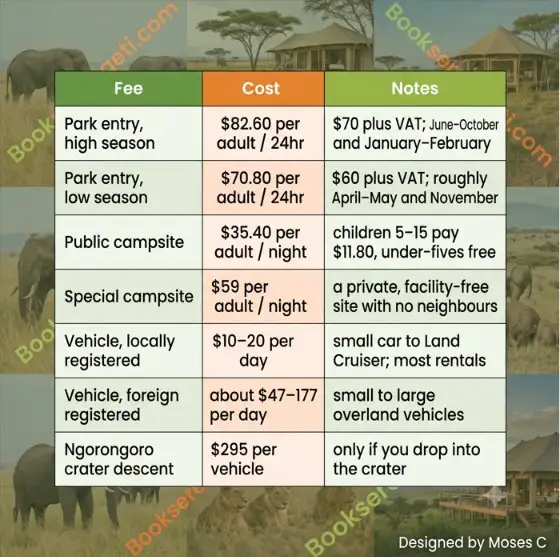
Here’s the part most guides skip: the real numbers an independent traveller pays TANAPA. These are non-resident rates with the 18% VAT already in.
Fee | Cost | Notes |
Park entry, high season | $82.60 per adult / 24hr | $70 plus VAT; June–October and January–February |
Park entry, low season | $70.80 per adult / 24hr | $60 plus VAT; roughly April–May and November |
Public campsite | $35.40 per adult / night | children 5–15 pay $11.80, under-fives free |
Special campsite | $59 per adult / night | a private, facility-free site with no neighbours |
Vehicle, locally registered | $10–20 per day | small car to Land Cruiser; most rentals |
Vehicle, foreign registered | about $47–177 per day | small to large overland vehicles |
Ngorongoro crater descent | $295 per vehicle | only if you drop into the crater |
There’s no higher “peak” park-fee tier beyond the $82.60, despite what some guides claim. Add it up and two people sharing a rented Land Cruiser spend roughly $128 each a day inside the park (high-season entry, a public site, the vehicle split), before the 4×4 rental itself, fuel and food. Set that against $400 to well over $2,000 a night for a lodge, and you can see why people camp. The full fee breakdown has every category.
Camping Safely in the Open
The sites are unfenced, and that’s not a marketing line. Buffalo wander through the Seronera camps at night, and it’s common to find one grazing by the toilet block at dawn; hyenas patrol the edges for anything left out. Nobody has laid on a barrier between you and them, so a few rules keep it safe rather than scary:
- Don’t leave the tent at night, at all. The standing advice from campers and rangers alike is not to go wandering to the toilet in the dark, so go easy on drinks before bed.
- Cook and eat well away from where you sleep, and lock all food, and anything scented, in the vehicle overnight. A cooler left out is an open invitation, and a hyena will happily wreck it for what’s inside.
- Keep a headlamp and a whistle in the tent, and if there are night rangers on site, know where they are.
- Never get between an animal and its escape route, and give the buffalo by the ablutions a very wide berth.
Treated with that respect, thousands camp here every season without trouble. The wildlife isn’t hunting you; it just lives here, and you’re the visitor.
Getting a Site, and the Rules
Rule & Requirement | How It Works | Essential Camper Advice |
Permit Booking | Reserve online via TANAPA system for serengeti public campsites. | Card payments only; book 2–3 months early for peak season. |
Park Fees & Timing | 24-hour clock applies to serengeti national park fees. | Track gate entry times; driving is banned from 6 PM to 6 AM. |
Self-Sufficiency | No food, fuel, or stores exist inside the campgrounds. | Buy all supplies in Arusha before booking a serengeti safari. |
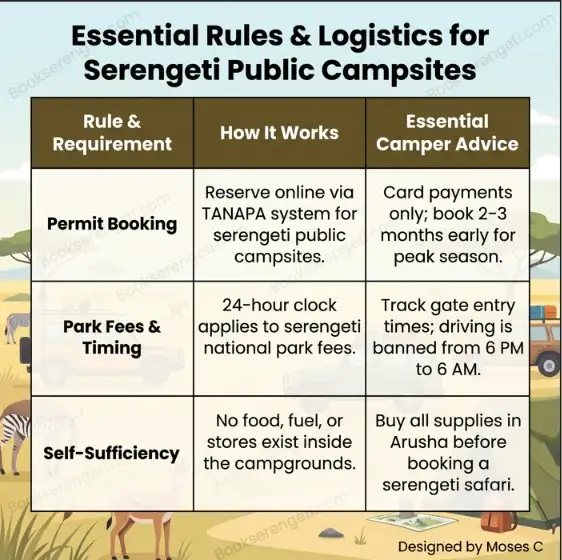
A few logistics that trip up first-time self-drivers:
- Book ahead. Public campsites are reserved through the TANAPA online system, and in high season (June–October, January–February) you want to book two to three months out. Special campsites go six months ahead.
- Card, not cash. The Serengeti gate takes Visa or Mastercard, and increasingly won’t take cash at all, so sort your control number or card payment before you’re standing at the barrier.
- The permit is a 24-hour clock from the moment you enter, so an early-afternoon arrival that runs to the next afternoon is one day’s fees, not two. Watch the gate time.
- Game drives run 6am to 6pm, and night drives are not allowed anywhere in the park, so plan to be in camp by dark.
- Stock up in Arusha. Nothing is sold inside the park, so carry all your food, water and fuel in with you, and charge devices off the vehicle as you drive.
- The Ngorongoro transit trap: driving between the Serengeti and Arusha through the NCAA means paying its fee even if you don’t visit the crater. You can avoid paying it twice by leaving the Serengeti via Klein’s Gate in the north-east on a Lake Natron routing. If sorting the permits and campsite bookings from abroad feels like a lot, I can take that end on, just send me the dates.
When to Camp
Travel Season | Wildlife & Conditions | Camper Recommendation |
Dry Season (Jun–Oct) | Peak wildlife viewing and river crossings near mobile camps serengeti. | Book early; high-season rates impact overall serengeti safari cost. |
Calving Season (Dec–Mar) | Herds gather on southern plains with half a million calves. | Ideal weather and prime conditions for open public camping. |
Green Season (Apr–May) | Rains turn tracks muddy; lowest daily park fees. | Best for expert self-drivers seeking lower costs than luxury lodges. |
The dry season, June to October, is the classic time: the game concentrates around water, the roads are firm, and it lines up with the northern crossings, though it’s also when park fees sit at the high-season rate and sites book out. December to March puts the calving herds down south around Ndutu, a wonderful time to camp in the south. The green season of April and May is cheapest, with the lower park fee and far fewer people, but the rains can turn the black-cotton tracks to a trap, so it’s really only for confident drivers. Match your camp to where the migration will be, the same as anyone else.
Common Questions
Are public campsites safe with all the wildlife around?
Yes, if you follow the rules: stay in the tent after dark, use the rangers, keep food locked in the vehicle, and don’t wander. Predators aren’t interested in a zipped tent; the real hazards are the big herbivores like buffalo you might surprise on a night walk, which is exactly why you don’t take one.
Do the campsites have showers and toilets?
Basic ones. Expect pit latrines or simple flush toilets and, at some sites, a cold-water shower; water isn’t always running. It’s proper camping, so bring what you’d need to be self-sufficient, including your own toilet roll.
Can I self-drive, or do I need a guide?
You can self-drive the Serengeti, and many do. A guide isn’t legally required for general game drives (unlike Ngorongoro’s crater floor), but the park is huge and the tracks are unmarked, so a good map, a GPS and a sensible pace matter. Walking safaris and the crater do require a ranger.
What’s the cheapest way to sleep in the Serengeti?
A public campsite, at $35.40 an adult, is the cheapest bed inside the park. Camping just outside the park boundary is cheaper still and skips the nightly concession, but you trade away waking up in the middle of the wildlife.
Planning a Camping Safari
Camping the Serengeti yourself is one of the great budget adventures in Africa, as long as you go in prepared: the right vehicle for however many days you’re out, sites booked ahead, supplies bought in Arusha, and a healthy respect for the unfenced dark. It’s worth pricing the wider trip too, so nothing surprises you. If you’d rather someone else handle the permits, the vehicle and the campsite bookings while you keep the budget-camping style, that’s something I can put together.
When you’ve got rough dates and a group size, the quote page is the place to start, and we’ll build a camping route that fits.
Editorial & Fact Check Validation Written by Moses C. – Veteran Wildlife Safari Guide & Operations Manager at BookSerengeti.com.
Welcome to bookserengeti.com
Thank you for visiting us! We're excited to help you plan an unforgettable safari adventure across Kenya.
Latest Safari Posts
Serengeti Migration Safari Packages: 2026/2027 Cost & Itinerary Guide
Serengeti Wildlife Safari Packages: 2026/2027 Price, Big Five & Routes
Serengeti Group Joining Safari Package: 2026/2027 Price & Route Guide