Skip to content
The Complete Guide on How to Plan a Serengeti Safari
Overview: To successfully master how to plan a serengeti safari, you must align your travel dates with the geographic location of the wildebeest migration across the park’s four distinct zones. A properly planned route starts with an overland drive from Arusha through smaller loop parks, includes a 2-to-4-night deep stay inside the central or northern savanna, and finishes with a fly-back flight from a bush airstrip. For a fully compliant peak-season trip in 2026 or 2027, budget an average of USD 3,610 to USD 7,710 per person sharing based on double occupancy.
Figuring out how to plan a serengeti safari can feel completely overwhelming when you first look at a map of East Africa. Most people open twenty different internet tabs, get lost in a sea of identical travel agency pitches, and end up more confused than when they started. They look at pictures of endless grasslands but don’t understand the strict government permit systems, massive driving distances, and complex lodge concessions that sit behind the scenes.
If you want to pull off this bucket-list trip without losing your mind or your savings, you need a straightforward blueprint built on real, ground-level field experience. Before we break down the seasonal movements of the animals, let’s look at the financial line items so you know exactly where your money goes.
The 5-Step Serengeti Planning Timeline
To prevent logistical overlap, execute your planning in this exact order:
Step 1: Pick Your Month First (The Migration Dictates Location)
Do not book a lodge until you cross-reference your dates with the herd locations (see our calendar below). This ensures you are in the right spot at the right time, all while tracking Africa’s famous Big Five (Lion, Leopard, Elephant, Rhino, and Cape Buffalo).
Step 2: Secure Your International Flights
Aim for Kilimanjaro International Airport (JRO) as your primary entry point, or Nairobi (NBO) with a regional connection down to Tanzania.
Step 3: Choose Your Transit Style (Drive vs. Fly)
Decide if you will do an overland circuit or a fly-in safari, as this dictates your internal flight bookings and vehicle arrangements.
Step 4: Select and Lock Accommodations
National park beds inside the Serengeti are limited; book 8 to 12 months in advance for the dry season to secure the best spots.
Step 5: Process Visas and Health Preps
Secure your Tanzanian eVisa online and arrange medical appointments for necessary immunizations, including your Malaria Prophylaxis and a Yellow Fever Certificate if you are transiting through an endemic country.
2026/2027 Package Comparison
The data grid below details a realistic, logistically sound 5-Day/4-Night multi-destination journey built for two people traveling together. It strictly enforces local conservation design laws: it allocates a maximum of 1 night to smaller intermediate destinations like Tarangire and the Ngorongoro Crater to prevent exhaustion, while reserving a 2-night focus block for the main grasslands of the Serengeti.
All rates reflect non-resident USD totals per person and are fully certified for the 2026 and 2027 travel windows.
Mobile-Scannable 5-Day Double-Occupancy Safari Packages
Package Tier | 5-Day Double-Occp. Rate (Per Person) | Prime Accommodations Included (Tarangire / Crater / Serengeti) | Core Flight & Transit Buffers |
USD 3,610 | Sangaiwe Tented Lodge / Karatu Simba Lodge / Osinon Tented Camp | 4×4 Cruiser, Peak Fees, Seronera to Arusha Fly-Back | |
Mid-Range Classic | USD 4,310 | Maramboi Tented Camp / Rhino Lodge / Kubukubu Tented Lodge | 4×4 Cruiser, Peak Fees, Seronera to Arusha Fly-Back |
USD 5,260 | Lemala Mpingo Ridge / Ngorongoro Serena Safari Lodge / Melia Serengeti Lodge | 4×4 Cruiser, Peak Fees, Seronera to Arusha Fly-Back | |
Luxury Plus Ultra | USD 7,710 | Sanctuary Swala Camp / andBeyond Ngorongoro Crater Lodge / Four Seasons Safari Lodge | 4×4 Cruiser, Peak Fees, Seronera to Arusha Fly-Back |
Optional Experience Add-on: You can add a sunrise hot air balloon flight over the central plains to any of these itineraries for USD 600 per person. This price includes the mandatory TANAPA flight permit, the balloon launch, and a champagne bush breakfast after landing.
👉 Book Now: Custom adjustments to any itinerary tier can be requested instantly via the BookSerengeti.com Custom Inquiry Form.
Related packages: 3-Day Serengeti Safari Package · 4-Day Serengeti Safari Package · All Serengeti Safari Packages
What Fees Are Included
We believe in complete transparency before you ever pack your bags. Here is a clear breakdown of what is covered inside our core tour rates, along with what you will need to pay for separately.
What is Always Covered:
- All updated TANAPA conservation fees and daily MNRT destination taxes for 2026/2027.
- Private use of a customized 4×4 safari land cruiser equipped with large windows, an open canvas roof hatch, and an internal inverter charging system.
- Full fuel allowances and the daily professional services of a licensed local guide.
- Mandatory government concession fees for every single night spent at camps inside the park boundaries.
- Emergency medical evacuation cover through the AMREF Flying Doctors system.
- All specified meals, fresh cold drinking water stored in the vehicle’s built-in fridge, and double-occupancy room charges.
- One-way regional flight tickets on local carriers like Coastal Aviation from the Seronera airstrip back to Arusha (with all mandatory operator buffers and heavy bag fees fully handled).
What is Excluded:
- International airfare and your official Tanzanian entry tourist visa ($100 for US citizens, $50 for UK and EU passport holders).
- Discretionary tips for your guide and individual lodge hospitality teams.
- Personal laundry service, optional premium alcoholic drinks at bars, and independent medical travel insurance policies.
If you want to view a specific set of dates or want to tweak an itinerary track to match your personal budget limits, you can fill out our direct BookSerengeti.com Custom Inquiry Form to get a detailed spreadsheet from our office staff.
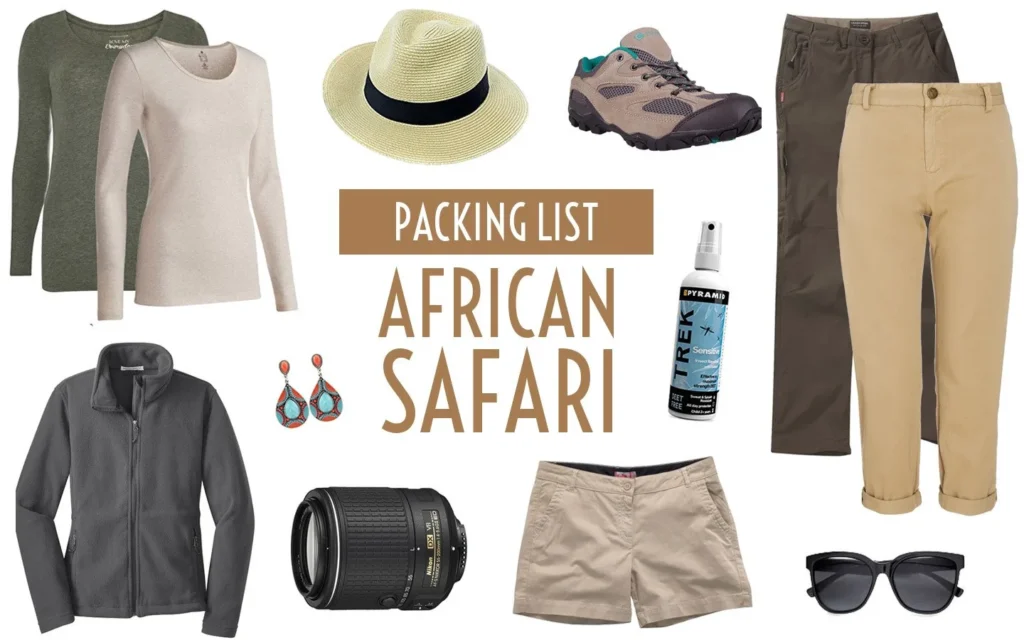
Critical Packing Essentials for the Serengeti
Category | Recommended Items | Critical Reason |
Apparel Colors | Khaki, Tan, Olive | Dark blue/black attracts tsetse flies |
Luggage Type | Soft-sided duffel bags | Max 15kg limit for bush flights |
Camera Setup | Long lens + beanbag | Stabilizes camera against vehicle vibration |
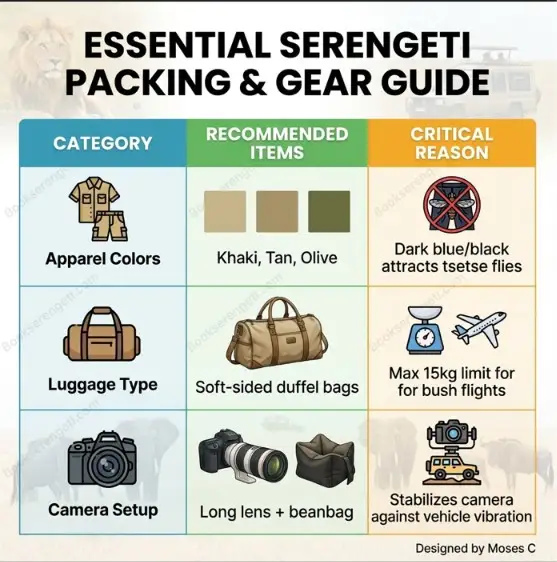
Beyond standard holiday clothing, your safari success relies on technical packing:
- Layers for Thermal Swings: Morning game drives start at dawn and can be a chilly 13°C (55°F), warming up to 28°C (82°F) by midday.
- Soft-Sided Luggage: Regional bush flights (like Coastal Aviation) enforce a strict 15kg (33 lbs) limit inside soft duffel bags. Hard-shell suitcases will not fit in the aircraft pods.
- High-Factor Biodegradable Sunscreen & Dust Buffs: The savanna dust can be intense during dry season transits, making a face buff an absolute lifesaver.
Insider Field Guide Challenges
When you attempt to analyze how to plan a serengeti safari, you are interacting with an ecosystem controlled by the Ministry of Natural Resources and Tourism (MNRT). Most commercial travel websites make the process look completely seamless. They skip over the physical complications that occur every day in the bush.
Our team manages vehicles on these roads year-round, and we see unguided itineraries collapse because travelers do not factor in regional choke points.
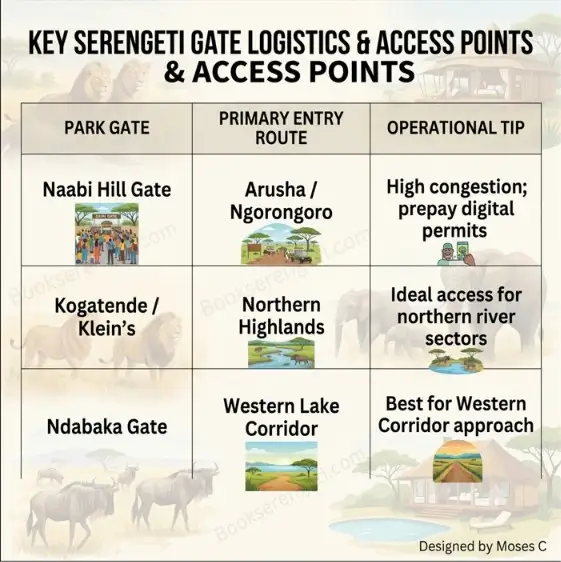
A clear example is the paperwork process at Naabi Hill Gate. This is the primary bottleneck where vehicles enter the main Serengeti tracks from the Ngorongoro side.
The park rangers check every vehicle’s digital permit manually and print physical receipt vouchers on old thermal paper machines. If your tour operator did not pre-clear your specific transit fees through the government’s online banking ledger days before you left Arusha, you will find yourself stuck.
You can easily spend ninety minutes sitting in an unmoving line of trucks while the midday sun heats the metal roof of your cruiser. Meanwhile, your guide will be trapped inside a crowded administrative office trying to reset a digital voucher.
There are also unique environmental factors that change how you should pack. Between the acacia thickets of the Western Corridor and the open grasslands of the central plains, there is a heavy concentration of tsetse flies. These insects are completely different from common flies. They bite through lightweight activewear like gym leggings or thin synthetic t-shirts.
Worse yet, they are visually drawn to dark shades of royal blue and black. If you wear a dark blue shirt on a drive through these wood lines, you will turn your vehicle into a target for bites.
We always tell our guests to pack solid khakis, light tans, and dusty olive greens. These shades blend directly into the background dust and keep the insects away.
You also have to think about the physical stability of your camera gear. I cannot promise you will see a lion hunt on your very first afternoon drive—nobody can honestly make that claim—but when an action sequence does happen, your truck’s engine will often be idling.
A human guide sounds confident but will occasionally hedge because wild animals don’t follow scripts. If you try to hold a long 400mm lens steady with just your hands while the truck chassis vibrates from a diesel motor, your images will look blurry.
Our vehicles feature thick canvas sandbags that rest directly across the open steel frames of the roof hatch. This simple tool allows you to rest your camera base on a solid, vibration-absorbing cushion, letting you capture sharp close-ups of a leopard resting high up in a yellow-fleshed acacia tree.
The Serengeti Booking Calendar: Matching Dates to Locations
To secure a successful Serengeti safari booking, you must match your travel months to the correct geographic sector of the park. Booking a high-end lodge in the wrong region means spending your entire day driving instead of viewing wildlife.
Travel Window | Herd Location | Prime Booking Sectors | Key Highlights & Risks |
January – March | Southern Plains / Ndutu | South Serengeti / Ngorongoro | Calving season; high predator action. Heavy mud risks. |
April – May | Western Corridor | Central & Western Serengeti | The “Long Rains.” Many mobile camps close; great pricing. |
June – July | Grumeti River / Central | Central & Western Corridors | Grumeti river crossings. High transition movement. |
August – October | Kogatende / Mara River Sector | Iconic Mara River crossings. Peak demand; book 12 months out. | |
November – December | Moving South | North & Central Serengeti | The “Short Rains.” Herds return south via eastern trails. |
Understanding the Key Geographic Hubs
- Seronera: Located in the central valley, this is the year-round heart of the park, famous for its dense resident big cat populations.
- Kogatende: Situated in the remote north, this sector features classic granite kopjes and serves as the primary staging ground for the dramatic Mara River crossings.
- Grumeti: Found in the narrow Western Corridor, this region features unique clay soils and hosts the river crossings during the early stages of the migration.
Logistical Failure Stories
Park Gate | Primary Entry Route | Operational Tip |
Naabi Hill Gate | Arusha / Ngorongoro | High congestion; prepay digital permits |
Kogatende / Klein’s | Northern Highlands | Ideal access for northern river sectors |
Ndabaka Gate | Western Lake Corridor | Best for Western Corridor approach |
Learning how to plan a serengeti safari correctly is easier when you see what happens when someone gets it wrong. A couple contacted our office last season after trying to plan an independent, self-driven itinerary through a generic car rental portal to save on management fees. They picked a guide who agreed to drive them all the way from downtown Arusha to the northern Mara riverbanks in a single continuous day, trying to skip the standard overnight stops entirely.
It turned out to be a complete logistical failure. The driving distance is well over 450 kilometers across rough, unpaved washboard tracks.
By the time they cleared the central southern boundaries, the unexpected arrival of an early afternoon rainstorm had turned the black cotton clay soils into thick, heavy mud pools. Their vehicle slipped off the main center line and sank up to its metal differentials.
They spent the entire night stuck in the dark, unable to move. They had to sit inside the cold cab listening to the high-pitched yells of spotted hyenas moving through the grass right outside their doors, surrounded by the sharp smell of wet clay and bruised grass.
They completely missed their non-refundable reservation at their luxury northern camp and lost two valuable days of their vacation because they tried to fight the basic geography of the country.
Godfrey A. is a licensed safari guide with 10 years of experience, and he regularly explains that the terrain will always dictate your daily schedule out here. Trying to force a massive distance into a single day just leaves you exhausted and stranded.
You must design your route in logical steps. Spend a night resting near Tarangire or on the crater rim to break up the initial journey, and then budget at least two to three nights deep inside the park system so you can track the resident prides at a normal, relaxed pace.
Safari Planning Frequently Asked Questions
Which entry gates should we use when entering the park?
Your entry gate depends entirely on your overall driving route. If you are coming along the classic northern route from Arusha or Ngorongoro, you will enter through Naabi Hill Gate. If you are coming from the western lake side near Mwanza, you will enter through Ndabaka Gate. Travelers descending from the northern highlands will utilize Klein’s Gate or Ikoma Gate. Each gate requires pre-paid digital permits from the MNRT ledger before your vehicle arrives.
What is the difference between a mobile tented camp and a permanent lodge?
Permanent luxury lodges use solid stone or wood structures and are built on fixed sites with large swimming pools and concrete foundations. Mobile tented camps are high-end canvas structures erected on wooden platforms. These camps move locations twice a year to stay near the migrating herds. Staying in a canvas camp lets you hear the night sounds of the savanna clearly, with nothing but a layer of canvas between your bed and the wild.
Can we view the iconic river crossings during the green season?
No, the famous Mara River crossings only occur during the dry season, usually between August and October, when the herds are concentrated in the far north. During the green season from January to March, the wildebeest are located on the southern plains for the calving season. If you visit the northern rivers in January, you will see beautiful scenery and resident hippos, but the million-wildebeest herds will be miles away in the south.
How do we catch a fly-in safari flight out of the park?
The park features several active bush airstrips managed by TANAPA, including Seronera in the center, Kogatende in the north, and Ndutu in the south. Local airlines like Auric Air operate daily scheduled bush flights using single-engine aircraft. When you request a fly-in option on BookSerengeti.com, we link your lodge check-out times directly with the pilot’s landing schedule so your guide can drop you off right at the dirt runway without wasting any game-viewing time.
Start Designing Your Custom Itinerary
A successful trip relies on accurate local knowledge and realistic timing. Do not leave your vacation plans to generic booking websites that do not understand the seasonal movements of the animals or local road conditions. Connect directly with our Arusha planning office through our Direct Reservation and Quote Page to check vehicle openings and lock in your expert field team for the 2026/2027 season.
Editorial & Fact Check Validation: Reviewed by Moses C. – Veteran Wildlife Safari Guide & Operations Manager at BookSerengeti.com.
Welcome to bookserengeti.com
Thank you for visiting us! We're excited to help you plan an unforgettable safari adventure across Kenya.
Latest Safari Posts
Serengeti Migration Safari Packages: 2026/2027 Cost & Itinerary Guide
Serengeti Wildlife Safari Packages: 2026/2027 Price, Big Five & Routes
Serengeti Group Joining Safari Package: 2026/2027 Price & Route Guide