The Wildebeest Migration Cycle: A Year in the Life of the Herds
Summary: The wildebeest migration cycle is a continuous, year-round loop, not a fixed parade. Close to two million wildebeest, zebra and gazelle follow the rains clockwise between Tanzania’s Serengeti and Kenya’s Masai Mara: calving in the south early in the year, crossing the northern rivers from about August, then drifting back. To plan around it you match your dates to the phase you want, then leave room for the weather to move things. Plan on roughly USD 3,610 to USD 7,710 per person sharing for a five-day trip, two of you to a vehicle, ending with a flight back to Arusha.
Planning a trip around the wildebeest migration cycle is one of the great wildlife experiences, and it’s easy to overthink. The brochures draw a tidy circle on a map and imply the herds hit the same river on the same date every year. They don’t. This is a restless loop of nearly two million animals that never really stops, steered by where the rain fell last week and where the grass came up green.
Book your camp off a static chart and you can spend a week looking at an empty plain. The fix is to understand the loop itself, then plan loosely enough that your guide can chase the herds wherever the rain has pulled them. Here is how the year actually turns, and what it means for your dates, your budget, and your border paperwork if you want to follow the herds all the way into Kenya.
Not sure which phase fits your dates? Tell us when you can travel and we’ll point you to the right corner of the loop, through our safari enquiry form.
The Cycle, Phase by Phase
Phase & Months | Core Action & Location |
Calving Phase
(Jan – Mar) | Southern plains & Ndutu. 500,000 calves born; heavy predator activity. |
The Trek North
(Apr – May) | Central Seronera columns. Quiet green season with lower lodge rates. |
Grumeti Crossing
(Jun – Jul) | Western Corridor river channels. Low vehicle crowds. |
Mara Crossings
(Aug – Oct) | Northern Kogatende sectors. Dramatic deep-water crocodile crossings. |
The Return South
(Nov – Dec) | Lobo valley and eastern plains. Herds drift back to restart loop. |
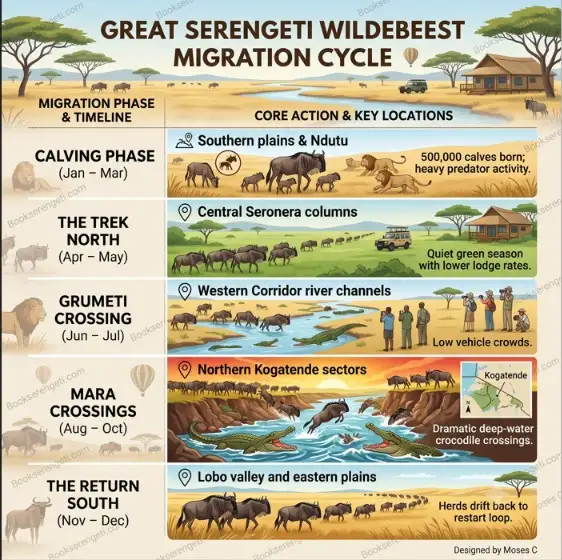
You can pick the loop up anywhere; we’ll start where the calves are born. There are four moving phases, each in its own corner of the ecosystem, then the long haul back south to begin again. The month-by-month timeline carries the day-level detail. This is just the shape of it.
Calving in the south (January to March)
Early in the year the herds are down on the short-grass Ndutu and southern plains, where the volcanic soil grows grass rich in calcium and phosphorus for nursing mothers. Around February something like half a million calves drop inside a few weeks, and every predator on the plains moves in. It is the green season, the air clear and the light clean, which is why photographers love it. One thing to budget for: much of Ndutu sits inside the Ngorongoro Conservation Area, so it carries a separate fee on top of the Serengeti’s.
The trek north (April to May)
As the southern grass burns off, the herds string into columns miles long and push northwest through the central Seronera valley. This is the quiet green shoulder: afternoon showers, emerald plains, thin crowds, and softer lodge rates. The rut starts up too, so expect noisy, head-clashing bulls out on the plains before any river is in sight.
The Grumeti (June to July)
In the western corridor the herds reach their first real river, the Grumeti, and bunch on the banks before pushing through its shallow, crocodile-held channels. This is the least crowded crossing of the whole loop, often a handful of vehicles rather than a queue.
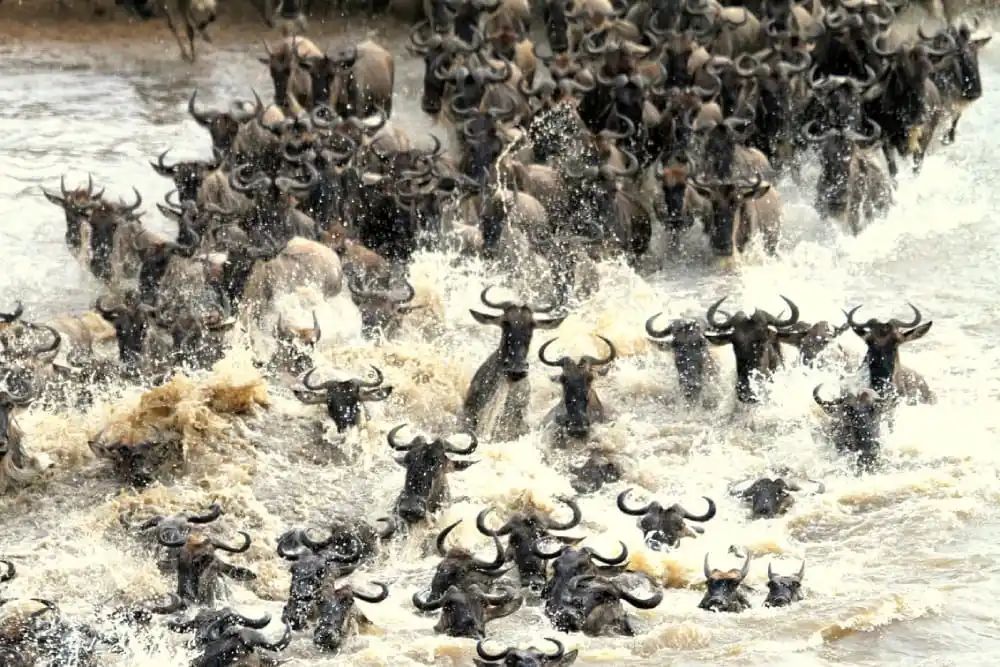
The Mara crossings (August to October)
This is the stretch everyone has seen on television. The herds reach the far northern plains around Kogatende and take on the Mara River: steep banks, deep water, big crocodiles, and a lot of doubling back. A good share of the herd stays on the Tanzanian side, crossing and recrossing for weeks, so you can see it without leaving the country. The cycle itself, though, does not stop at the border, which is where Kenya comes in.
The return south (November to December)
As the short rains green the south again, the herds drift back down through the Lobo valley and the eastern plains toward Ndutu, ready to calve and begin again.
Crossing into Kenya
From roughly August to October a large part of the herd pushes over the border into Kenya’s Maasai Mara, and the detail that trips travelers up most is this: the East Africa Tourist Visa does not cover Tanzania. It is a joint visa for Kenya, Uganda and Rwanda only. If your trip pairs the Serengeti with the Mara, you need two separate visas, not one.
In practice that means a Kenya eTA (apply online before you fly, since there is no visa on arrival, and it is single entry) plus a Tanzania eVisa (USD 50, or USD 100 for US and Irish passports; Tanzania ended visa-on-arrival in early 2025, so arrange it online ahead of time). Most overland crossings between the two parks run through the Isebania border post. Carry a yellow fever certificate as well, because either side can ask for it at the crossing and you will generally need it to enter Tanzania from Kenya. Single-entry visas cannot be reused, so the usual order is Kenya first, then Tanzania, and fly home from there.
There’s a way around all of it, though: stay on the Tanzanian bank around the Lamai Wedge and Kogatende, and you get the very same crossings without a single border form.
Why the Calendar Lies
Old Brochure Myth | Real Savanna Fact |
Herds arrive at specific spots on fixed dates. | Changing rains rule the loop. Arrival times swing by weeks. |
The whole migration moves as one tight group. | Herds split across massive areas in separate phases at once. |
Printed tracking maps are 100% accurate. | Routes shift daily. Guides track real-time rainfall data. |
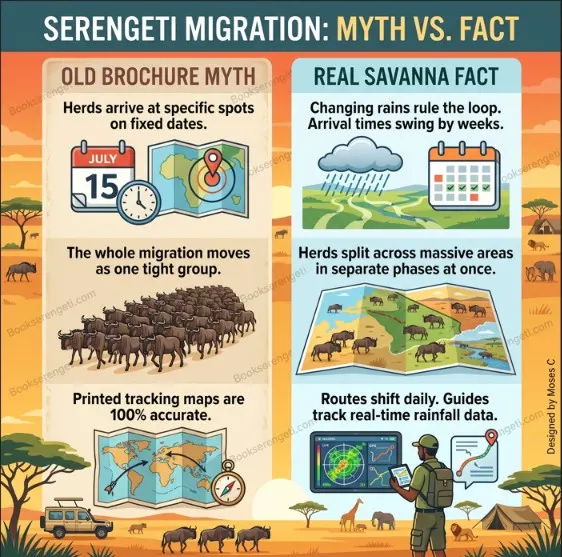
Treat every date above as an average, never a promise. The rains have turned erratic over the last few years, and the herds simply follow the water wherever it falls. Moses has watched them reach the Mara in late June one year and still be strung across the southern plains past March the next. So pick your month, then hold the plan loosely.
So the most useful thing you can do is build slack into the trip. Give each region a few nights so the herds have time to turn up. Aim at the broad window of a phase, and let your guide adjust the plan day to day. In my experience the trips that come home disappointed are almost always the ones pinned to one rigid date. The best time to visit sets out the odds for each month, and how to track the herds covers what your guide actually does once you are there.
When to Book
The catch with the cycle is that the best beds sit in very small camps. A luxury mobile camp positioned for the July and August crossings, or for February’s calving, often needs booking eight to twelve months out, because the prime weeks go first. Shoulder dates you can sometimes pull together a few months ahead. Either way, lock the camp before you book the flights, not the other way round.
What It Costs
Below is a realistic 5-Day/4-Night multi-destination loop for two sharing a private 4×4, with the smaller stops (Tarangire, the Ngorongoro Crater) held to a night each and two nights on the migration camps themselves. Non-resident USD per person.
5-Day Double-Occupancy Safari Packages
Package Tier | 5-Day Rate (Per Person Sharing) | Camps: Tarangire / Crater / Serengeti |
USD 3,610 | Sangaiwe Tented Lodge / Karatu Simba Lodge / Osinon Tented Camp | |
Mid-Range Classic | USD 4,310 | Maramboi Tented Camp / Rhino Lodge / Kubukubu Tented Lodge |
USD 5,260 | Lemala Mpingo Ridge / Ngorongoro Serena / Melia Serengeti Lodge | |
Luxury Plus Ultra | USD 7,710 | Sanctuary Swala Camp / andBeyond Crater Lodge / Four Seasons Serengeti |
Optional add-on: a sunrise hot air balloon flight for USD 600 per person, including the TANAPA permit, the launch, and a champagne bush breakfast after landing.
Want a tier tweaked or a date checked? Send your plan through the safari booking form and our Arusha team will build it around you.
Related packages: 3-Day Serengeti Safari · 4-Day Serengeti Safari
What’s in the price
Most of the cost is simply the price of being there. The park takes the biggest share through the daily conservation fees collected by TANAPA and the per-night concession charge, both fixed government money set by the Ministry of Natural Resources and Tourism, with no room to haggle. The rest is what a private trip needs: your own 4×4 with fuel and a guide, every meal, water in the truck, your room on a shared-double basis, and the one-way flight back to Arusha at the end. The inclusion people forget to ask about is AMREF Flying Doctors evacuation cover, which you will be glad is there if anything goes wrong out in the bush.
What you pay yourself is the obvious stuff: international flights, your visa, travel insurance, tips, laundry, and drinks at the bar. And if you like the raw maths, the fees behind the rate, per adult per day with 18% VAT in: USD 82.60 to enter the Serengeti, USD 59 to 60 a night for the inner-park concession, and USD 35.40 for a public campsite on a tight budget.
Migration Cycle FAQ
What is the best month to see the migration?
It depends on the phase you want. For calving and heavy predator action on the southern plains, aim for January to March. For the dramatic river crossings in the north, plan for July to October. There is no single “best” month, only the best month for the scene you are after.
Do I need two visas for a Serengeti and Masai Mara trip?
Yes. Tanzania is not part of the East Africa Tourist Visa, so you need a Kenya eTA and a separate Tanzania eVisa, plus a yellow fever certificate for the border crossing. Arrange both online before you travel.
How far is it from Arusha to the Serengeti?
About 335 km (208 miles) to Naabi Hill, and roughly 450 km (280 miles) on into the central Seronera camps, all of it unpaved. Most trips break the drive or fly one leg.
Can you drive from Arusha to the park in a day?
You can, but it is a hard 7 to 8 hours of gravel and we steer people away from it. You arrive worn out and skip the game in Tarangire and the Ngorongoro Crater on the way up.
How strict are the bush-flight baggage limits?
A firm 15 kg (33 lb), soft bags only. A rigid roller case will not bend through the small cargo hatch of a Cessna Caravan and gets left on the tarmac, so pack a soft duffel you can squash by hand.
Plan Your Migration Loop
The cycle rewards people who plan the broad shape and keep the days flexible: pick the phase, give it room, and book the camp early. Send our Arusha team your rough dates and what you most want to see, calving or crossings, and we’ll shape the loop around them on our quote page. You can plan the whole thing on BookSerengeti.com, with a field team out there reading the herds week by week.
Editorial & Fact Check Validation Reviewed by Moses C. – Veteran Wildlife Safari Guide & Operations Manager at BookSerengeti.com.
Welcome to bookserengeti.com
Thank you for visiting us! We're excited to help you plan an unforgettable safari adventure across Kenya.
Latest Safari Posts
Serengeti Migration Safari Packages: 2026/2027 Cost & Itinerary Guide
Serengeti Wildlife Safari Packages: 2026/2027 Price, Big Five & Routes
Serengeti Group Joining Safari Package: 2026/2027 Price & Route Guide