How to Track the Wildebeest Migration Like a Field Guide
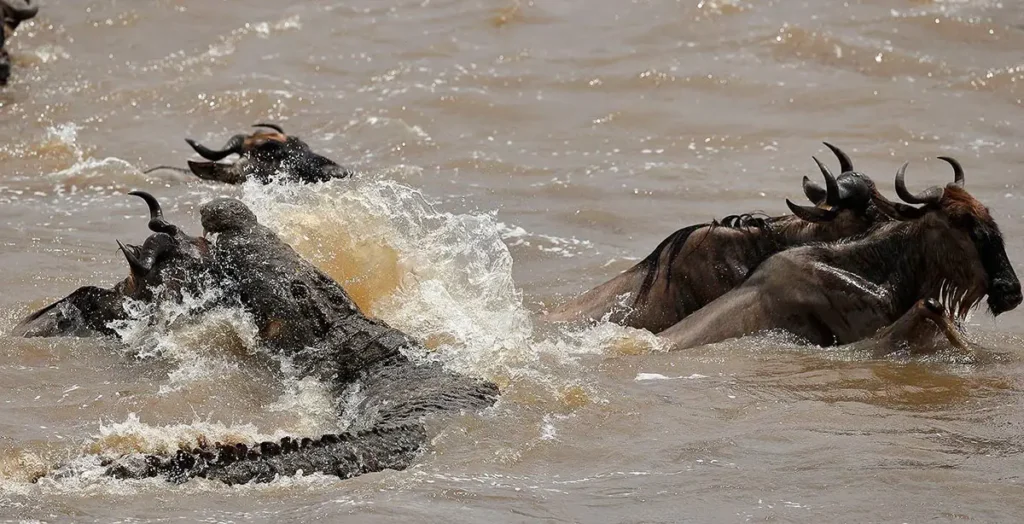
Summary: To track the wildebeest migration you match your dates to the sector where the herds are feeding, then read the land once you’re there. It isn’t a fixed parade — it’s a rain-chasing loop of over 1.5 million animals that swings between Tanzania’s Serengeti and Kenya’s Masai Mara. Use the live online maps to plan months ahead, and a guide’s radio network to find them day to day. For a well-planned 5-day double-occupancy safari that targets the moving herds and flies you back to Arusha, non-resident rates run from about USD 3,610 to USD 8,100 per person sharing.
Pinning down millions of moving hooves on a map is the hardest part of planning an African safari. Look up how to track the wildebeest migration and you’ll mostly find tidy maps with clean arrows sweeping the herds clockwise on an exact monthly schedule. The ground truth is messier and better: this is a living loop of well over a million wildebeest, zebra and gazelle, driven by local thunderstorms and the smell of fresh grass, and they don’t read the calendar.
Book a lodge off a static graphic and you can spend a week staring at empty dirt. To actually find the herds you do two things — plan the macro picture before you fly, then read the land once you’re in it. Here’s how both halves work.
Want a second opinion on your dates before you commit? Send them to us and we’ll tell you honestly where the herds should be — start at our safari enquiry form.
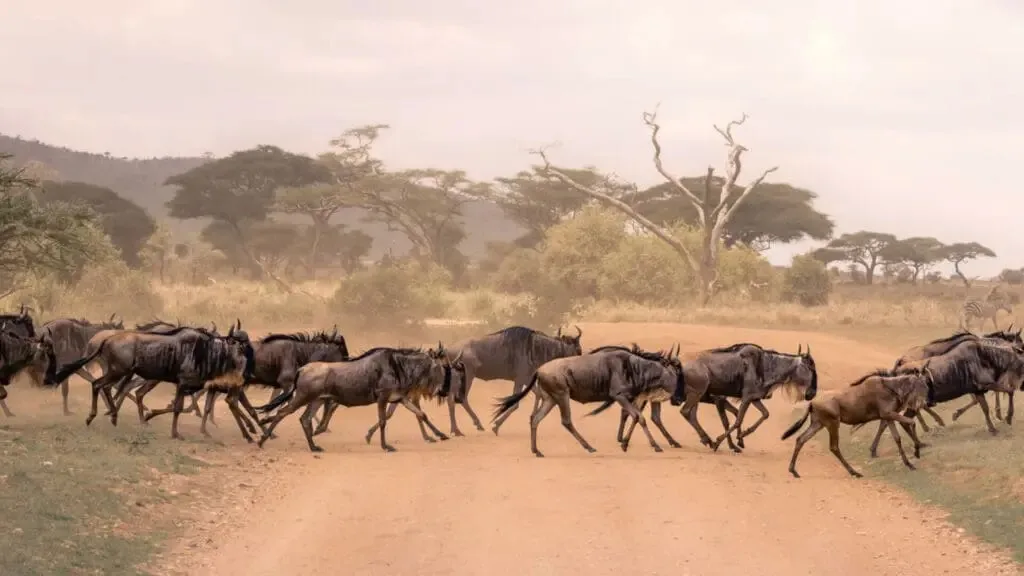
The Migration Calendar
Before any field tricks, you need the macro anchor: which sector to book. This is the historical baseline — useful for planning, but never a guarantee, because the rains shift it by weeks each year.
Months | Where the herds are | What’s happening |
Jan–Mar | Southern Ndutu plains | Calving — births, predators close behind |
Apr–May | Central Seronera, moving north and west | The long trek; the rut begins |
Jun–Jul | First river crossings, at the Grumeti | |
Jul–Oct | Northern Serengeti and the Masai Mara | The famous Mara crossings |
Nov–Dec | Lobo, then south toward Ndutu | The return run |
That’s the skeleton; the full month-by-month timeline puts flesh on it. The single biggest planning mistake is treating those rows as fixed dates rather than a moving average.
Serengeti vs Masai Mara
Here’s the part Tanzania-focused guides leave out: the migration is a trans-boundary loop, and for roughly July to October a big share of the herds is over the border in Kenya’s Maasai Mara National Reserve. If you ignore that, you can book the wrong country for your dates.
The herds don’t recognise the line. They first reach it at the Sand River, the watercourse marking the Tanzania–Kenya border, which is usually the first crossing point as they push north out of the northern Serengeti. From there they wander back and forth between the two countries for weeks — a herd can cross into the Mara one morning and swing back into Tanzania days later.
What changes is the rulebook. On the Tanzanian side you track with a TANAPA-licensed guide and stay on park tracks. The Mara is a different system — the reserve is run by Narok County (its western Mara Triangle by a separate conservancy), with its own daily fees, roughly USD 100 per person. The practical upshot for tracking: you can watch the same crossings from the Tanzanian bank around the Lamai Wedge and Kogatende without any Kenyan visa or border paperwork, or you can base in the Mara itself — but you can’t follow a single guide across the border in one vehicle. Decide which side you’re tracking from before you book.
What It Costs
A real, well-paced 5-Day/4-Night multi-destination safari for two sharing in a private 4×4, with the smaller stops (Tarangire, the Ngorongoro Crater) kept to a night each and two nights on the Serengeti’s mobile camps. Rates are non-resident USD per person, valid for the current seasons.
5-Day Double-Occupancy Safari Packages
Package Tier | 5-Day Rate (Per Person Sharing) | Camps: Tarangire / Crater / Serengeti |
USD 3,610 | Sangaiwe Tented Lodge / Karatu Simba Lodge / Osinon Tented Camp | |
Mid-Range Classic | USD 4,310 | Maramboi Tented Camp / Rhino Lodge / Chaka (Nyikani) Camp |
USD 5,260 | Lemala Mpingo Ridge / Ngorongoro Serena / Ubuntu Migration Camp | |
Luxury Plus Ultra | USD 8,100 | Sanctuary Swala Camp / andBeyond Crater Lodge / Olakira Migration Camp |
Optional add-on: a sunrise hot air balloon flight for USD 600 per person — and a balloon is one of the best ways to read the herds, giving you an aerial sense of where the columns are massing. TANAPA permit, launch, and a champagne bush breakfast included.
Want a tier adjusted to chase a specific phase of the herds? Send your dates through the safari booking form and our Arusha team will build it around you.
Related packages: 3-Day Serengeti Safari · 4-Day Serengeti Safari
What’s in the Price
Most of what you pay is just the cost of being there. The park takes the biggest slice. The daily conservation fees and the concession charge for every night you sleep inside the boundary are fixed government money, set by the Ministry of Natural Resources and Tourism, and there’s no haggling them down. The rest is what makes a private trip actually work: your own 4×4 with the fuel and a proper guide, every meal, cold water in the truck, your room on a shared-double basis, and the one-way bush flight back to Arusha at the end. The one inclusion nobody thinks to ask about, and everybody’s glad of, is AMREF Flying Doctors cover, so if something goes wrong out there, an evacuation is already arranged.
What you cover yourself is the predictable stuff: your international flights, the US$100 tourist visa, travel insurance, drinks at the bar, laundry, and tips for the guide and camp crews. None of it’s buried in fine print — it’s just the part that isn’t ours to bundle.
And if you like to see the raw maths, the fees behind the rate, per adult per day and with the 18% VAT already in: USD 82.60 to enter the Serengeti, USD 59–60 for a night’s lodge concession inside the park, and USD 35.40 for a public campsite if you’re going low-budget.
How Guides Find the Herds
Field Tracking Cue | Guide Interpretation & Action |
Online Live Maps | Use interactive digital plots from bush pilots and rangers solely for macro-planning. |
VHF Radio Cues | Monitor private regional radio networks for real-time, coded Swahili location updates. |
Dung Conditions | Moist, dark dung means herds are nearby; pale, baked dung means they left days ago. |
Dust & Vultures | Follow low, flat horizon dust for marching herds and circling vultures for kills. |
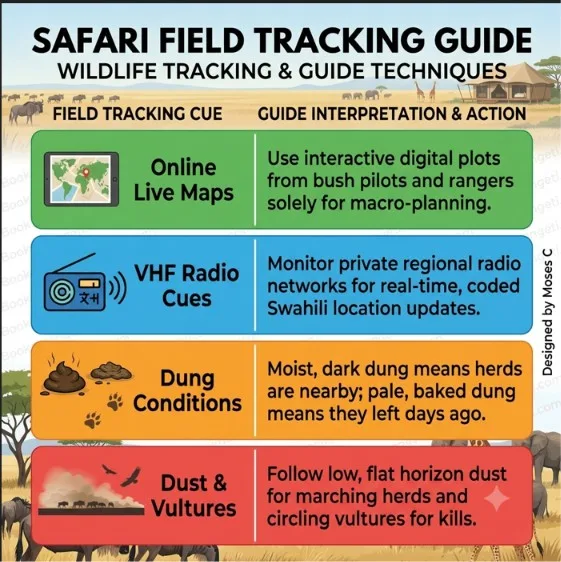
Tracking really happens in two stages: digital before you fly, human once you land.
Before the trip, use the free live migration maps online. They pull daily sightings from bush pilots, rangers and guides and plot them on an interactive map you can filter by sector and date, so six months out you can see roughly where the herds sit in your window and pick your base accordingly. Treat them as a planning aid, not gospel — they’re predictions built on past years, and one heavy storm can move the whole picture.
In the field, the apps die. Cell signal drops out past the main gates — Naabi Hill, Ikoma, Klein’s — so guides fall back on an unwritten VHF radio network tuned to regional frequencies that self-drivers can’t reach. They don’t broadcast a big sighting to everyone; a driver who finds a crossing or a kill will call a few trusted colleagues in coded Swahili, using landmarks rather than coordinates: “the third dead acacia past the rocky bend,” “the old ranger-post pool.” Without a guide plugged into that net, you simply don’t hear it.
Then there’s reading the ground itself. Moses, who’s guided here for over a decade, will tell you fresh dung is the most honest clock out there: dark and still moist means the column is over the next ridge; baked pale and grey means they moved through days ago. He reads the dust the same way — a tight, fast-spinning tower is usually a few zebra rolling in a wallow, while a low, flat haze of fine powder hanging across the horizon for miles is the herd itself on the march. Two more cues worth knowing: vultures spiralling down mark a kill or the aftermath of a crossing, so they’re worth driving toward; and the zebra often front the columns, because they crop the tall coarse grass first and the wildebeest follow for the shorter regrowth. Find the zebra and the gnu aren’t far behind.
Where Trackers Go Wrong
The mistakes that cost people the herds are rarely about luck:
- Locking a rigid route to a static map. The arrows are an average of past years, not a timetable. Leave your guide room to change the plan day to day.
- Booking the wrong sector for the month — chasing a river crossing in February, or calving in August. Match the sector to the calendar above first.
- Too few nights in one place. A single afternoon rarely delivers; give a sector three nights and let the herds come to the water and the grass.
- Self-driving without the radio net, then chasing every distant dust cloud — most of which is a wallowing elephant, not a million wildebeest.
And one ground hazard that strands the unwary: after an afternoon storm the low black-cotton tracks turn to grease in minutes. A guide who knows the ground pulls up onto the ridge lines and waits; the self-driver who pushes into a marshy confluence ends up axle-deep, waiting hours for a winch. Reading the weather is part of reading the herds.
Migration Tracking FAQ
How far ahead should I book to catch a specific phase?
For the calving (February) or the Mara crossings (August–September), six months to a year — the small camps in the right sector fill early, and you want to lock your dates while the good ones are open. Shoulder windows you can sometimes arrange closer in.
How far is it from Arusha to the tracking grounds?
About 335 km (208 miles) to Naabi Hill, and roughly 450 km (280 miles) on into the central Seronera valley or the northern rivers — all of it unpaved, which is why most trips break the drive or fly one leg.
Can you drive from Arusha to the Serengeti in a day?
You can, but it’s a hard 7 to 8 hours of gravel and we steer people away from it — you arrive worn out and skip the game in Tarangire and the Crater on the way.
How strict are the bush-flight baggage rules?
A firm 15 kg (33 lb), and soft bags only. A rigid roller case won’t bend through the small cargo hatch of a Cessna Caravan and gets turned away at the steps — pack a soft duffel you can squash by hand.
What happens if the rains come late?
The herds simply stay put in their current sector for a few extra weeks until fresh grass appears — they follow the grass, not a date. A good operator stays in contact with pilots and the tracking network and adjusts your daily drives, which is exactly why how many days you give it matters more than picking one “perfect” week.
Plan Your Tracking Safari
Tracking the migration well is half homework, half local knowledge: the live maps and the right sector before you fly, then a guide who reads dung, dust and the radio once you’re there. Get those right and you spend your mornings among the herds instead of hunting for them. Tell our Arusha team your dates and travel style through the safari booking form, and if you’re still settling on timing, the best time to visit sets it all against the seasons. You can plan the whole thing on BookSerengeti.com, with a field team that actually knows where the herds are this week.
Editorial & Fact Check Validation Reviewed by Moses C. – Veteran Wildlife Safari Guide & Operations Manager at BookSerengeti.com.
Welcome to bookserengeti.com
Thank you for visiting us! We're excited to help you plan an unforgettable safari adventure across Kenya.
Latest Safari Posts
Serengeti Migration Safari Packages: 2026/2027 Cost & Itinerary Guide
Serengeti Wildlife Safari Packages: 2026/2027 Price, Big Five & Routes
Serengeti Group Joining Safari Package: 2026/2027 Price & Route Guide