The Wildebeest Migration Timeline, Month by Month
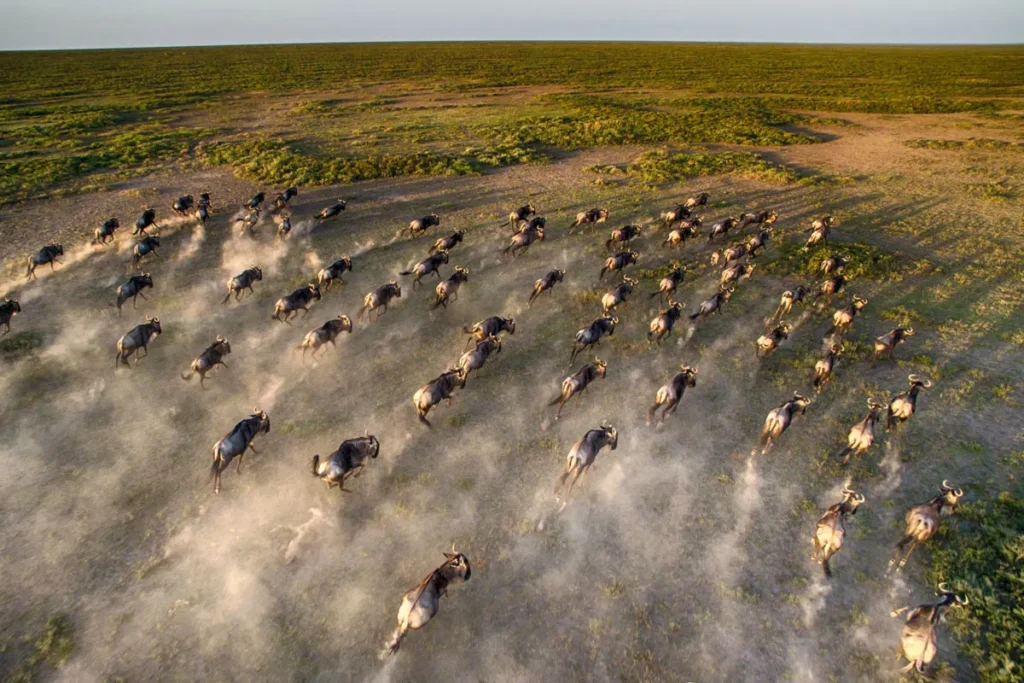
Summary: The annual wildebeest migration timeline is not a train schedule. It is a constant, rain-driven hunt for fresh grass that loops nearly 1,000 km across East Africa. Tracking it means lining up your travel month with the area holding the herds at that time — from the southern calving plains early in the year to the northern river crossings in the dry months. For a well-planned 5-day double-occupancy package that follows those movements and includes a domestic fly-back, realistic non-resident prices run between USD 3,610 and USD 7,710 per person sharing.
Trying to pin the wildebeest migration calender to a fixed calendar is the most common mistake travelers make. Here is the thing: the wildebeest don’t read calendars. They follow the rain. If the downpours skip a region, the herds skip it too — so treat the dates below as a strong guide, not a timetable.
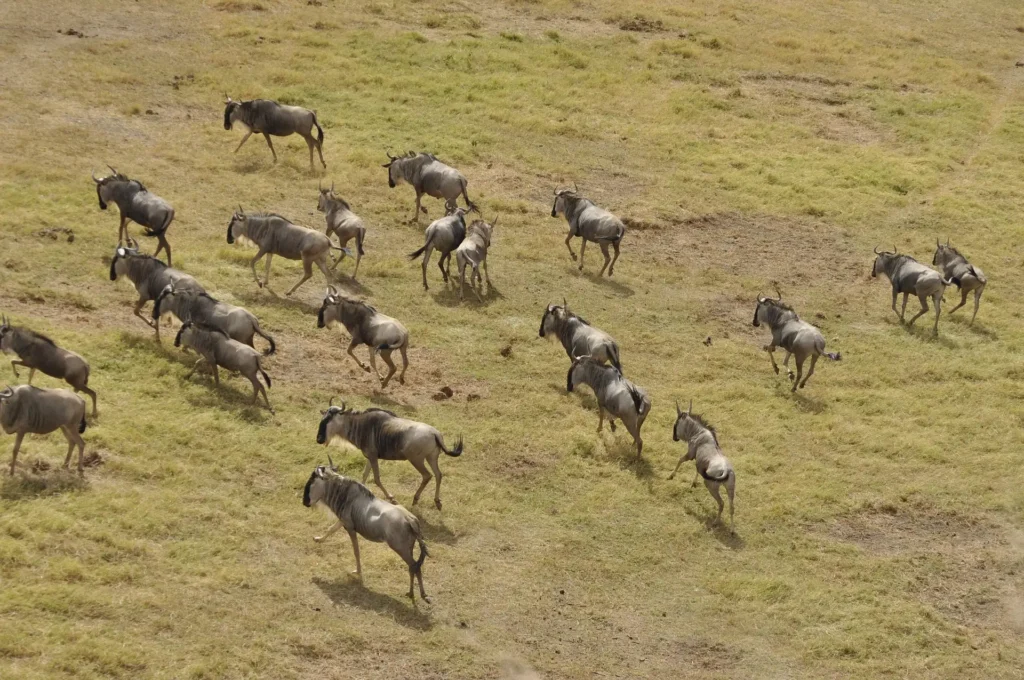
Over 1.5 million wildebeest, plus a few hundred thousand zebra and gazelle, move in a rough 1,000 km loop that never really stops. What you actually plan around is which area holds the herds in a given month, and how patient you are willing to be. Temper your expectations on that patience: people have sat by a river for four days and seen nothing, while others pulled up and caught a crossing inside fifteen minutes. And at the famous crossing points in peak season, you are sharing the bank with dozens of other vehicles — it is rawer, dustier, and more crowded than the documentaries suggest.
Two ground rules before the calendar, then. Learn how to plan a Serengeti safari around the herds rather than a postcard date, and skim how the migration cycle works so the monthly movements below make sense. Money first, then the months.
What a 5-Day Serengeti Safari Actually Costs
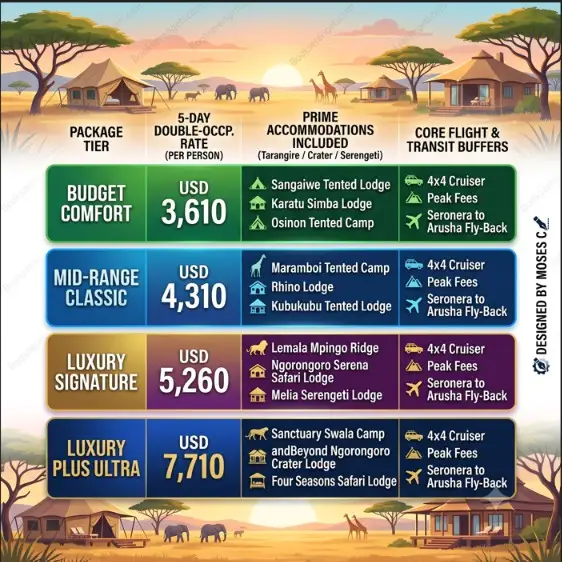
Rough numbers first, since that is what everyone wants: a budget-comfort version runs about $3,610 a head, and going all-out — Four Seasons, andBeyond’s Crater Lodge — lands closer to $7,710. The table below shows a realistic 5-Day/4-Night multi-destination trip for two sharing. We keep the smaller loops — Tarangire, the Ngorongoro Crater — to one night each to avoid driving fatigue, leaving a solid two nights on the main Serengeti tracking routes. Rates are non-resident USD per person, valid for the current seasons.
Package Tier | 5-Day Double-Occp. Rate (Per Person) | Prime Accommodations Included (Tarangire / Crater / Serengeti) | Core Flight & Transit Buffers |
USD 3,610 | Sangaiwe Tented Lodge / Karatu Simba Lodge / Osinon Tented Camp | 4×4 Cruiser, Peak Fees, Seronera to Arusha Fly-Back | |
Mid-Range Classic | USD 4,310 | Maramboi Tented Camp / Rhino Lodge / Kubukubu Tented Lodge | 4×4 Cruiser, Peak Fees, Seronera to Arusha Fly-Back |
USD 5,260 | Lemala Mpingo Ridge / Ngorongoro Serena Safari Lodge / Melia Serengeti Lodge | 4×4 Cruiser, Peak Fees, Seronera to Arusha Fly-Back | |
Luxury Plus Ultra | USD 7,710 | Sanctuary Swala Camp / andBeyond Ngorongoro Crater Lodge / Four Seasons Safari Lodge | 4×4 Cruiser, Peak Fees, Seronera to Arusha Fly-Back |
Optional Experience Add-on: You can add a sunrise hot air balloon flight over the central plains to any of these for USD 600 per person — TANAPA flight permit, launch, and a champagne bush breakfast after landing included.
If you want custom dates, or want to swap individual properties to target a specific stage of the herd track, talk to our Arusha office through the Tailored Serengeti Itinerary Planner.
Related packages: 3-Day Serengeti Safari · 4-Day Serengeti Safari
What’s Included in Our Rates
Here is what sits inside our base tour rates, and what you pay for separately at the gates.
What is Always Covered:
- All updated TANAPA daily conservation entry permits and destination taxes.
- Private use of a customized 4×4 safari land cruiser with heavy-duty suspension, large windows, and an open canvas roof hatch.
- Full fuel allowances and the daily professional services of an authorized local guide.
- Mandatory government concession fees for every overnight stay inside the park parameters.
- Emergency medical evacuation cover through the regional AMREF Flying Doctors network.
- All specified daily meals, cold mineral water kept in the vehicle’s fridge, and double-occupancy room costs.
- One-way regional flight tickets on domestic operators like Coastal Aviation, Auric Air, Regional Air, or Flightlink from a bush airstrip back to Arusha (with operator buffers and bag fees handled).
What is Excluded:
- International flights and your official entry tourist visa ($100 for US citizens).
- Discretionary tips for your guide and individual camp hospitality teams.
- Personal laundry services, premium alcoholic drinks at bars, and independent medical travel insurance policies.
The Government Fees (Per Adult, Per Day)
The park charges these per adult, per 24 hours, VAT included. They are the same whatever the season, which is why your length of stay drives the budget:
- Serengeti Conservation Entry Fee: USD 82.60 per adult / day.
- Inner-Park Lodge Concession Fee: USD 59.00 to USD 60.00 per adult / night.
- Public Campsite Fee (If budgeting): USD 35.40 per adult / night.
Month-by-Month: Where the Herds Are
The Southern Calving Ground (January to March)
Early in the year the herds bunch up on the short-grass volcanic plains between the southern Serengeti and the Ndutu area of the Ngorongoro Conservation Area. There is a reason they pick this exact spot: volcanic ash blown off the Ngorongoro highlands has enriched the soil, and the short grass that grows here is unusually rich in the calcium and minerals a pregnant wildebeest needs. In January they settle roughly between Naabi Hill, the Gol Kopjes, and Lake Ndutu.
At the February peak, somewhere around 8,000 calves are dropped a day — an operator’s estimate rather than a hard census, but the scale is real, and so is what follows. Wildebeest give birth standing up, and the calves are on their feet and running within minutes, because the alternative is the lion prides, cheetahs, and hyenas working the edges of the plain. It is the most concentrated predator action of the whole year. You also get every other baby animal at once — zebra foals, gazelle fawns, warthog piglets, wobbly giraffes — all timed to the green flush.
Two practical things the glossy guides skip. First, this is one of the few parts of the Serengeti where off-road driving is allowed (in designated Ndutu areas), so a good guide can position you for light and angles you simply cannot get in the north — a gift for photographers. Second, because calving is about staying put rather than moving, February is actually more reliable to plan around than the famous crossing months. One catch: the balloon doesn’t fly over Ndutu — only the central Serengeti, a 90-minute pre-dawn transfer away — and the heavy March-into-April rains can turn the Ndutu tracks to soup, which is the window to avoid. If you are weighing this against other seasons, the best time to visit breaks it down.
The Move North (April to May)
As the southern grass burns off at the end of the long rains, the herds string into single-file columns that run for miles, pushing northwest through the central plains between the Moru Kopjes and the Seronera valley. This is the green shoulder season: you might cop a twenty-minute afternoon downpour, but the country turns emerald, the crowds thin out, and lodge rates drop.
It is also when the calves face their first water. The Mbalageti River, in the western reaches, is often the first river the young have to cross — an early endurance test most timelines never mention. And from mid-May the rut kicks in: males clash horns and carve out territory while the columns keep moving, a noisy, dusty spectacle that runs into early July.
The Western Corridor (June to July)
By June the herds press into the narrow Western Corridor toward their first real barrier, the Grumeti River. At the end of May the “mega-columns” pour in, and the pressure on the banks peaks in the first days of June.
Here is the honest part nobody puts in a brochure: the Grumeti crossing can be a non-event. In a dry year the river shrinks to disconnected pools, and the wildebeest simply walk across on dry ground without ever meeting a crocodile. When it does run, though, it is a very different show from the Mara — the banks are wooded, so the herds burst out of the trees straight into the water in a sudden reveal, and you are close enough to shoot it on a wide lens instead of a long one. The trade-off everyone loves: where a Mara crossing can draw 30 to 80 vehicles, the Grumeti’s banks see a handful, and inside the private concessions you might be one of two or three cars at the water. Inside the national park, Kirawira and Ndabaka are the main public spots to watch the herds gather. The western forests also hide black-and-white colobus monkeys you won’t find on the open plains. And if you are based in the centre, it is only about 50 km from Seronera, so the Grumeti works as a long day trip rather than a full relocation.
The Northern River Crossings (August to October)
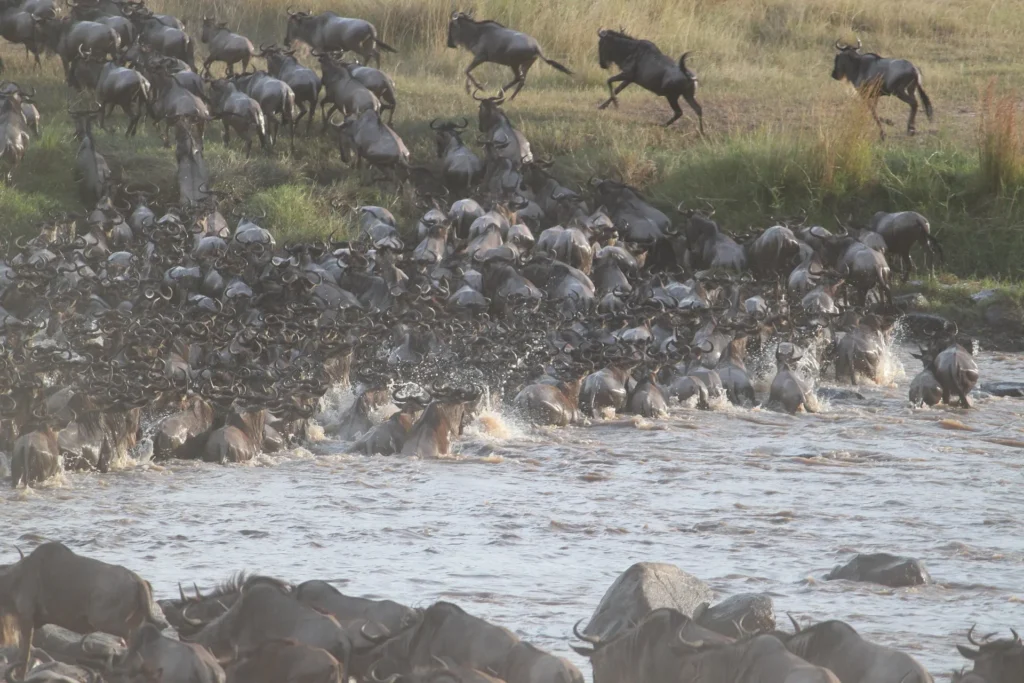
This is the phase the world pictures. The survivors push into the northern Serengeti around Kogatende and the Lamai Wedge to face the Mara River. Kogatende is the practical base — main airstrip, most camps, fastest access to several crossing points. The Lamai Wedge, a triangle of land sealed off from the rest of the park by the river and reachable only over one tiny seasonal bridge, is the quieter, pricier, more private alternative.
A few realities from people who have actually sat on those banks. Crossings tend to happen in the morning, once the herds are active after a night’s rest, which is why north camps run 5:30–6:00 AM drives with packed breakfasts. The danger is not mainly the crocodiles — though the big ones top five metres and have fasted for months — it is the water itself: more animals drown or are crushed on the steep, greasy banks, which work like a slide with no grip. Watch the zebra, too; they swim far better than wildebeest, break the current with their legs, and will form a circle to kick at a crocodile, while a panicking wildebeest tends to drown.
The biggest misconception is direction. The herds cross north one day and back south a few days later, for no obvious reason, and a second big crossing often comes in late October as they start heading home — so a large share of the action stays on the Tanzanian side, and you do not need to cross into Kenya to see it. Guides reference specific numbered and named crossing points along the river, but which one fires on a given day is anyone’s guess. Two field tips worth their weight: don’t choose a northern camp by its distance to the river on a map — ask where the guide can actually drive at sunrise and how wide the game-drive radius is; and remember the resident game is superb regardless, with lion prides up to thirty strong around the Wogakuria area on a blank crossing day. If you want fewer vehicles, the mid-to-late-October return through Kogatende can be remarkably quiet — travelers have had a morning at the river with barely ten other cars.
Heading Back South (November to December)
The short rains green up the southern plains, and the herds turn for home, drifting down through the north-east and the Lobo woodlands toward Ndutu to start the cycle again. It is a low-key, low-crowd window with good resident game and excellent birding as migrant species arrive. One quiet gem to know about: Namiri Plains, in the eastern Serengeti, was closed to tourism from 1985 to 2014 for a cheetah-research project, and from late October the migration drifts through it — a migration-adjacent option with almost no crowds.
Which Airstrip for Which Month
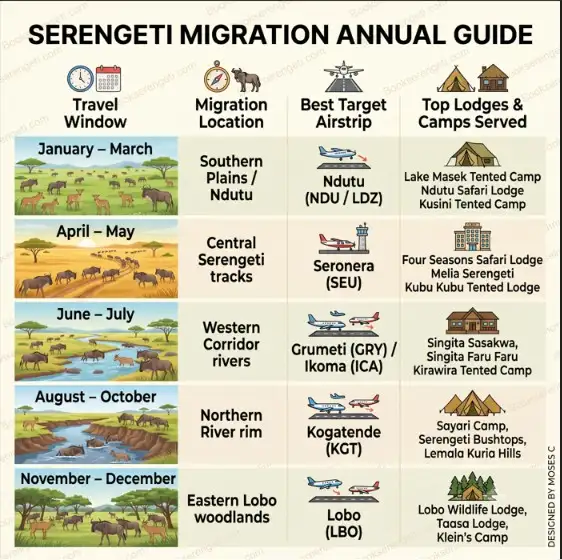
If you are flying between stages, match your landing strip to the area holding the herds that month. A booking quirk to watch: the ticket codes shift between carriers — Seronera is SEU, Sasakwa SSK, Lobo LOB, Ndutu LDZ, and Kogatende shows up as both KOG and ULX. (For the full rundown of bush strips, see the airstrips guide.)
Travel Window | Migration Location | Best Target Airstrip | Top Lodges & Camps Served |
January – March | Southern Plains / Ndutu | Ndutu (NDU / LDZ) | Lake Masek Tented Camp, Ndutu Safari Lodge, Kusini Tented Camp |
April – May | Central Serengeti tracks | Seronera (SEU) | Four Seasons Safari Lodge, Melia Serengeti, Kubu Kubu Tented Lodge |
June – July | Western Corridor rivers | Grumeti (GRY) / Ikoma (ICA) | Singita Sasakwa, Singita Faru Faru, Kirawira Tented Camp |
August – October | Northern Mara River rim | Kogatende (KGT) | Sayari Camp, Serengeti Bushtops, Lemala Kuria Hills |
November – December | Eastern Lobo woodlands | Lobo (LBO) | Lobo Wildlife Lodge, Taasa Lodge, Klein’s Camp |
Flying Into the Bush
Here is a reality check about flying out here: your plane is basically a hop-on, hop-off commuter bus with wings. If the pilot’s clipboard says someone needs to get off at a dirt strip along the way, you are landing. First-timers board in Zanzibar or Arusha expecting a direct hop and get rattled when the little Cessna Caravan touches down three times before their strip. It is normal. It flies even for one passenger.
Direct from Arusha (ARK) is about 45 to 60 minutes; straight from Kilimanjaro (JRO), about 75. From Zanzibar (ZNZ) a morning flight runs around two hours, but it can stretch past 3.5 if there is a fuel stop or an aircraft swap in Arusha. Standalone one-way legs generally run USD 350 to USD 600 per person. Because you skip the road park gates, your operator has to pre-pay your permits through the government ledger in advance — I have seen a self-booked traveler lose a whole morning under a runway shade structure while a ranger tried to clear control numbers his agent never arranged. Get yours sorted before the wheels leave the tarmac. (Getting there covers the hub-by-hub options.)
Baggage: What Actually Flies
Every site repeats the same line — “15kg, soft bags only, strictly enforced.” Talk to anyone who flies these routes, though, and the truth is looser. There are no scales out on a grass clearing at Kogatende or Ndutu; the rep ticks your name off a list and the pilot hefts your bag by hand.
The real limit is shape, not a few extra pounds. The cargo pods under a Caravan are tight, awkward spaces with small metal doors, and a rigid roller case with a fixed frame won’t bend through. I have watched people tip their clothes into loose piles on the dirt because the suitcase physically would not go in. A slightly heavy soft duffel beats a light hard case every time.
Carrying camera gear? Look at the “freight seat” trick — airlines like Regional Air will sell you an extra cabin seat, which buys your party roughly 75 kg (165 lbs) of space right beside you. You can also wear a photographer’s vest and load the heavy battery bricks and lenses onto your body before you climb the stairs; the crew won’t weigh what you have on. One genuine rule, not a suggestion: don’t pack single-use plastic carrier bags as clothing liners — Tanzania bans them nationwide and they get confiscated. (The packing list has the rest.)
What Happens When You Book the Wrong Month
A couple of seasons back I ran into a self-booked group up north in April. Total disaster. In April the herds are way south near the Moru Kopjes, but they had booked a gorgeous lodge on the northern Mara River anyway, because they figured the park was the same everywhere. It isn’t.
So every morning their driver tried to force a five-hour push south to find animals. One afternoon a downpour caught them out, the black-cotton clay turned to grease, and the Land Cruiser slid off the track and sank to its axles. They spent the whole night stuck in the dark, listening to a lion pride move through the wet grass past the bumper, no cell signal, nobody coming. They lost two days and missed the calving entirely. Don’t let that be you — book the month to the region, not the other way round.
How Long to Stay
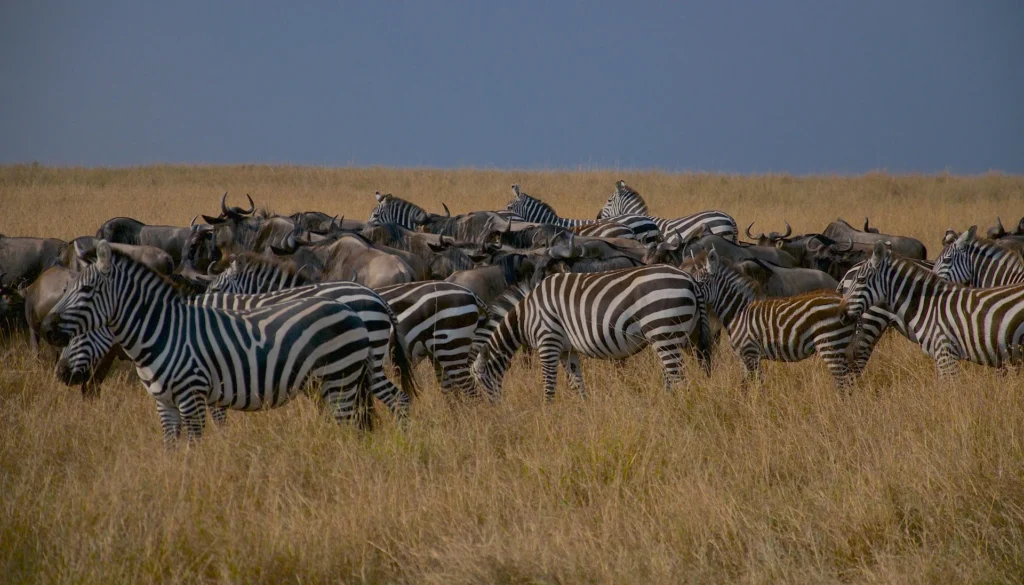
Photographers: give yourself 4 to 5 nights in the migration zone. A herd can stand on a bank for two days before it crosses, so multiple mornings at the same spot is how you afford to be patient and wait for the light. Pack a lens blower and a solid dust-proof dry bag.
Families with young kids: keep it to 2 nights inside the park and seriously consider flying in. The 7-hour overland grind from Arusha wears out kids under ten fast — stick to the central Seronera loops where drives are short and the cat action holds their attention. (The how-many-days guide goes deeper.)
Honeymooners and luxury travelers: 3 or 4 nights, split between a mobile camp that shifts through the year to stay near the herds and a permanent lodge on a high escarpment — raw canvas one night, romantic comfort the next.
Whatever the style, the north rewards staying put. Three nights is the practical minimum during crossing season, because it gives your guide time to read the herds — the dust, the tension on the bank, the crocodile positions, the radio chatter from other drivers — instead of gambling everything on one rushed morning.
Migration Planning FAQ
Will I definitely see a river crossing?
No, and be wary of anyone who promises it. Crossings are unscheduled and weather-driven; some people wait days, others get lucky in minutes. The way to stack the odds is to be in the right area for the month and to stay at least three nights so you are not betting on a single drive.
How far in advance should I book?
For the July-to-October northern crossings, as early as you can — the north strictly caps the number of camps, so the good ones go 6 to 12 months out. Calving camps in Ndutu also fill fast because accommodation there is limited.
What is the actual distance from Arusha to the Serengeti?
Roughly 335 km (208 miles) to the southern gate at Naabi Hill. If you drive on through the park tracks to the central Seronera lodges, it stretches to about 450 km (280 miles) of unpaved travel.
Can you drive from Arusha to the Serengeti in one day?
Yes, but it is 7 to 8 hours of hard travel on gravel corrugations, which is why we steer people away from it — you miss Tarangire and the Ngorongoro Crater on the way, and arrive too tired for an evening drive.
What are the names of the campsites around the central tracks?
The public TANAPA sites near the central valley are named for local animals: Pimbi (hyrax), Tumbili (vervet monkey), Nyani (baboon), Nguchiro (mongoose). They have basic shared restrooms; the private “special campsites” have nothing at all — a clearing in the wild where you bring your own water and supplies.
What happens if the seasonal rains are late?
The herds simply stall and graze where they are for a few extra weeks until the new grass comes up down the line. No one can call exact rainfall, which is why a good operator stays in constant radio contact with bush pilots and trackers to adjust your daily routes and find the herds anyway. (How to track the migration explains the tools.)
Secure Your Expert Field Guide Today
A good migration safari comes down to local knowledge, realistic drive times, and a feel for where the herds actually are this week. Skip the automated platforms that don’t understand the distances or the track conditions. Talk to our Arusha office through the Tailored Serengeti Itinerary Planner to check vehicle openings and lock in your field team for the season.
Reviewed by Moses C. – Veteran Wildlife Safari Guide & Operations Manager at BookSerengeti.com
Welcome to bookserengeti.com
Thank you for visiting us! We're excited to help you plan an unforgettable safari adventure across Kenya.
Latest Safari Posts
Serengeti Migration Safari Packages: 2026/2027 Cost & Itinerary Guide
Serengeti Wildlife Safari Packages: 2026/2027 Price, Big Five & Routes
Serengeti Group Joining Safari Package: 2026/2027 Price & Route Guide