Walking Safaris in the Serengeti: On Foot in the Wilderness Zones
Summary: A walking safari in the Serengeti takes you out of the vehicle and onto the ground, on foot behind an armed ranger, through the park’s “wilderness zones” that no car is allowed to enter. It’s the oldest and most intense way to experience the plains: you stop chasing big game and start reading tracks, plants and birds, often for days without seeing another soul. It ranges from a short lodge stroll to a full camp-to-camp trek, and the multi-day version is a bespoke, premium trip.
Most of the Serengeti never sees a vehicle. Only about 30 percent of the park is open to cars; the rest is set aside as wilderness, and the only way into it is on foot. That’s what a walking safari really offers, not just a novelty stroll, but access to huge, untouched country where you can walk for days and not meet another person. Here’s how it works and how to choose the right version.
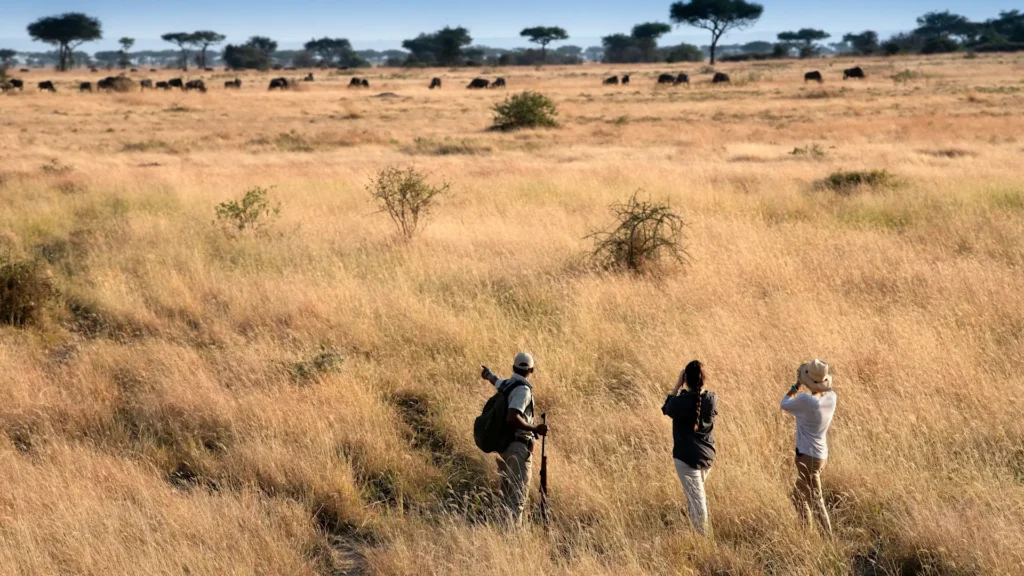
What a Walking Safari Actually Is
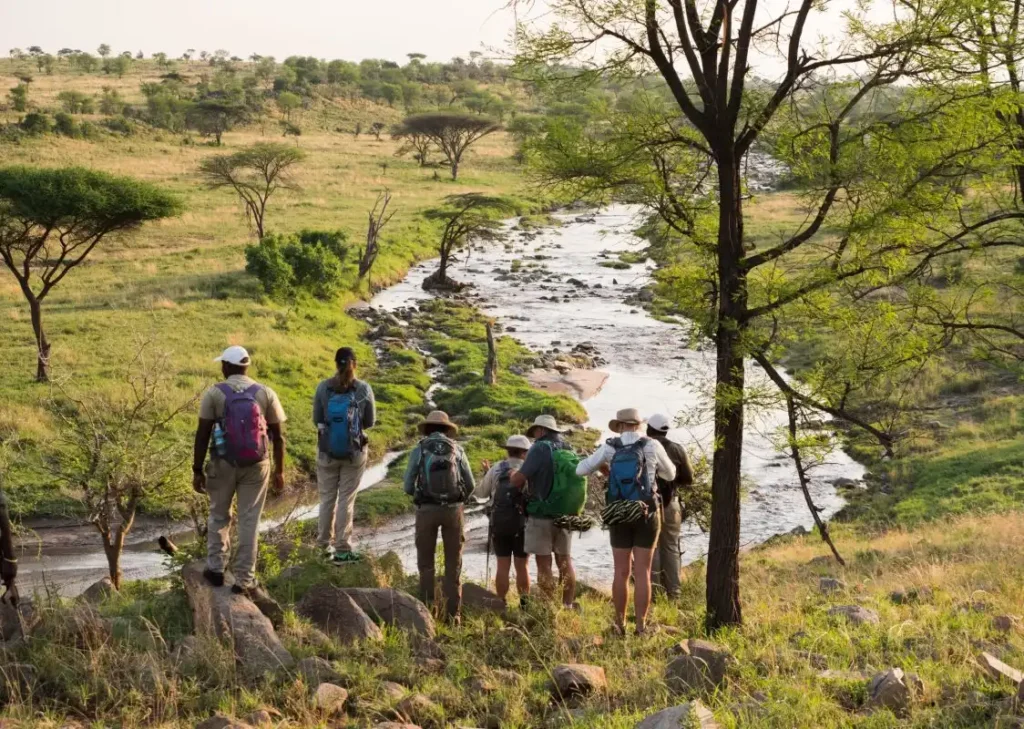
You walk in a small group, single file, with two people looking after you: a specialist walking guide and an armed ranger from TANAPA. Both know the bush cold, and the ranger’s rifle is a last resort that almost never comes into play.
Here’s the thing people don’t expect: the animals give you a wide berth. Generations of wariness mean wildlife treats a person on foot very differently from a vehicle, keeping its distance rather than closing in. So a walk isn’t about creeping up on lions. It’s about the small things you’d never notice from a car, fresh tracks, which plant the Maasai use for medicine, a dung beetle at work, the alarm call that tells you a predator moved through. You cover perhaps 10 kilometres in a morning, out early before the heat, and you’re usually back in camp by lunch. Guests often describe slipping into an almost meditative state after a day or two of it.
The Three Kinds of Walking Safari
The word “walk” covers three quite different experiences, and it helps to know which you’re booking:
- A lodge nature walk. Many permanent camps offer a short guided stroll, roughly 45 minutes to a couple of hours, in the immediate area with a guide and ranger. It’s a taste of being on foot rather than a trek, and it’s the gentle option for a half-day or for families.
- Walks from a base camp. A specialist walking camp sends you out for two to four hours each morning, radiating from a fixed camp you return to for lunch and an afternoon rest. You cover real wilderness without having to move your bed each night.
- A full fly-camping expedition. The deep version: you trek from one lightweight camp to the next, day after day, while the crew packs up and moves ahead of you. This camp-to-camp immersion is what the walking specialists built their name on, and it’s sold as a bespoke, premium trip rather than a fixed nightly rate.
A Sample Multi-Day Route
Day | Route & Core Experience |
Day 1 | Arrival, orientation loop, and rock sundowners. |
Day 2 | Floodplain trek to Lobo rocks for elephant tracking. |
Day 3 | Foothill hike to Buffalo Camp with panoramic views. |
Day 4 | Westward woodland walk alongside migrating herds. |
Day 5 | Bologonja River tracking and departure flight. |
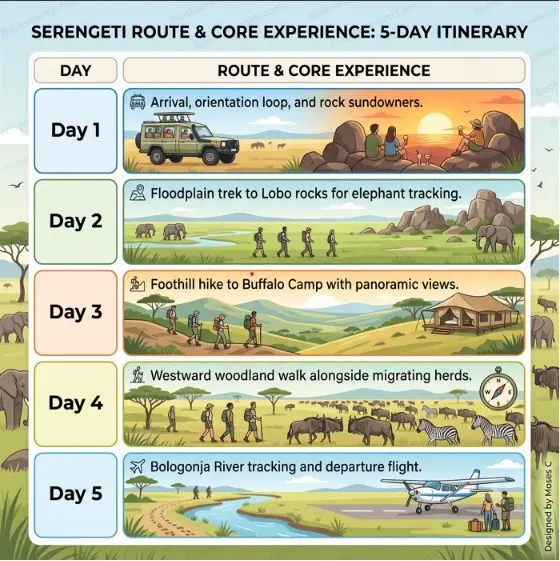
Multi-day walks are planned around where the herds are, so no two are identical, but here’s how a real northern circuit unfolds:
- Day 1. Fly into the Serengeti and transfer to the first mobile camp for lunch, then an easy afternoon loop to set the group’s pace and learn the guide’s hand signals, ending with sundowners on a rock.
- Day 2. A full morning across the drying flood plains toward the Lobo rocks, where the woodland thickens and elephant herds gather. Camp is pitched under big fig trees while you rest through the midday heat.
- Day 3. Walk around the north of Lobo onto the foothills to a site the crew call Buffalo Camp, with views over the whole northern Serengeti. The camp has leap-frogged ahead of you and is standing by the time you arrive.
- Day 4. Turn west into the woodlands, often thick with migrating herds, and camp on a ridge line above the plains.
- Day 5. Follow the drainage lines down to the Bologonja River for a last morning of birding and big-game tracking, then a game drive to the airstrip for the flight out.
Your actual route is usually set only a week or two before departure, once the guides know where the migration has got to.
The Operators, and the Zones
Only a handful of outfitters are licensed to run these deep-zone walks, which is part of why they stay so quiet.
Wayo Africa is the pioneer, founded in 1999 by Jean Du Plessis under the slogan “Touch the Earth,” and now part of the Wilderness group. Its mobile walking camp moves through the Serengeti’s wilderness zones with seven “star tents”, gauze-walled so you fall asleep looking up at the sky, and it can reach corners of the park most tourists never see. Asilia runs a seasonal walking-and-fly-camping route from December to March that finishes at Namiri Plains, the old big-cat research area famous for its cheetahs, with a minimum age of 16. Alex Walker’s Serian does fly-camping walks with Hadzabe guides whose families have tracked this land for generations.
All of them work the designated wilderness and rhino-protection zones, off-limits to vehicles, where the sense of having the place to yourself is the whole point. On any of them you’ll need a private vehicle in the package too, for rest days and for reaching the start points.
When to Walk Where
Walking works year-round because every part of the park holds resident game, but the zone shifts with the season:
- Central Serengeti (the Kilimafedha wilderness zone near Banagi) walks well all year, with resident wildlife around the Seronera water.
- The south, around the Wayo Green Camp near Ndutu, is best December to March, when the calving herds fill the short-grass plains.
- The north, the Lobo and Bologonja country, comes into its own July to October, when the migration is up there and you can track it on foot.
Matching the walk to the right months is worth doing carefully.
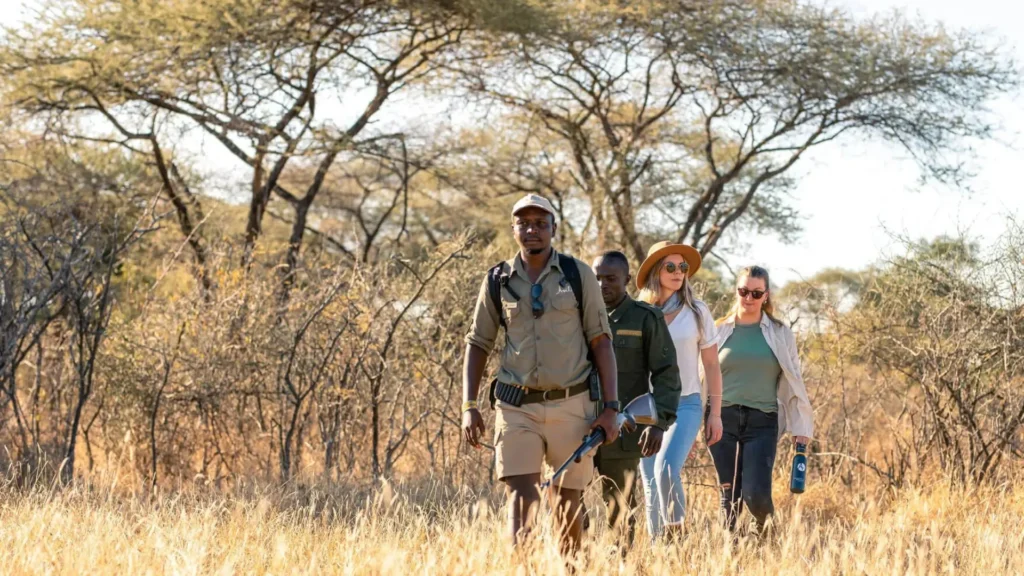
What to Bring, and the Rules
A walking safari asks a bit more of your kit and your discipline than a game drive:
- Boots you’ve already broken in. The ground is uneven and rocky in places, and the whistling-thorn acacia drops long, hard spines that go straight through a thin sole, so a sturdy high-ankle boot, a Danner or Salomon type, beats a trainer.
- Neutral colours, tan and olive; never bright white, and never the dark blue or black that draws tsetse flies.
- Long trousers and a light long-sleeved top for the thorns and the cool early start.
- Walk single file, keep your voice down, and learn the guide’s hand signals before you set off.
- If an animal takes notice of the group, the rule is simple and absolute: do exactly what your guide says, hold still, and never run, because running is what triggers a chase.
On age, operators differ: Asilia sets 16 for its expeditions, while Wayo will take adventurous children from around 8 on gentler walks. The packing list covers the rest of the kit.
What a Trip Costs
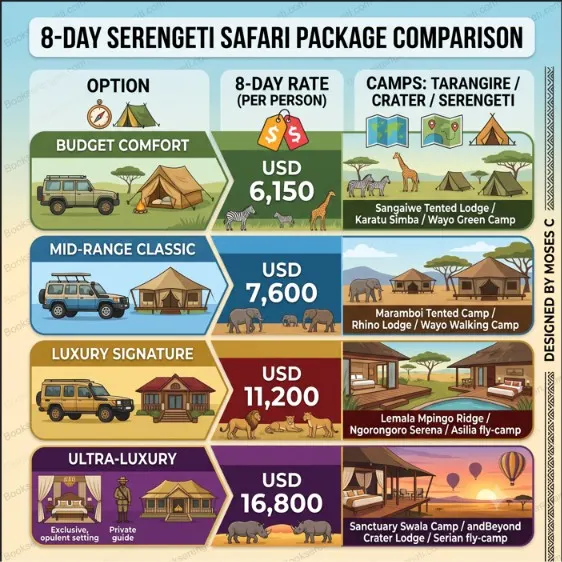
A walking safari is usually built into a wider trip, with a night or two on foot inside a broader route. This 8-Day/7-Night example is for two travelling together, non-resident USD per person, valid across 2026/2027, with the walking leg in the Serengeti.
An 8-day trip, two people sharing
Option | 8-day rate (per person) | Camps: Tarangire / Crater / Serengeti |
USD 6,150 | Sangaiwe Tented Lodge / Karatu Simba / Wayo Green Camp | |
Mid-Range Classic | USD 7,600 | Maramboi Tented Camp / Rhino Lodge / Wayo Walking Camp |
USD 11,200 | Lemala Mpingo Ridge / Ngorongoro Serena / Asilia fly-camp | |
Ultra-Luxury | USD 16,800 | Sanctuary Swala Camp / andBeyond Crater Lodge / Serian fly-camp |
Here’s what that rate covers:
- The private 4×4 and guide for the drive days, plus the specialist walking guide and armed ranger for the trek.
- All park permits, set by the MNRT and collected by TANAPA, with the NCAA covering Ngorongoro.
- The mobile fly-camp, all meals, drinking water, and your lodging on the drive nights.
- The one-way flight from the Seronera airstrip back to Arusha on a carrier like Coastal Aviation.
And what it doesn’t:
- Your international flights and visa ($100 on a US passport).
- Optional extras like a balloon flight.
- Tips (there’s a what-to-tip guide), drinks and laundry.
To build a walking leg into a route, tell me your dates.
Common Questions
Is walking among lions and buffalo actually safe?
It’s far safer than it sounds, as long as you follow the guide. You’re with an experienced walking guide and an armed ranger, you keep your distance, and the animals keep theirs, because wildlife is genuinely wary of people on foot. The real discipline is simple: stay in line, stay quiet, and never run.
How far will I walk in a day?
Around 10 kilometres on a full morning, at an easy pace with plenty of stops, and it’s adjustable to the group. The Serengeti is mostly flat, so it’s the heat rather than the terrain that sets the limit, which is why you walk early and rest through midday.
Is there a minimum age?
It depends on the operator. Asilia’s fly-camping expeditions require age 16, while Wayo will take adventurous children from around eight on shorter, gentler walks. For younger kids, a lodge nature walk is the better fit.
What happens if an animal charges?
Your guide is trained for exactly this and will tell you what to do in the pre-walk briefing. The universal rule is to stand your ground and never run, running turns you into prey, and to follow the guide’s instructions instantly. It very rarely comes to that.
Plan Your Walking Safari
The best walking trips pair a night or two on foot with the comfort of a vehicle for the rest, timed to put you in the right wilderness zone for the season. Settle roughly how many days you have and what the wider trip costs, and I’ll shape the walk into it.
When you’ve got rough dates and a group size, the quote page is the place to start, and we’ll route the trek through the quietest country I can find you.
Editorial & Fact Check Validation Written by Moses C. – Veteran Wildlife Safari Guide & Operations Manager at BookSerengeti.com.
Welcome to bookserengeti.com
Thank you for visiting us! We're excited to help you plan an unforgettable safari adventure across Kenya.
Latest Safari Posts
Serengeti Migration Safari Packages: 2026/2027 Cost & Itinerary Guide
Serengeti Wildlife Safari Packages: 2026/2027 Price, Big Five & Routes
Serengeti Group Joining Safari Package: 2026/2027 Price & Route Guide