Family-Friendly Lodges in the Serengeti: Which One Suits Your Kids
Summary: The right family-friendly lodge in the Serengeti depends less on luxury than on your children’s ages and a fenced-versus-unfenced choice: big resort-style lodges give toddlers a fence and a kids’ club, while intimate canvas camps put the wild right outside the tent and set minimum ages for safety. The bigger decision, though, is a private vehicle, which is the single thing that makes a family safari work. For an 8-day private family trip with vehicle costs and a fly-back flight, rates run from about USD 5,950 to USD 21,500 per person sharing.
Taking children onto the plains is one of the best gifts you can give them, watching a seven-year-old’s face when an elephant fills the window is worth the airfare on its own. But a family safari lives or dies on planning, and the mistakes are easy to make. Pick a lodge that’s beautiful but three hours from the wildlife and your kids spend the trip melting down in a hot vehicle. So the choice of where to stay, and how you drive, matters more for a family than for anyone else.
The One Thing That Matters Most
Before the lodges, the single most important decision: book a private vehicle, not a shared seat-in-vehicle. It’s the difference between a good family trip and a miserable one.
With your own 4×4 you stop when a child needs the loo, head back to camp the moment someone’s had enough, and go at your family’s pace rather than a stranger’s. It also quietly solves another problem: many camps set a minimum age for their own shared vehicles, but on a private safari those limits fall away, because you’re not sharing with other guests. If you take one piece of advice from this page, take that one.
The Best Family Lodges, Compared
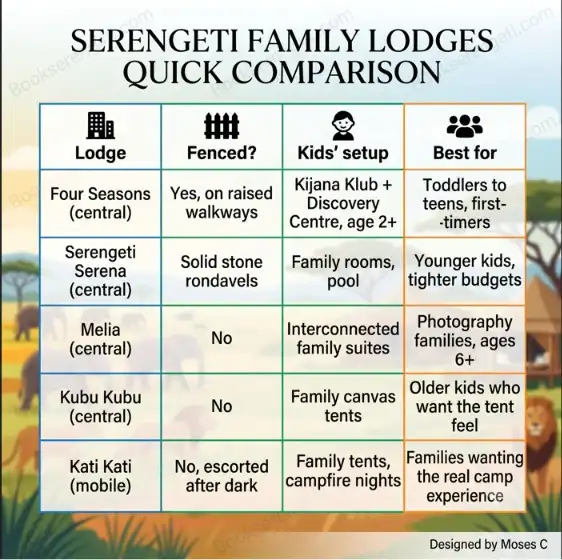
Your meta-level choice is fenced resort versus unfenced camp. Here’s how the main family options stack up:
Lodge | Fenced? | Kids’ setup | Best for |
Four Seasons (central) | Yes, on raised walkways | Kijana Klub + Discovery Centre, age 2+ | Toddlers to teens, first-timers |
Serengeti Serena (central) | Solid stone rondavels | Family rooms, pool | Younger kids, tighter budgets |
Melia (central) | No | Interconnected family suites | Photography families, ages 6+ |
Kubu Kubu (central) | No | Family canvas tents | Older kids who want the tent feel |
Kati Kati (mobile) | No, escorted after dark | Family tents, campfire nights | Families wanting the real camp experience |
A little more on each, including the catch:
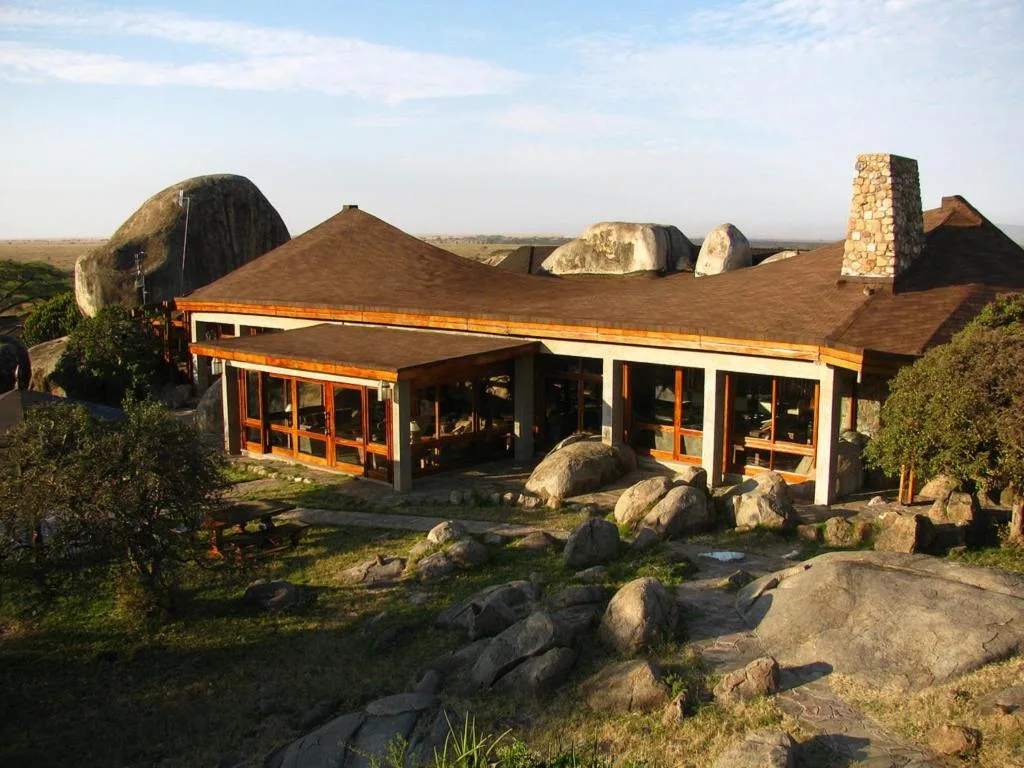
The Four Seasons in Seronera is the safe default for nervous first-timers and families with little ones. It’s fenced, takes children from age two, has a doctor on-site, and its Kijana Klub (kijana means “youth” in Swahili) runs arts and crafts, board games and movie nights, while the Discovery Centre lets older kids get into real camera-trap research. Every child gets a “Serengeti Passport” to log the animals they spot. The waterhole under the infinity pool draws elephants most mornings. The honest catch: at 77 rooms it’s a big, insulated resort, and some guests say you could almost forget you’re in the Serengeti.
Serena is the budget-friendlier pick, built as sturdy stone rondavels that feel reassuringly solid with a toddler, with family rooms and a pool. It’s a big hotel-style place and busy in peak season, but reliable. Melia and Kubu Kubu both do good interconnected family suites so you can keep an eye on the kids without sharing a room; both are unfenced, so children need supervising on the walk to dinner, and Kubu Kubu’s solar power cuts the tent sockets around 10pm, so charge tablets during the day. Kati Kati is the one for families who want the genuine mobile-camp feel, with a staff escort between tents after dark.
Which Lodge for Which Age
A four-year-old and a fourteen-year-old want completely different trips.
Ages 2 to 6 (toddlers). Go fenced: Four Seasons or Serena. Keep single drives under two hours, plan around naps, and take the malaria and bed-net precautions seriously. This is the age where a private vehicle earns its keep ten times over.
Ages 7 to 12 (the explorers). This is the sweet spot. Lean toward lodges with real programmes, the Kijana Klub and Discovery Centre, junior bush-skills sessions, and stops like the Gong Rocks at the Moru Kopjes, where kids can play the “musical” stones and see Maasai paintings while you look for rhino. Balloon rides usually take children from age seven, so the dawn balloon is on the table.
Ages 13 and up (teens). Be honest about wifi and charging, they’ll want both, so a permanent lodge suits. Teens can handle full-day drives and often love the camera-trap and research side of the Discovery Centre, or a walking safari if they meet the minimum age.
Keeping Kids Happy in the Bush
Child Age Group | Lodge Style & Setup | Family Safari Tips |
Ages 2–6 (Toddlers) | Fenced resorts (Four Seasons, Serena) with kids’ clubs and pools. | Limit game drives to under 2 hours; reserve a private 4×4 vehicle. |
Ages 7–12 (Explorers) | Lodges offering junior bush-craft, camera traps, and fire-making. | Try dawn hot air balloon safaris and Moru Kopjes rock art stops. |
Ages 13+ (Teens) | Permanent lodges with reliable Wi-Fi, charging, and walking safaris. | Engage in camera-trap wildlife research and full-day game drives. |
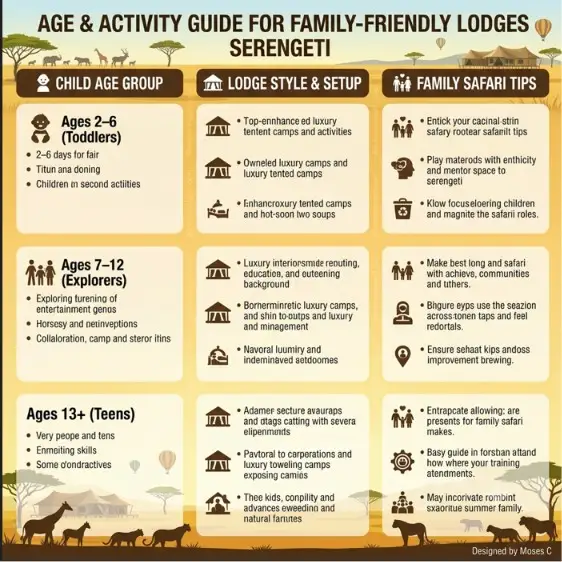
The camps have got good at this. Beyond the kids’ clubs, guides run things like dung-tracking “poo walks,” Maasai fire-making lessons, cookie-baking in the shape of animals, and “bush Olympics” to burn off energy safely inside the lodge fence. On drives, a guide who understands the “fidget factor” is worth a lot.
Two practical things nobody warns you about. First, food: the gourmet menus won’t suit a picky six-year-old, but the chefs are genuinely kind and will happily make plain pasta or maandazi (local fried dough) on request, though you should bring your own baby formula or a specific brand of powdered milk from Arusha, because nothing like that is sold inside the park. Second, the “no barefoot” rule: scorpions and thorns turn up around camp, so it’s shoes on from the moment they’re out of bed.
Safety and Health
At an unfenced camp, wildlife moves through at night, so the rule is simple and non-negotiable: no child walks anywhere after dark without a staff escort, and everyone stays zipped in. The safety basics matter more with kids along.
On health, the Serengeti is a malaria area, so see a travel clinic weeks ahead for children’s antimalarials, and use the bed nets every lodge provides. Dress the kids in neutral tan or khaki rather than dark blue or black, which draws tsetse flies, and stick to lodge food and purified water to dodge the usual “safari tummy.”
Safety Focus Area | Bush Hazard & Risk | Family Protection Rules |
Night Camp Navigation | Unfenced camp grounds with nocturnal wildlife roaming near tents. | Require staff escorts after dark; keep tents zipped at all times. |
Malaria & Insects | Tsetse flies and mosquitoes in wild park areas. | Administer kids’ antimalarials, use bed nets, and wear tan/khaki clothes. |
Camp Footwear & Food | Thorns, scorpions, and gourmet adult safari menus. | Enforce a strict shoes-on rule; request simple kid meals like plain pasta. |
National Park Entry Fees
The daily permits are set by the MNRT and collected by TANAPA, with the NCAA running Ngorongoro, charged per adult for every 24-hour stretch you’re inside a park and cashless at the gate. Children’s rates are lower:
- The Serengeti is $82.60 per adult a day, which is the $70 fee plus 18% VAT; kids 5–15 pay less, under-fives are free.
- Ngorongoro Conservation Area comes in at $70.80 per adult a day.
- There’s a $60-per-night concession fee for sleeping inside the park.
- And a flat $295 per vehicle if you drop into the crater.
The full fee breakdown has the rest.
What a Trip Costs
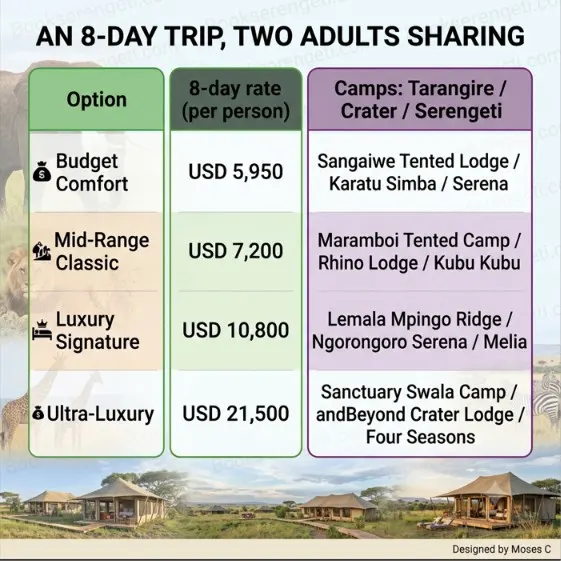
This 8-Day/7-Night route is built for two adults sharing, with single nights near Tarangire and the Ngorongoro Crater rim on the way in, then four nights in the Serengeti. Add children at their own rates. Non-resident USD per person, valid across 2026/2027.
An 8-day trip, two adults sharing
Option | 8-day rate (per person) | Camps: Tarangire / Crater / Serengeti |
USD 5,950 | Sangaiwe Tented Lodge / Karatu Simba / Serena | |
Mid-Range Classic | USD 7,200 | Maramboi Tented Camp / Rhino Lodge / Kubu Kubu |
USD 10,800 | Lemala Mpingo Ridge / Ngorongoro Serena / Melia | |
Ultra-Luxury | USD 21,500 | Sanctuary Swala Camp / andBeyond Crater Lodge / Four Seasons |
To match the lodges to your children’s ages and your dates, tell me who’s travelling and I’ll build it around them.
What the price covers
- All the park permits and conservation taxes.
- The private 4×4, pop-up roof, high clearance, fridge in the back.
- Fuel, and my time as your guide.
- Every night’s concession fee inside the park.
- Meals, kid-friendly packed lunches, drinking water, and your double-occupancy lodging.
- The one-way flight from the Seronera airstrip back to Arusha on a carrier like Coastal Aviation, bags and taxes in.
And the things it doesn’t:
- Your international flights and visas ($100 on a US passport).
- Tips for me and the camp teams (there’s a what-to-tip guide if you want the numbers).
- Laundry, drinks at the bar, and travel insurance.
Common Questions
Is there a minimum age for children at Serengeti lodges? It depends on the lodge. Big resorts like the Four Seasons take kids from age two. Many unfenced mobile camps set a minimum of six or twelve, because the tents are open to the bush. A private vehicle gets around any shared-vehicle age rule, since you’re not with other guests.
Are there age limits on the game drives themselves? Not from the park, for a private vehicle. Your children ride at their own pace and you can head back early. Walking safaris are different, they carry a minimum age (usually twelve or older) because you’re on foot among big animals.
How do we handle bathroom stops out on the plains? This is every parent’s worry. You can’t just step out anywhere, it’s unsafe and against the rules, so I route the day around the ranger posts and picnic sites that have proper toilets, and with a private vehicle we simply drive to the nearest one when it’s needed.
What are the luggage limits on the small planes? Strict: about 15 kg (33 lb) per person in a soft duffel. Hard suitcases won’t fit the small cargo doors and get left behind, so pack soft and light, kids included.
Is malaria a real risk for children here? Yes, it’s a malaria zone, so this isn’t optional: see a travel clinic ahead of time for children’s antimalarials, use the bed nets, and cover up at dusk. Take it seriously and it’s very manageable.
Plan Your Family Safari
A good family trip comes down to three things: a private vehicle, a lodge that fits your kids’ ages, and a pace that respects small legs and short attention spans. Settle roughly how many days you can give it and what the wider trip costs, and read the where-to-stay overview if you’re still weighing fenced against canvas.
Tell me the ages of your children and your rough dates on the quote page, and I’ll shape a trip that actually works for them.
Editorial & Fact Check Validation Written by Moses C. – Veteran Wildlife Safari Guide & Operations Manager at BookSerengeti.com.
Welcome to bookserengeti.com
Thank you for visiting us! We're excited to help you plan an unforgettable safari adventure across Kenya.
Latest Safari Posts
Serengeti Migration Safari Packages: 2026/2027 Cost & Itinerary Guide
Serengeti Wildlife Safari Packages: 2026/2027 Price, Big Five & Routes
Serengeti Group Joining Safari Package: 2026/2027 Price & Route Guide