Serengeti Black Rhino Safari: Tracking the Moru Kopjes Rhinos
Summary: A Serengeti black rhino safari means one place above all: the Moru Kopjes in the south-central park, where the last wild rhinos hold on in thick brush under round-the-clock ranger protection. They’re genuinely hard to see, so most trips pair Moru with a morning on the Ngorongoro Crater floor, where the odds are far better. For a 7-day private multi-park route with permits and a fly-back included, high-season rates run from about USD 4,950 to USD 14,900 per person sharing.
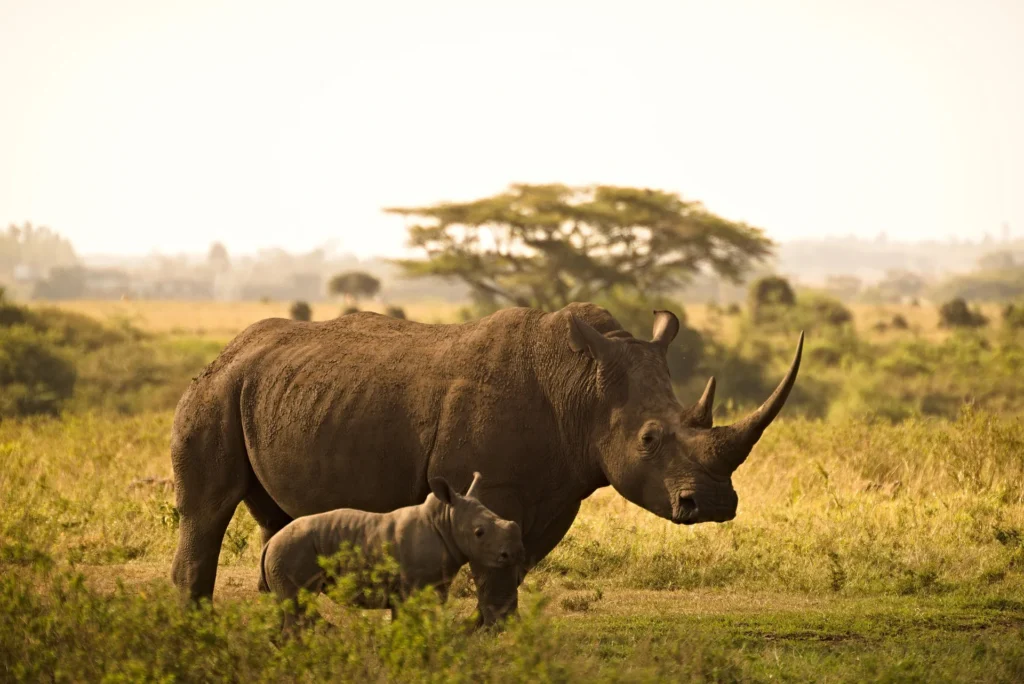
A Serengeti black rhino safari is not the relaxed, roadside-rhino experience of a small fenced park. The ones out here are wild, skittish and heavily guarded, and armed anti-poaching teams watch them around the clock because a horn is worth a fortune to smugglers. They keep to the thickest thorn and the roughest ridges, so if a driver just runs the main tourist tracks, you won’t see one. It takes a slow pace, good optics, and a guide who knows where the old bulls go to drink at first light. Manage your expectations, and it’s one of the most rewarding sightings in Africa; expect a zoo, and you’ll be let down.
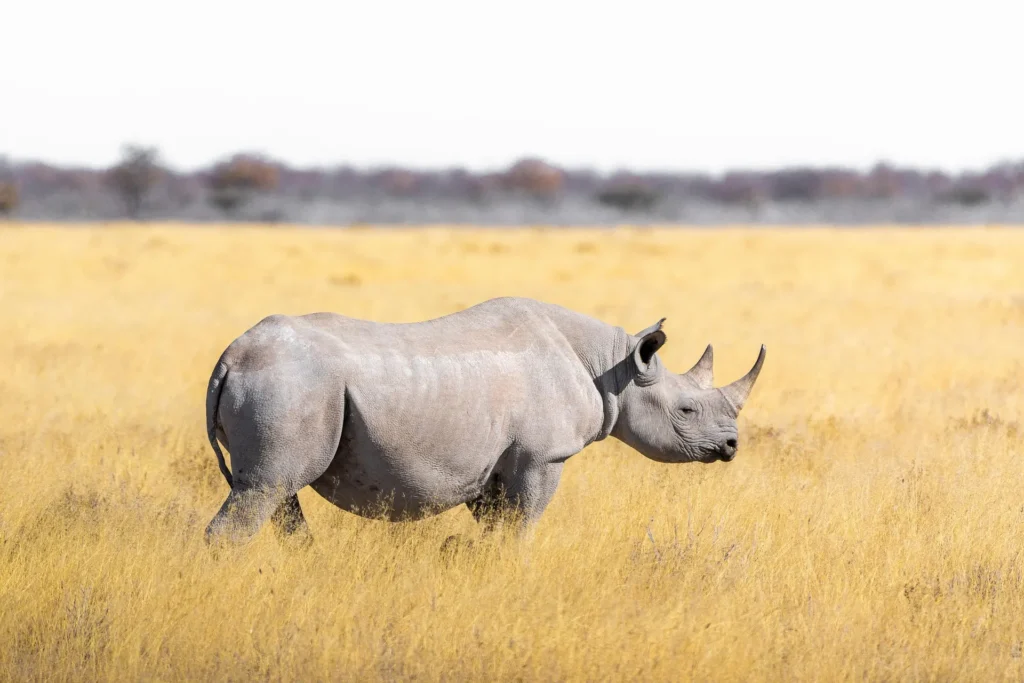
Where the Rhinos Hide
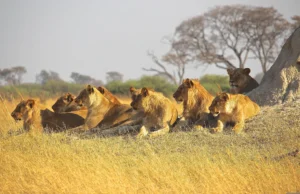
The place to look is the Moru Kopjes, the great piles of smooth grey granite rising out of the grass in the south of the central park. Rain collects in hollows in the rock and keeps the surrounding acacia and croton green and thick, which is exactly the browse a black rhino wants. Rangers glass for them daily from the tops of the kopjes, and the monitoring post here has run since the 1990s. The same acacia woodland is lion country, so the drive out is rarely dull.
Finding one yourself is a matter of reading small things. A rhino’s hide is almost the exact grey of weathered granite, so you’re not looking for a rhino so much as for what it disturbs: the tops of low croton bushes twitching unnaturally as it strips leaves with its hooked lip, or a white-browed robin-chat rattling out a sharp alarm from the thicket as the animal moves down to water. Get the engine off and sit still.
A word on the ethics of it, because it matters here more than anywhere. I once drove a couple who badly wanted a close-up of a horn, and they got angry when I wouldn’t push the cruiser off the track toward a mother and calf. I kept my foot off the gas. Driving off the tracks is illegal, it wrecks the fragile topsoil, and around animals this pressured it’s simply not on. You watch a Moru rhino from the legal line with a long lens, or you don’t watch one at all.
Field Sign | Rhino Behavior | Guide Tracking Strategy |
Twitching Bushes | Stripping croton leaves with lip | Scan moving brush tops |
Robin-Chat Alarms | Ruffled by moving animal | Engine off, listen closely |
Grey Granite Hide | Blending into kopje rocks | Glass vegetation, not stone |
The Serengeti Rhino Project
It’s worth knowing what you’re actually looking at, because the story is stark. In the mid-1970s the Serengeti held around 700 black rhinos. Poaching through the late 1970s and 80s all but wiped them out, and a 1993 survey funded by the Frankfurt Zoological Society found just three left alive in the Moru Kopjes.
From 1996, FZS and TANAPA built the project that turned it around: the Michael Grzimek Memorial Rhino Post on one of the Moru hills, a radio network, aerial surveillance, and ranger teams living in the field full-time and patrolling roughly 3,500 square kilometres. One of those three survivors, a female the rangers call Mama Serengeti, has since had more than ten calves. The Moru population is back above fifty, all wild-born, and the wider Serengeti-Ngorongoro rhinos are now one of the largest free-ranging black rhino populations left in Africa. Your park permits are part of what keeps that going, which is a fair thing to remember when the sighting is hard-won.
Gong Rock and the Maasai Paintings
Moru isn’t only rhinos. A short guided walk up the granite leads to a set of Maasai rock paintings tucked under the overhangs: a shield, elephants and human figures, painted in the colours of a Maasai shield. The whites and yellows are clay, the black is ash from the wild caper bush, and the red is clay mixed with the juice of wild nightshade. They’re the work of young warriors, the il-moran, who ranged this country before settling to a herding life, and the caves below were used to shelter livestock until about fifty years ago.
A little way off is Gong Rock, a big boulder pocked with circular hollows that rings like a struck bell when you tap it with a stone. It carried across the plains as a signal long before the park existed. Access to both is controlled to protect the site, so you go up with a guide.
When to Go
Rhinos are resident year-round, but how easily you’ll see one swings hard with the season:
Season | Months | What it means for rhino tracking |
Dry season | Jul–Oct | Best. The thickets thin out and the rhinos stay tied to permanent water round the kopjes, so their movements are more predictable. |
Short rains | Nov–Dec | Fair. The grass greens up and the animals spread into more remote ridges. |
Green season | Jan–Mar | Harder. Tall plains cover makes a granite-grey animal very tough to pick out from the legal tracks. |
Long rains | Apr–May | Hardest. The Moru mud tracks get difficult and the rhinos stay deep in the brush. |
If a rhino is the priority, come in the dry months. It’s also worth knowing the migration passes through Moru on its way north around May-June and back south around November, which adds a lot to the drive even when the rhinos are being shy.
What to Bring
Because you view these animals at a distance and off-roading isn’t allowed, gear does real work here. Bring proper binoculars, 8×42 or 10×42 with good low-light glass, since most tracking happens in the first grey light of the morning. For photographs, you want reach: a telephoto around 400 to 600mm, or a 1.4x teleconverter on what you have, because the rhino will rarely be close. The fine dust out here is hard on lenses, so keep them bagged between shots; the full packing list covers the rest.
The 7-Day Route
This is the shape of the trip in the table below, so you can see where the nights fall and how the driving breaks up:
- Day 1 Land at Kilimanjaro (JRO) and transfer to Arusha for the night.
- Day 2 Tarangire for the elephants and baobabs, one night that side.
- Days 3–5 Into the central Serengeti and the Moru sector, the core of the rhino tracking.
- Day 6 Down onto the Ngorongoro Crater floor for the morning, the best single-day odds on a rhino.
- Day 7 Fly back from the Seronera airstrip to Arusha.
If a Rhino Is the Whole Point
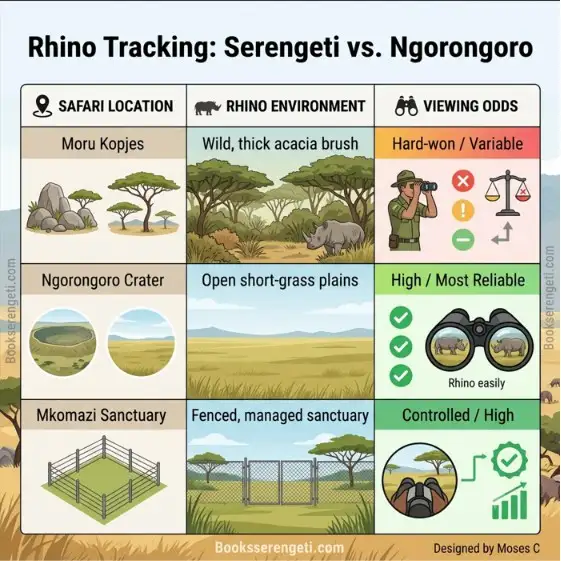
Safari Location | Rhino Environment | Viewing Odds |
Moru Kopjes | Wild, thick acacia brush | Hard-won / Variable |
Ngorongoro Crater | Open short-grass plains | High / Most Reliable |
Mkomazi Sanctuary | Fenced, managed sanctuary | Controlled / High |
Be honest with yourself about why you’re coming. Wild Moru tracking is the real thing, but it can end in a distant grey smudge or nothing at all. That’s why I build the crater morning into the route: Ngorongoro holds a small resident group of around thirty black rhinos that graze the open short grass near the Lerai Forest, and it’s the best odds you’ll get of a clear look, and of rounding out the Big Five before you fly.
If seeing a rhino is genuinely the only reason for the trip, there’s also the fenced rhino sanctuary at Mkomazi, in the north-east of the country. It’s a separate journey and a much more managed setting than wild Serengeti tracking, and access is limited, but the animals are easier to see.
National Park Entry Fees
The daily permits are set by the MNRT and collected by TANAPA, with the NCAA running Ngorongoro. They’re charged per adult for every 24-hour stretch you’re inside a park, cashless at the gate:
- The Serengeti itself is $82.60 a day, which is the $70 fee plus 18% VAT.
- Ngorongoro Conservation Area comes in at $70.80 a day.
- There’s a $60-per-night concession fee for sleeping inside the park.
- And a flat $295 per vehicle if you drop into the crater.
The full fee breakdown has the rest.
What a Trip Costs
This 7-Day/6-Night route is built for two travelling together: single nights near Tarangire and the Ngorongoro Crater rim on the way in, then four nights in the central Serengeti with the Moru sector on the itinerary. Non-resident USD per person, valid across 2026/2027.
A 7-day trip, two people sharing
Option | 7-day rate (per person) | Camps: Tarangire / Crater / Serengeti |
USD 4,950 | Sangaiwe Tented Lodge / Karatu Simba / Osinon Camp | |
Mid-Range Classic | USD 6,120 | Maramboi Tented Camp / Rhino Lodge / Nyikani Migration Camp |
USD 8,850 | Lemala Mpingo Ridge / Ngorongoro Serena / Melia Serengeti | |
Ultra-Luxury | USD 14,900 | Sanctuary Swala Camp / andBeyond Crater Lodge / Four Seasons |
To swap the camps or build the route around a longer Moru stay, tell me your dates and I’ll put it together.
What the price covers
- All the park permits and conservation taxes.
- The private 4×4, pop-up roof, high clearance (you’ll want it on the Moru rock tracks).
- Fuel, and my time as your guide.
- Every night’s concession fee inside the park.
- Meals, drinking water, and your double-occupancy lodging.
- The one-way flight from the Seronera airstrip back to Arusha on a carrier like Coastal Aviation, bags and taxes in.
And the things it doesn’t:
- Your international flights and visa ($100 on a US passport).
- Tips for me and the camp teams (there’s a what-to-tip guide if you want the numbers).
- Laundry, drinks at the bar, and travel insurance.
Common Questions
Why are black rhinos so rare here?
Poaching in the 1970s and 80s took the Serengeti from around 700 rhinos down to three by the early 1990s. The survivors held out in the roughest Moru brush, and it’s been a slow, guarded recovery since, back above fifty at Moru now, which is why every sighting feels earned.
Black rhino or white rhino, what’s the difference?
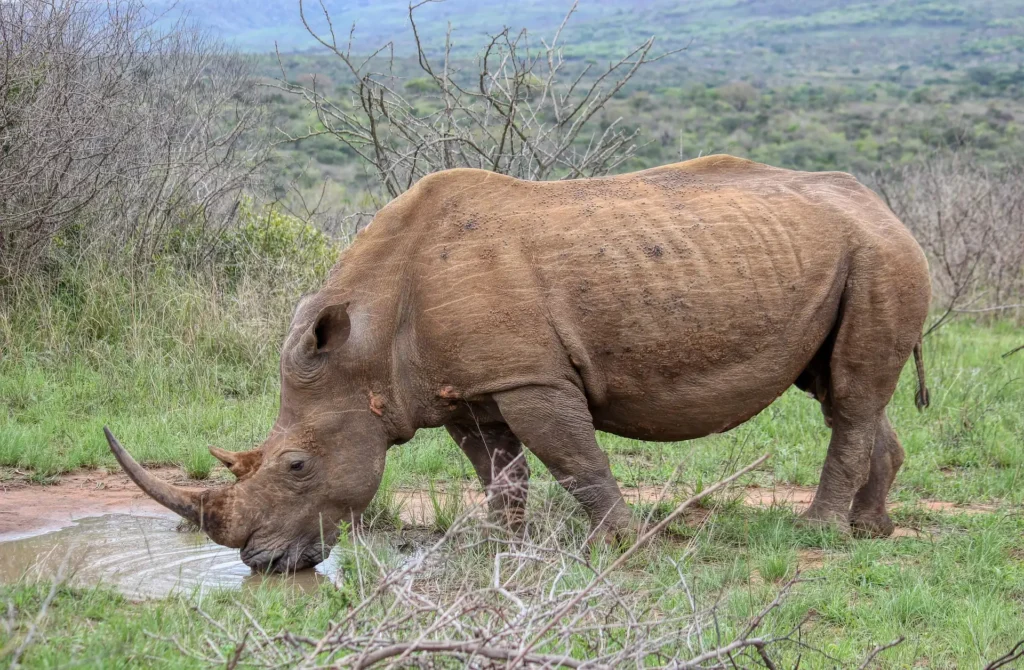
There are no wild white rhinos in this park. Black rhinos are browsers, using a pointed, hooked lip to strip leaves off woody bushes; white rhinos are bigger, square-lipped grazers that crop grass, and they’re generally calmer. The Moru animals are the short-tempered browsers.
Can we get out of the vehicle for a photo?
No. Inside the park you stay in the cruiser except at set spots, the Moru ranger post and the guided walk up to the paintings, the picnic clearings, and the gate areas. You track and photograph rhinos from the legal track with a long lens.
Which months are best?
July to October, the dry season, when the cover thins and the rhinos stay near permanent water and move more predictably. See the seasonality table above for the rest of the year.
Does the crater really improve our chances?
Yes, a lot. Moru is wild tracking with no guarantees, so a morning on the Ngorongoro Crater floor, with its ~30 resident rhinos on open grass, is the reliable part of the plan rather than an afterthought.
Plan Your Rhino Safari
A good rhino trip is really about honest expectations and the right pairing: patient tracking at Moru for the wild version, a crater morning for the near-sure look, and a guide who won’t break the rules to force a sighting. It helps to settle how many days you can give it and roughly where you’d like to stay, and what the wider trip costs come to.
When you’ve got rough dates and a group size, the quote page is the place to start, and we’ll shape the route from there.
Editorial & Fact Check Validation Written by Moses C. – Veteran Wildlife Safari Guide & Operations Manager at BookSerengeti.com.
Welcome to bookserengeti.com
Thank you for visiting us! We're excited to help you plan an unforgettable safari adventure across Kenya.
Latest Safari Posts
Serengeti Migration Safari Packages: 2026/2027 Cost & Itinerary Guide
Serengeti Wildlife Safari Packages: 2026/2027 Price, Big Five & Routes
Serengeti Group Joining Safari Package: 2026/2027 Price & Route Guide