A Guide to Serengeti Wildlife Safari Packages, Beyond the Migration
Summary: Most people come to the Serengeti for the migration, but the park is a year-round wildlife destination regardless of where the herds are. The resident lions, leopards, cheetahs, elephants, and rhino don’t leave. A wildlife safari package is built around game drives and the Big Five rather than the wildebeest, which means it works in any month and puts you in the sectors that hold animals all year. Priced with a private 4×4, park fees, lodging, and a fly-back, a wildlife circuit from Arusha runs roughly USD 3,200 to USD 24,500 per person sharing. See the full safari cost breakdown for what drives the range.
I have guided the Serengeti for fifteen years, and the question I get most is some version of “when do I come to see everything.” The honest answer is that the big resident animals are here all year. The migration moves, but the lions holding the Seronera valley, the leopards in the riverine trees, the elephant herds in Tarangire, the rhino down on the crater floor, none of them go anywhere. If your priority is the Big Five and good predator action rather than a river crossing on a specific week, a wildlife package gives you far more flexibility on timing and usually a better price.
This guide is about that trip. Where each animal actually lives, which region to base in, what it costs, and how a game-viewing day works once you are out there.
To check open dates and vehicles for 2026/2027, send yours to my team on the quote page.
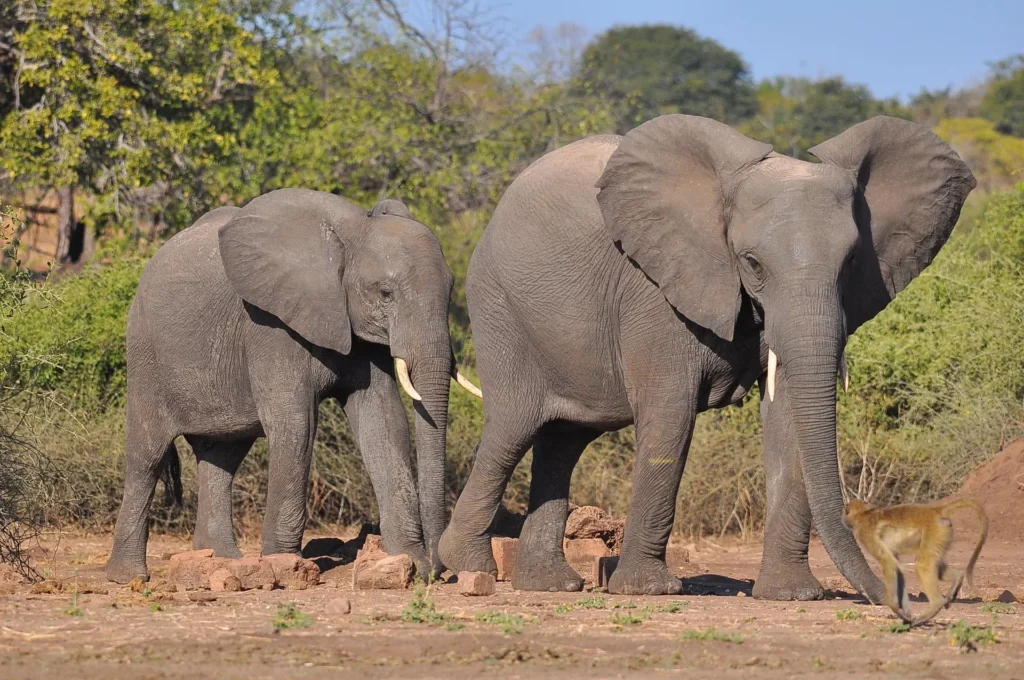
Where the Big Five Live
The Serengeti is enormous, and the animals are not spread evenly across it. If you want a specific one, you base near where it actually is. Here is the short version.
Animal | Best Region | Notes |
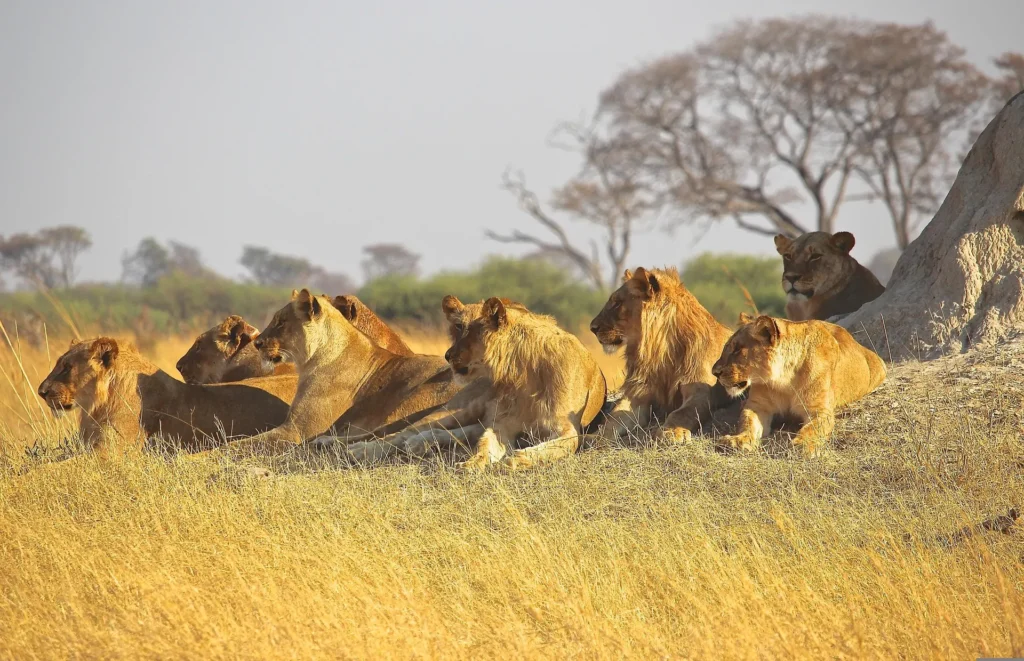
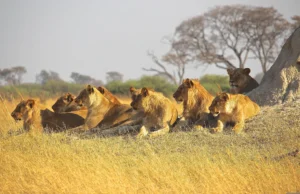
Lion | Central Seronera and the kopjes | Over 3,000 in the park; the prides use the granite kopjes as lookouts and shade |
Leopard | Seronera river valley | Around 1,000 in the park; they drape in the big riverine trees, best at dawn |
Elephant | Tarangire and northern Serengeti | Tarangire has the densest breeding herds, all but guaranteed |
Buffalo | Throughout, thick in the west | Big herds in the woodland belts; the solitary bulls are the dangerous ones |
Rhino | Ngorongoro Crater floor, some at Moru | Black rhino, and the crater is the single most reliable place to see one |
Two things the listings skip. Central Serengeti is the real engine of a wildlife trip, because it holds cats year-round no matter where the migration is, which is why almost every route bases there. And the crater is worth a day on its own for the rhino, since you can see all of the Big Five in that one contained bowl in a single morning, which is rare anywhere in Africa.
What It Costs
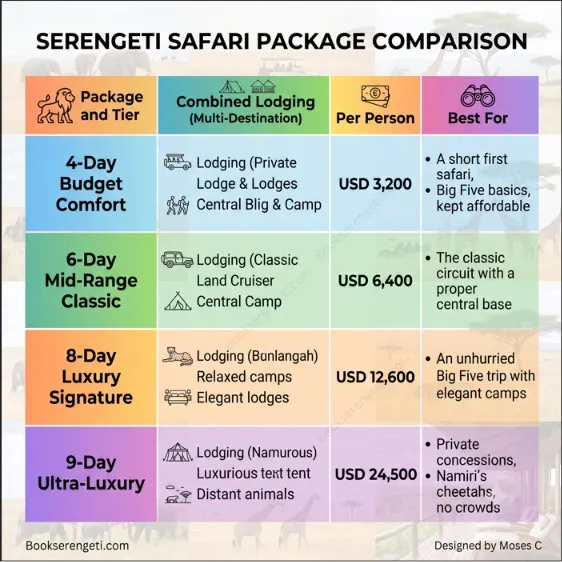
Realistic private wildlife circuits for two sharing, from Arusha, driving in and flying back on the final morning. Non-resident USD, per person, for 2026/2027.
Package and Tier | Combined Lodging (Multi-Destination) | Per Person | Best For |
4-Day Budget Comfort | Whistling Thorn Camp / Eileen’s Trees Inn / ThornTree Camp | USD 3,200 | A short first safari, Big Five basics, kept affordable |
6-Day Mid-Range Classic | Tarangire Simba Lodge / Kirurumu Manyara / Serengeti Kati Kati (2 nights) | USD 6,400 | The classic circuit with a proper central base |
8-Day Luxury Signature | Lemala Mpingo Ridge / Ngorongoro Sopa / Melia Serengeti (3 nights) | USD 12,600 | An unhurried Big Five trip with elegant camps |
9-Day Ultra-Luxury | Sanctuary Swala / andBeyond Crater Lodge / Namiri Plains (4 nights) | USD 24,500 | Private concessions, Namiri’s cheetahs, no crowds |
The gap between the budget and luxury ends of that table is not the wildlife, which is the same animals for everyone. It is the vehicle, the camp, and the crowds. At the top, private-concession camps like Namiri Plains or the Grumeti reserves give you off-road driving, night drives, and near-empty sightings that the public park does not allow.
You can hold a date and a licensed vehicle by sending us your travel window and group size.
Covered Package Features
What the base quote covers, so nothing catches you out at the gate.
In the package:
- A private 4×4 Land Cruiser, pop-up roof, heavy suspension, fridge, the vehicle fees and fuel included.
- Your driver-guide, licensed and local, who knows where the cats have been sitting.
- Park entry and conservation fees through the official TANAPA portal, with the 18% VAT built in.
- In-park lodging vouchers, all meals, packed bush lunches, and cold water in the vehicle.
- The fly-back from Seronera to Arusha on the last morning, taxes included.
Not in the package:
- International flights into Kilimanjaro.
- The tourist visa, USD 100 on a US passport.
- Tips, around USD 20 to 30 a day from the vehicle for your driver, plus the camp crew.
- Travel and camera insurance.
- Imported drinks at the bar.
Best Time for Wildlife
Because a wildlife trip is not chasing the herds, your timing is freer. That said, the seasons do change what game viewing is like.
Dry season (June to October) is the classic window. The grass is short and thin, the bush has dropped its leaves, and animals concentrate at the remaining water, so they are easier to see and photograph. It is peak season and priced accordingly.
Green season (November to May) is lush and quieter, with 20 to 40 percent lower rates. The resident wildlife is all still here; sightings just take a little more work in the taller grass. The calving months of January and February are excellent for predator action on the southern plains, and April to May is the cheapest time to come.
For a pure Big Five trip, I usually point people at June to October if the budget allows, and the green months if value and low crowds matter more than the easiest possible viewing.
Route Options by Length
The 4-Day Short Circuit
Tarangire on Day 1 for elephants, the Ngorongoro Crater on Day 2 for rhino and the Big Five in one morning, then the central Serengeti for a night and a full day before the fly-back. It is the efficient way to see a lot of animals fast, though it is a busy schedule.
The 6-Day Classic
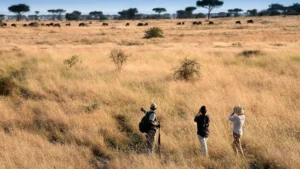
The one most people should book. It adds Lake Manyara (tree-climbing lions, big baboon troops) on the drive in and gives you two full nights in the central Serengeti, which is enough time to work the Seronera valley properly for leopard and lion rather than passing through.
The 8 or 9-Day Deep Trip
Intermediate parks drop to a night each and you spend three or four nights inside the core wildlife sectors. This is the layout for serious photographers and anyone who wants Namiri Plains, the old cheetah country in the east that only reopened to a couple of camps, without rushing.
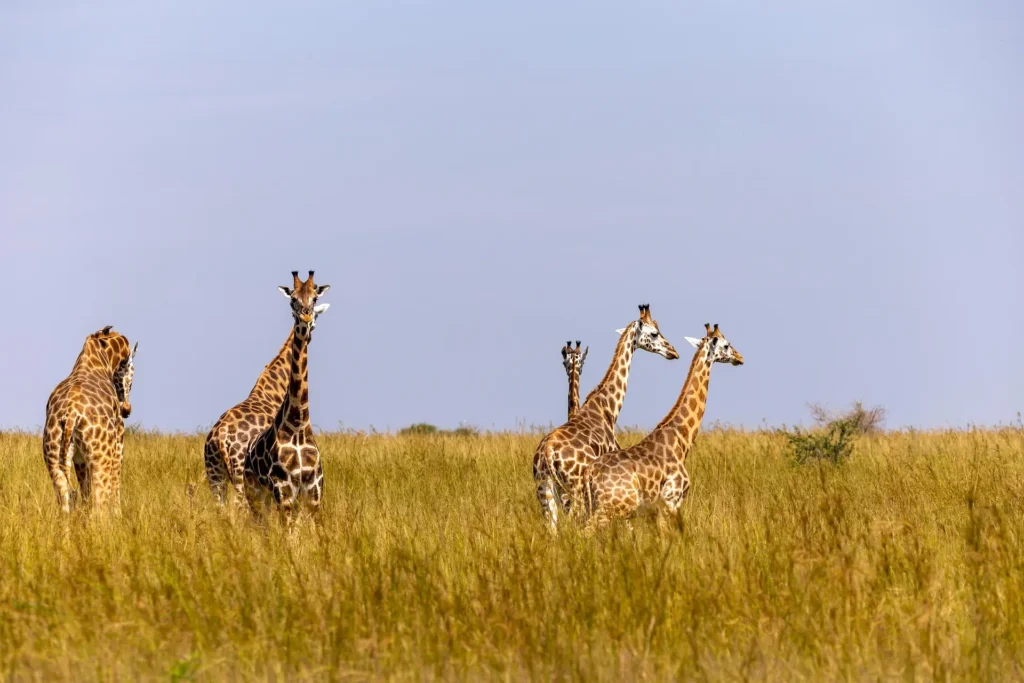
Reading a Game Drive
A good wildlife day is less about luck than people think. Early is everything: predators hunt in the cool of dawn and rest up by mid-morning, so the first two hours after the gate opens are your best window for a kill or cats on the move. Your guide works the radio, but the good ones also read the ground, following vultures dropping onto a carcass, or fresh tracks crossing the road, or the alarm calls of impala and baboons that mean a cat is near.
The midday hours are slow. Most people go back to camp through the heat, and that is when the light is flat anyway. The exception is a leopard, which will often lie up in a sausage tree through the day, so a slow midday loop of the Seronera river can pay off when everyone else has gone in.
A few practical things. Keep the camera in a bag between sightings, because the fine volcanic dust past Klein’s Gate works into a lens fast. At the Retina Hippo Pool, time your visit for midday, when a couple of hundred hippos are packed into one bend, yawning and jostling. And do not rush your guide at a sighting; the best moments, a leopard finally coming down a tree, a lioness starting a stalk, come to the vehicles that wait.
Common Questions
Can we really see the Big Five?
On a well-routed trip that includes the Ngorongoro Crater, yes, the odds are good. Lion, elephant, and buffalo are near-certain across the Serengeti. Leopard is common in the Seronera valley but takes a little luck. Rhino is the hard one, and the crater floor is where you realistically get it.
Is a wildlife trip cheaper than a migration trip?
Often, yes. You are not paying a premium to be positioned at the northern river crossings in peak season, and you have the flexibility to travel in the cheaper green months. The animals are the same.
What is the luggage limit on the fly-back?
15 kg per person, in a soft duffel. The Cessna Caravans have narrow cargo pods under the floor, so a hard case with a frame or wheels won’t fit and gets left on the tarmac.
Do we need to do the migration at all?
No. A lot of first-timers assume the migration is the only reason to come, but the resident wildlife and the crater deliver a full Big Five safari on their own, any month of the year.
How many days do we need?
Four days covers the Big Five basics but it is a rush. Six is the sweet number for most people. Eight or nine if you want to slow down, reach the remote sectors, or shoot seriously.
Book Your Wildlife Safari
A good wildlife safari comes down to basing in the right sectors, giving the central Serengeti enough time, and a guide who can read a sighting before it happens. Get that right and you will see more in a week here than most places show you in a month.
Book through us and your vehicle carries a valid TALA licence and clean gate paperwork. Send your dates and group on the quote page and we will build the route around the animals you most want to see. Karibu.
About the Author I’m Moses C.. I have spent fifteen years driving the Serengeti and running the field logistics behind the scenes at BookSerengeti.com. Ask me for a leopard and I will usually find you one, though the bush makes liars of us all eventually.
Welcome to bookserengeti.com
Thank you for visiting us! We're excited to help you plan an unforgettable safari adventure across Kenya.
Latest Safari Posts
Serengeti Migration Safari Packages: 2026/2027 Cost & Itinerary Guide
Serengeti Wildlife Safari Packages: 2026/2027 Price, Big Five & Routes
Serengeti Group Joining Safari Package: 2026/2027 Price & Route Guide