Serengeti Elephant Herds: How to Track the Big Families
Summary: Finding the Serengeti elephant herds is less about the open plains and more about water and woodland: elephants are resident browsers, not part of the great migration, so you follow the permanent rivers and river-forest where the big families feed and drink. For an 8-day private multi-park route that handles the permits and includes the flight back to Arusha, high-season rates run from about USD 5,750 to USD 15,200 per person sharing.
Elephants are harder to find than people expect. The postcard shows an old bull dozing under an acacia, so you assume you’ll meet a family five minutes from camp. Not necessarily. A herd of forty can melt into the thorn bush and go dead quiet, walking through thick woodland without snapping a twig. So you read the country instead. Watch the water, follow the weather. On any given day the elephants, tembo in Swahili, are wherever the water and the good browsing happen to be, and that isn’t always where a general guide would point you.
National Park Entry Fees
The daily permits are set by the MNRT and collected by TANAPA, with the NCAA running Ngorongoro. They’re charged per adult for every 24-hour stretch you’re inside a park, and it’s all cashless at the gate now. An elephant route usually crosses a few parks, so the gate fees stack up:
- The Serengeti itself is $82.60 a day, which is the $70 fee plus 18% VAT.
- Ngorongoro Conservation Area comes in at $70.80 a day.
- Tarangire and Lake Manyara are $59 each.
- And it’s a flat $295 per vehicle if you drop into the crater.
The full fee breakdown has the rest.
High Season Safari Packages
This 8-Day/7-Night route balances the driving across the northern circuit: single nights near Tarangire, Lake Manyara and the Ngorongoro Crater rim on the way in, then four nights in the core Serengeti. Non-resident USD per person, valid across 2026/2027.
8-Day Double-Occupancy Safari Packages
Package Tier | 8-Day Rate (Per Person) | Camps: Tarangire / Manyara / Crater / Serengeti |
USD 5,750 | Sangaiwe Tented Lodge / Farm of Dreams / Karatu Simba / Osinon Camp | |
Mid-Range Classic | USD 6,800 | Maramboi Tented Camp / Kirurumu Manyara / Rhino Lodge / Nyikani Migration Camp |
USD 9,250 | Lemala Mpingo Ridge / Lake Manyara Kilimamoja / Ngorongoro Serena / Melia Serengeti | |
Ultra-Luxury | USD 15,200 | Sanctuary Swala Camp / Manyara luxury lodge / andBeyond Crater Lodge / Four Seasons |
To shift the camps or aim the route at the dry-season water, tell me your dates and I’ll build it around them.
What the price covers
- All the park permits and conservation taxes.
- The private 4×4, pop-up roof, high clearance, fridge in the back.
- Fuel, and my time as your guide.
- Every night’s concession fee inside the park.
- Meals, drinking water, and your double-occupancy lodging.
- The one-way flight from the Seronera airstrip back to Arusha on a carrier like Coastal Aviation, bags and taxes in.
And the things it doesn’t:
- Your international flights and visa ($100 on a US passport).
- Tips for me and the camp teams.
- The personal bits, laundry, drinks at the bar, and your travel insurance.
Finding Elephants in the Dry Valleys
Field Sign | Elephant Behavior | Guide Strategy |
Stripped Bark | Seeking inner mineral bark | Check yellow fever trees |
Sand Digging | Sinking wells to groundwater | Scan dry riverbed sand |
River Confluences | Late afternoon family drinking | Position near Retima Pool |
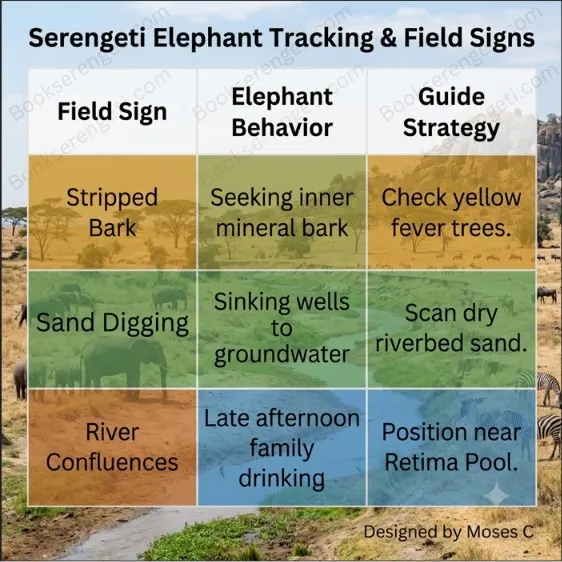
When the dry season sets in, the herds leave the open plains. The shallow seasonal pans have dried up, so they pull back to the permanent river channels of the central and northern sectors. The Retima Hippo Pool is a good place to catch them, where the Seronera and Orangi rivers meet north of the central hub. Most people come for the hundred-odd hippos. Watch the tree line in the late afternoon, though, and you’ll see the family groups break out of the acacia to drink, an old bull wading straight into the deep channel while the hippos grumble aside to give him room.
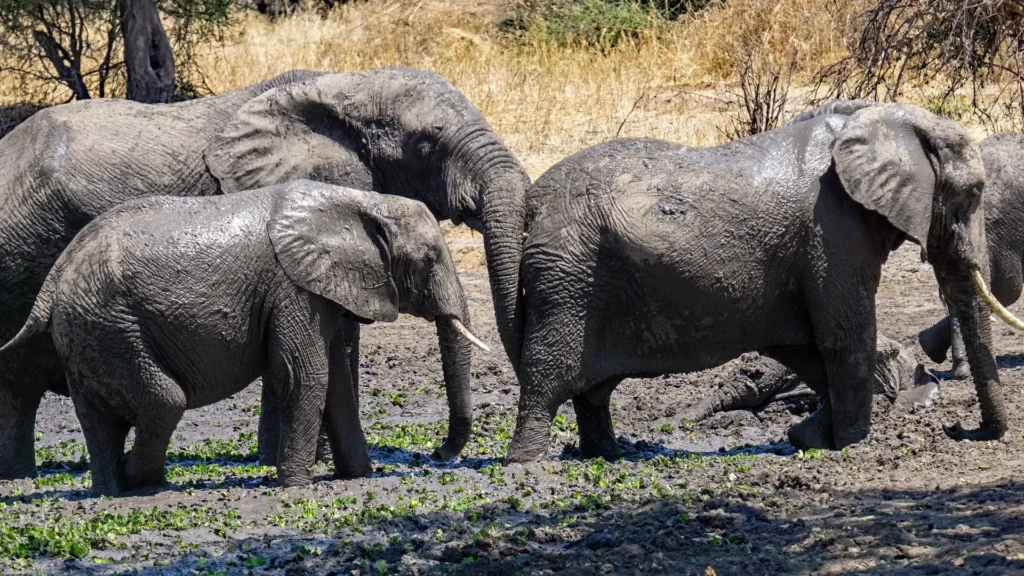
You’ll hear them before you see them, working the Seronera woodland, the crack of bark coming off the yellow fever trees. They strip the outer layer to get at the moist, mineral-rich inner bark. And where the rivers run dry, they dig, sinking a hole in the sand with trunk and feet to reach the water table underneath. Worth knowing, that. A herd standing in what looks like bare sand is often drinking from a well of its own making. Park quietly on the lower bank, engine off, and you can watch the calves throw mud over their backs against the sun.
Elephants, Camps and Infrasound
Elephants keep old routes in their memory, and plenty of those routes run straight through modern lodge grounds. Stay at the Melia or the Four Seasons, or in an unfenced tented camp like Osinon or Nyikani, and the herds treat the lawns and the leaky pipework as just another water source. You’ll wake to a matriarch pulling branches off an ornamental tree, or working her trunk over the camp plumbing. So carry a torch on the walkways after dark. A three-ton animal can stand dead silent a few feet off your steps, and you’d never know it was there.
Two sounds give them away at night. One is infrasound, the deep rumbles below human hearing that elephants use to talk across miles; parked close to a family group you don’t hear it so much as feel it, a low tremble through the steel floor of the truck. The other is just digestion. The belly rumble (borborygmi) of a big animal is loud enough at close range that first-timers swear a herd passing the tent is an idling diesel engine. Watch the older cows: a trunk lifted to test the air, or ears spread wide with a foot stamped down, is a warning going out to elephants you can’t even see.
Why Elephants Don’t Follow the Migration
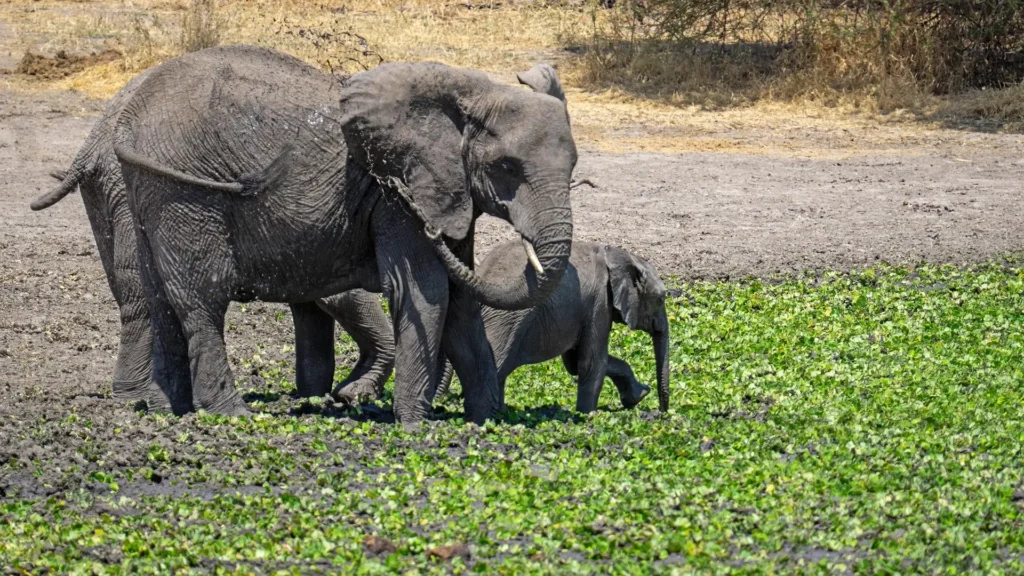
Elephants don’t move with the wildebeest. Get that wrong and you’ll spend the trip looking in the wrong place. The great migration is more than a million grazers chasing fresh grass across the open plains; elephants are bulk browsers, after bark and canopy and deep-rooted shrubs, so they go the other way, into the trees and along the water. Dry season, they lock onto the year-round rivers of the Seronera and the northern valleys while the plains game is off crossing the Mara. Come the rains, they scatter through the Lobo woodlands and the western corridor forest, well away from the short-grass plains packed with calving herds. Plan an elephant trip around the migration calendar and you’ll be looking in exactly the wrong spot.
They also read the weather from a long way off. GPS studies have tracked elephants moving toward thunderstorms as much as 150 km away, picking up the low-frequency sound of the storm and heading for the rain days before it arrives. In practice that means a storm breaking over the northern hills can pull the herds across the park while the plains stay dry, so I keep half an eye on the far horizon; a distant wall of cloud is often the best clue to where the big families will be tomorrow.
The Off-Road Rule
The low river basins are black-cotton clay, and one afternoon shower turns them into a trap that will sink a cruiser to its axles, so cutting off the track to get closer to a bull is both illegal and a fast way to lose an afternoon to a winch. The fine dust is hard on cameras, so keep gear bagged and lean on the packing list. One piece of etiquette that matters more with elephants than anything else: keep the radio down when you’re close. A sudden burst of VHF static can startle a relaxed matriarch or set off a bull in musth, and a mock charge from a few metres away is not the photo you came for.
Common Questions
A few questions come up on every elephant trip.
When’s the best month for big herds?
July through October, the peak dry season. As the outlying pans dry up, elephants from the edges of the ecosystem bunch tightly around the permanent rivers and springs, which is when you get the biggest aggregations.
How far is the drive from Arusha?
About 335 km to Naabi Hill Gate, and more again to reach the central Seronera lodges most elephant routes run from. It’s a long day on unpaved road, so I’d break it rather than push straight through.
Can you drive Arusha to the Serengeti in one afternoon?
No. It’s a full seven or eight hours over rough road, and rushing it wears out both you and the vehicle, which is why the longer routes put an intermediate night near Tarangire or up in the Karatu highlands.
What’s the luggage limit on the small planes?
15 kg, in a soft bag. The Cessna’s cargo holds have narrow doors a hard-shell case won’t fit through, and the pilot will leave it on the tarmac, so pack soft and light.
Plan Your Elephant Safari
Tracking the big families comes down to timing the dry season, routing along the water rather than the plains, and a guide who reads the weather. Before you lock anything in it’s worth settling how many days you can give it and roughly which part of the park you’d base in, because that shapes the rest, then where you’d like to stay and what the trip costs come to.
When you’ve got rough dates and a group size, the quote page is the place to start, and we’ll shape the vehicle and route from there.
Editorial & Fact Check Validation Written by Moses C. – Veteran Wildlife Safari Guide & Operations Manager at BookSerengeti.com.
Welcome to bookserengeti.com
Thank you for visiting us! We're excited to help you plan an unforgettable safari adventure across Kenya.
Latest Safari Posts
Serengeti Migration Safari Packages: 2026/2027 Cost & Itinerary Guide
Serengeti Wildlife Safari Packages: 2026/2027 Price, Big Five & Routes
Serengeti Group Joining Safari Package: 2026/2027 Price & Route Guide