Best Migration Camps in the Serengeti: Which One to Book, and When
Summary: The best migration camps Serengeti travelers ask about are mobile, tented, and built to be packed up and moved several times a year so they stay near the wildebeest. Which one is right for you comes down to one thing — the month you travel — because the herds, and the camps that chase them, sit in different corners of the park in February than in August. For a well-paced 5-day trip for two sharing, with a private 4×4 and a fly-back to Arusha, peak-season rates run from about USD 3,950 to USD 8,100 per person.
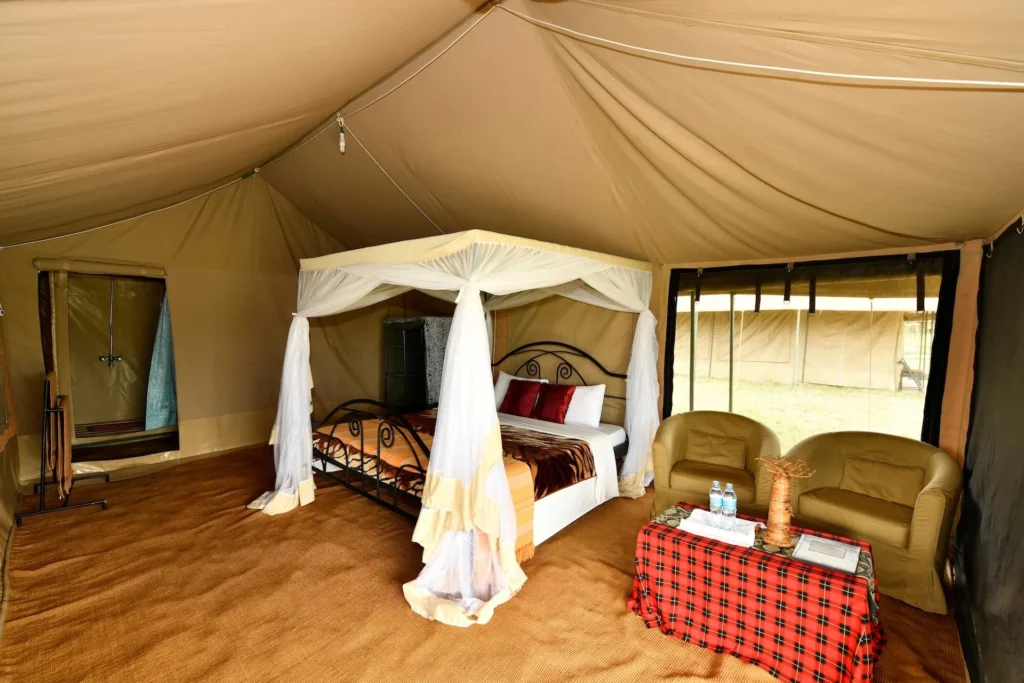
mobile tented camp is about as close to the old rhythm of the bush as a paying guest can get. The catch the glossy galleries leave out: these aren’t stone lodges with mains power and deep plumbing. They’re light, clever outposts — canvas, solar, a bucket of hot water — that get struck, loaded onto trucks, and rebuilt somewhere else a few times a year, following the rain and the herds across ground managed by TANAPA and the Ministry of Natural Resources and Tourism.
Pick a camp for its copper-bathtub photos and you can end up beautifully housed in an empty valley, a two-hour drive from the nearest wildebeest. So this guide is built around the only question that really decides your trip — which camp is where, in which month — plus the operational quirks that nobody mentions until you’re standing in them.
Already planning around a specific month? Tell us your dates and we’ll place you in the right camp at the right time through our safari enquiry form.
Which Camp, Which Month
Here’s the part most lists skip. A mobile camp isn’t one place — it’s two or three, and the move dates are fixed years in advance to shadow the Great Wildebeest Migration. Roughly how it falls:
When | Where the herds are | Camps in position |
Dec–Mar | Olakira (south), Ubuntu (Kusini), Chaka/Nyikani (Ndutu) | |
Apr–May | Drifting north through the centre; heavy long rains | Most mobile camps close — use a permanent Seronera lodge |
Jun–Jul | West toward the Grumeti | Ubuntu and Chaka shifting north; fewer mobile beds |
Aug–Oct | Northern Kogatende, the river crossings | Olakira (Mara), Chaka/Nyikani (Machwechwe), Ubuntu (Lamai) |
Nov | Turning back south | Camps mid-relocation — a quiet gap |
April and May are the wash-out months. The long rains turn the black-cotton tracks to grease, and most camps strike their tents and wait it out. If those are your only dates, base yourself in a permanent lodge in the central Serengeti and accept that you’re watching resident game, not the migration.
Life in a Mobile Camp
True mobility means giving up a few comforts, and it’s better to know which ones going in.
Power is solar, topped up by a quiet generator, and the batteries only hold so much — most camps cut the high-draw sockets around 10 p.m. Hair dryers and straighteners are out across the board; they trip the inverters on the spot. If you depend on a CPAP machine, don’t assume a tent socket will run it overnight. Tell your operator weeks ahead so the crew can wire a dedicated deep-cycle battery to your tent frame.
Washing is done under a safari bucket shower — a 20-litre canvas bag of fire-heated water hauled up on a pulley behind your bathroom canvas, filled to the temperature you ask for. There’s a knack to it. Pull the cord wide open while you lather and the whole bag drains in under three minutes, leaving you cold and soapy in the evening breeze. Rinse, shut it off, soap up, rinse again. That’s the rhythm.
One small booking detail pays off: when you reserve, you can ask where your tent sits in the camp loop. An outer tent gives you open savanna straight off the front; a central tent means fewer things brushing your guy-ropes in the small hours, which matters if you sleep lightly. Just say which you’d rather have.
Flying In
Most camp stays are fly-in, landing on dirt strips like Ndutu or Kogatende where “check-in” is a rep ticking your name off a clipboard. The thing that catches people isn’t the 15 kg (33 lb) weight limit so much as bag shape: the cargo pods under a Cessna Caravan are tight, and a rigid roller case won’t bend through the hatch. Bring a soft duffel you can squash by hand.
What It Costs
Numbers up front, so you can see the shape of it before reading on. The table is a real 5-Day/4-Night multi-destination trip for two sharing in a private 4×4 during peak migration months, with the smaller stops — Tarangire, the Ngorongoro Crater — held to a night each and two nights on the mobile camps themselves. Rates are non-resident USD per person, valid for the current seasons.
5-Day Double-Occupancy Safari Packages
Package Tier | 5-Day Rate (Per Person Sharing) | Camps: Tarangire / Crater / Serengeti |
USD 3,950 | Sangaiwe Tented Lodge / Karatu Simba Lodge / Osinon Tented Camp | |
Mid-Range Classic | USD 4,500 | Maramboi Tented Camp / Rhino Lodge / Chaka (Nyikani) Camp |
USD 5,550 | Lemala Mpingo Ridge / Ngorongoro Serena / Ubuntu Migration Camp | |
Luxury Plus Ultra | USD 8,100 | Sanctuary Swala Camp / andBeyond Crater Lodge / Olakira Migration Camp |
Optional add-on: a sunrise hot air balloon flight over the central plains for USD 600 per person — TANAPA permit, the launch, and a champagne bush breakfast included.
Want a tier adjusted — a camp swapped, a night shifted? Send your dates through the safari booking form and we’ll build it around you.
Related packages: 3-Day Serengeti Safari · 4-Day Serengeti Safari
What’s Included
Always included:
- All daily conservation permits and destination taxes managed by the park authority.
- Private use of a customized 4×4 safari land cruiser with heavy-duty suspension, large viewing windows, and an open canvas roof hatch.
- Full fuel and the daily services of an authorized local guide.
- Mandatory government concession fees for every overnight stay inside the park boundaries.
- Emergency medical air evacuation cover through the regional AMREF Flying Doctors network.
- All daily meals, cold mineral water in the vehicle’s fridge, and double-occupancy room costs.
- One-way regional flights on domestic carriers such as Coastal Aviation from the bush airstrip back to Arusha (operator margins, fuel buffers, and luggage handled).
Not included:
- International flights and your tourist visa ($100 for US citizens).
- Tips for your guide and camp teams.
- Personal laundry, premium drinks at the bar, and independent travel insurance.
The Camps Compared
Camp Option | Best Suited For |
Chaka (Nyikani) | First-timers, solo travelers, and budget-conscious comfort. |
Ubuntu | Eco-conscious travelers wanting excellent locations affordably. |
Olakira | Photographers and honeymooners looking for star-bed luxury. |
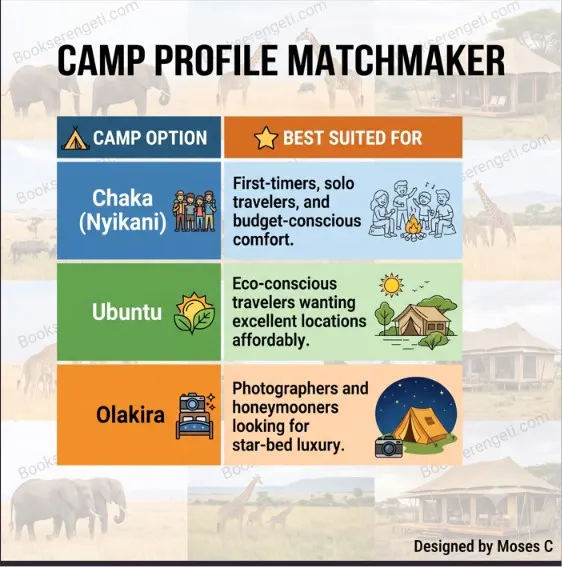
Three mobile camps come up again and again, and they sit at genuinely different price points. Here’s how they actually differ — and who each one suits.
Chaka (now Nyikani): value and warmth
“Chaka” is short for kichaka, Swahili for bush, and that’s the pitch — an honest, intimate camp without the top-tier price. It’s semi-permanent, nine-ish tents set 15 to 20 metres apart, each with a flush loo, a bucket shower, and a shaded veranda, plus a steward bringing coffee to your tent at first light. December to March it sits at Ndutu (the special campsite is signed “Old Ndutu,” about five minutes from the airstrip); from late May it’s up north near Kogatende at a site called Machwechwe. When it’s down south you can slip over to Olduvai Gorge on a slow morning. Guests rave about the food — homemade bread, proper soups — and, more than that, the staff. This is the one solo travelers and first-timers tend to love for its campfire, swap-stories feel. (You’ll see it listed under either name while the rebrand to Nyikani settles.)
Ubuntu: simple, green, well-fed
Asilia’s Ubuntu is the comfort-tier sibling to Olakira — a touch plainer, the same enviable locations. It runs mid-June to the end of October up in the Lamai wedge of the northern Serengeti, then strikes camp and reappears in the southern Kusini area in November to meet the herds coming back down. Ten tents, bucket showers, solar charging in the tent. The kitchen leans on produce from villages outside the gates, and dinner runs to three courses under the stars. The thing that still gets me about these camps: the whole operation can be packed, trucked across the ecosystem, and stood back up in about eight days, with nothing left behind but flattened grass.
Olakira: the stargazing splurge
Olakira sits at the top of the mobile range, and its signature is the tent itself — a 270-degree mesh panel that lets you wheel your bed onto a netted deck and sleep under the open sky, zipped safe from mosquitoes, with lions grumbling somewhere out in the dark. One guest woke to a giraffe peering down through the mesh at her. It moves between Ndutu in the south (December–March, technically inside the Ngorongoro Conservation Area) and the far north from June, where it pitches at the confluence of the Mara and Bologonja rivers, by the crossing locals call makutano — Swahili for, simply, “the crossing.” If you’re a photographer, this is the one: you can book Olakira’s adapted photographic vehicle in the north between June and October. Best for honeymooners and anyone happy to pay more for that bed-under-the-stars night.
Where Bookings Go Wrong
The mistake that costs people a day isn’t picking the wrong camp — it’s flying in on park fees that were never actually paid. Because mobile camps sit well past the road gates like Naabi Hill, you land on a dirt strip with no payment desk. If your agent didn’t clear those fees through the TANAPA portal ahead of time, the rangers find no record, and you don’t move.
I watched it happen at the Ndutu strip a couple of seasons back. A couple who’d booked through a cut-rate online agent sat on a bench in the midday heat for the best part of three hours — swatting tsetse, which are drawn to dark blue and black, so pack khaki and olive, not navy — while their guide tried to force an emergency card payment through a thin satellite signal. They lost the afternoon’s drive. Moses, who’s guided these camps for a decade, is blunt about it: the fees and the camp dates both have to be locked before you board the plane. When we book a trip through BookSerengeti.com, our Arusha office clears those control numbers days ahead, so the cruiser is waiting at the strip when you climb down.
The other half of this is lead time. Good mobile camps are tiny — eight to ten tents — and their move dates are set years out, so the prime weeks (February’s calving, the August crossings) go six months to a year ahead. Decide your dates early and hold the tents.
Nights in Camp
Bush Scenario | Camp Safety Protocol |
Walking After Dark | Never walk alone; escort required by torch-bearing steward. |
Noises Outside Tent | Stay inside; wildlife uses canvas to scratch an itch. |
Night Emergency | Use the provided two-way radio or air horn from inside. |
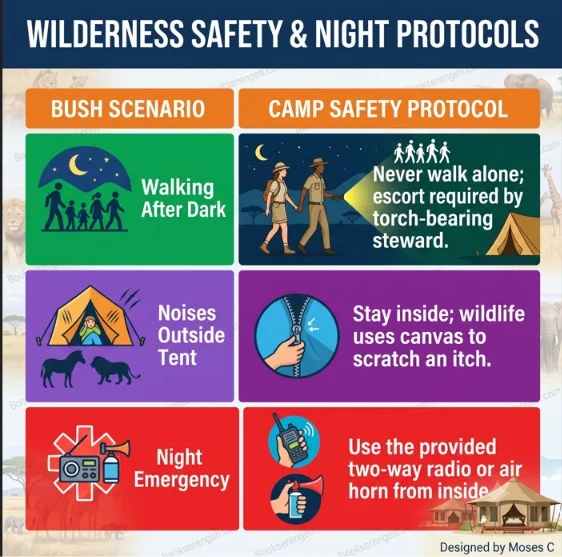
An unfenced camp is a sensory thing after dark. You lie in bed listening to hyenas whoop past the guy-ropes, catch the woodsmoke off the dying fire, and hear a lion working through its territorial rounds. The wild campsites here are even named for the animals that use them — Pimbi (hyrax), Tumbili (vervet monkey), Nyani (baboon), Nguchiro (mongoose).
Because animals wander the lanes between tents at night, you don’t walk back alone after dinner — a steward with a torch and a radio walks you to your zip. And if something heavy thumps your ropes at 2 a.m., it’s nearly always a zebra or a gazelle using the canvas to scratch an itch. Nearly always. The honest truth is the bush doesn’t run to a script, which is exactly why you keep to the boundaries the camp sets.
Migration Camp FAQ
What if the herds move early and the camp’s in the wrong spot?
It’s the standing worry, and the answer is undramatic: your guide packs a lunch box and drives further out to find the columns. You’ll still see the migration — your commute from the tents just stretches by an hour or so. The camps plan their moves on years of records, but the rains, and the herds, keep their own schedule.
How far ahead should we book?
For February calving or the August–September crossings, six months to a year. The camps are small, and because their relocation dates are fixed years in advance, the good weeks fill fast. Shoulder dates you can sometimes grab closer in.
Can we charge cameras and use normal plugs?
Yes — most camps have universal charging strips in the tent or the lounge, usually UK-style Type G sockets, fine for camera batteries and phones. What they can’t take is anything high-wattage; a hair dryer or travel iron will trip the solar inverter instantly.
How do we reach staff at night in an emergency?
You don’t step outside to do it. Every tent has a two-way radio, or an old-fashioned air horn, to call the night watchman across the camp. That’s the system — raise the alarm from inside your canvas, and someone comes to you.
Is laundry included?
Often, yes, at the better camps — but it’s hand-washed and sun-dried, not machine-done. For cultural reasons, underwear is usually left off the service; you’re handed a little detergent to rinse those through yourself in the tent.
Are these camps safe for young children?
Most enforce a minimum age, commonly five or twelve, because they’re unfenced and sit in active wildlife corridors. With littler ones, a permanent family lodge with walls and a gate in the central Seronera valley is the safer call. The drive up from Arusha is also long and rough for small kids, which is another reason most camp trips fly at least one way.
Get Your Camp Booked Before It’s Gone
The camps that matter for the migration are small, and they fill early — especially for the calving and the crossings. If you’ve got a month in mind, the next move is simple: send it over. Our Arusha team will tell you which camps are actually open on your dates, what’s still free, and what it costs — then hold the tents while you decide. Start with the safari booking form, and if you’re still weighing dates, read the best time to visit first. You can plan the whole trip on BookSerengeti.com without once touching a generic booking platform that doesn’t know a bucket shower from a power cut.
Editorial & Fact Check Validation Reviewed by Moses C. – Veteran Wildlife Safari Guide & Operations Manager at BookSerengeti.com.
Welcome to bookserengeti.com
Thank you for visiting us! We're excited to help you plan an unforgettable safari adventure across Kenya.
Latest Safari Posts
Serengeti Migration Safari Packages: 2026/2027 Cost & Itinerary Guide
Serengeti Wildlife Safari Packages: 2026/2027 Price, Big Five & Routes
Serengeti Group Joining Safari Package: 2026/2027 Price & Route Guide