Skip to content
How to Get to Serengeti - Flight & Route Guide
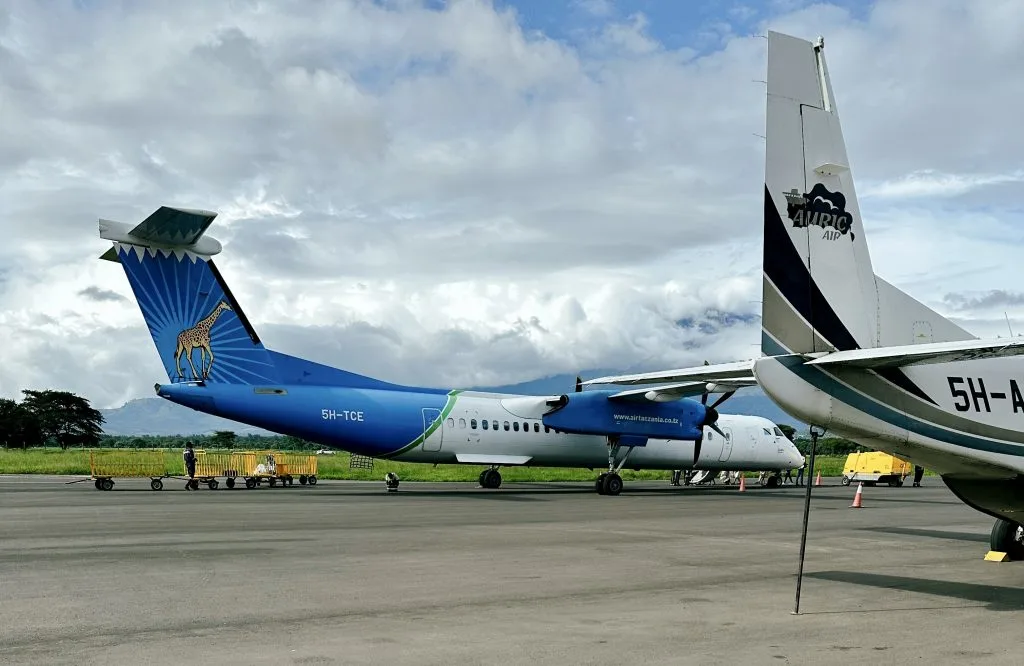
Summary: To figure out how to get to serengeti safely and efficiently, you must choose between a regional fly-in safari or an overland driving route starting from the town of Arusha. International travelers fly into Kilimanjaro International Airport (JRO) before connecting to Arusha Airport (ARK) for small bush planes, or boarding a private 4×4 land cruiser. For a well-planned 5-day double-occupancy journey that combines both driving tracks and a fly-back option, realistic peak-season prices for 2026 and 2027 range between USD 3,610 and USD 7,710 per person sharing.
Figuring out the logistics of how to get to serengeti is the most important step when building your Tanzanian travel layout. If you run a quick search online, you will find hundreds of automated travel blogs that make the journey look like a simple afternoon commute. They show lines on a map but leave out the massive distances, bumpy dirt corrugations, and complicated airport transfers that happen behind the scenes.
The Serengeti is not connected by paved highways or public transit lines. It is an isolated, wild landscape protected by strict government permits. If you pick the wrong transit connection, you can easily waste two full days of your vacation sitting inside a hot terminal or waiting for a broken axle to be repaired on a remote track.
Here are the realistic costs for these routes, so you can set a budget before we get into specific runways and gates.
Package Comparison
The table below breaks down a well-paced 5-Day/4-Night multi-destination safari built for two people traveling together. The local mantra here is “less is more”: fewer stops mean more time actually watching animals rather than rattling between parks, which is why the routing keeps smaller intermediate stops like Tarangire National Park and the Ngorongoro Crater to a single night while giving the core Serengeti plains a dedicated two-night block.
All rates reflect non-resident USD totals per person and are fully valid for the 2026 and 2027 seasons.
5-Day Double-Occupancy Safari Packages
Package Tier | 5-Day Double-Occp. Rate (Per Person) | Prime Accommodations Included (Tarangire / Crater / Serengeti) | Core Flight & Transit Buffers |
USD 3,610 | Sangaiwe Tented Lodge / Karatu Simba Lodge / Osinon Tented Camp | 4×4 Cruiser, Peak Fees, Seronera to Arusha Fly-Back | |
Mid-Range Classic | USD 4,310 | Maramboi Tented Camp / Rhino Lodge / Kubukubu Tented Lodge | 4×4 Cruiser, Peak Fees, Seronera to Arusha Fly-Back |
USD 5,260 | Lemala Mpingo Ridge / Ngorongoro Serena Safari Lodge / Melia Serengeti Lodge | 4×4 Cruiser, Peak Fees, Seronera to Arusha Fly-Back | |
Luxury Plus Ultra | USD 7,710 | Sanctuary Swala Camp / andBeyond Ngorongoro Crater Lodge / Four Seasons Safari Lodge | 4×4 Cruiser, Peak Fees, Seronera to Arusha Fly-Back |
Optional Experience Add-on: You can add a sunrise hot air balloon flight over the central plains to any of these itineraries for USD 600 per person. This price includes the mandatory TANAPA flight permit, the balloon launch, and a champagne bush breakfast after landing.
Itinerary Customization: You can request custom adjustments to your route through our Tailored Serengeti Itinerary Planner.
Related packages: 3-Day Serengeti Safari Package · 4-Day Serengeti Safari Package
What Fees Are Included
We would rather lay out the costs honestly before you lock in your route. Here is an exact breakdown of what we include inside our core tour rates, along with what you will need to pay for on your own.
What is Always Covered:
- All updated TANAPA conservation fees and daily MNRT destination taxes.
- Private use of a customized 4×4 safari land cruiser equipped with large windows, an open canvas roof hatch, and an internal inverter charging system.
- Full fuel allowances and the daily professional services of a licensed local guide.
- Mandatory government concession fees for every night spent at camps inside the park boundaries.
- Emergency medical evacuation cover through the AMREF Flying Doctors system.
- All specified meals, fresh cold drinking water stored in the vehicle’s built-in fridge, and double-occupancy room charges.
- One-way regional flight tickets on local carriers like Coastal Aviation from the Seronera airstrip back to Arusha (with all mandatory operator margins and luggage buffers fully handled).
What is Excluded:
- International airfare and your official Tanzanian entry tourist visa ($100 for US citizens, $50 for UK and EU passport holders).
- Discretionary tips for your guide and individual lodge hospitality teams.
- Personal laundry service, optional premium alcoholic drinks at bars, and independent medical travel insurance policies.
One billing detail the glossy guides skip: a Serengeti park “day” is counted as 24 hours from the moment you enter the gate, not by the calendar date, which quietly changes how many fee-days a multi-night trip actually costs. It also means you don’t have to pay park entry for every night you are in the area. Some travelers base themselves at a tented camp just outside the boundary — animals still wander past the veranda — and only pay the conservation fee on the days they actually drive in. The park is big enough that a few days inside usually does the job.
If you are ready to book your vehicle or want to compare routes, you can fill out our direct BookSerengeti.com Custom Inquiry Form to view our tailored itinerary options.
The Core Choice: Fly vs Drive
Travel Mode | Transit Time | Core Advantage |
Overland Drive | 7–8 hours | Scenic views of Great Rift escarpment |
Bush Flight | Under 1 hour | Fast transit; skips rough dirt tracks |
Fly-Drive Combo | Balanced itinerary | Drive out to parks, fly back to town |
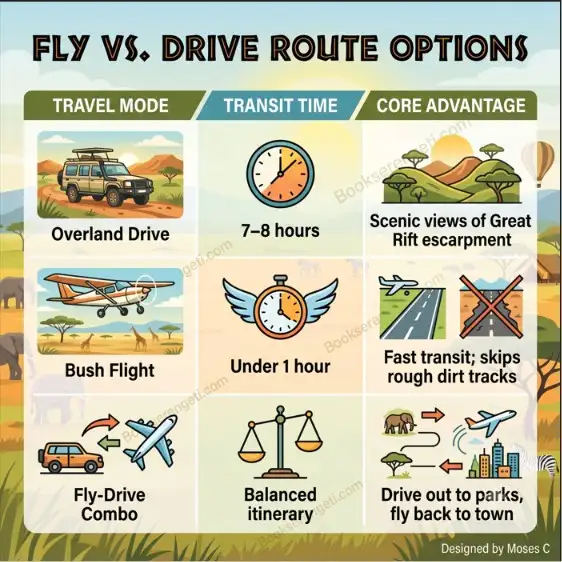
Your transit options across northern Tanzania come down to two classic strategies. You can either drive the entire way over land or use a regional flight to jump straight into the wilderness. Each comes with trade-offs that change the pace of your trip.
Overland driving lets you see the shifting landscapes up close. You leave the bustling markets of Arusha, climb up the agricultural walls of the Great Rift Valley escarpment, and wind through the dense green forests of the Ngorongoro highlands before descending onto the endless volcanic grasslands. It’s a beautiful drive, but it takes patience. The unpaved corrugation tracks shake the vehicle constantly, and if you do not have a strong back, the long road trip can be physically exhausting.
Flying saves you time but costs more. Small regional airlines operate single-engine Cessna Grand Caravans that fly directly from local runways into unpaved bush airstrips. A flight takes less than an hour, letting you skip days of rough driving.
For the best balance, we usually suggest combining the two: drive out through the smaller loop parks first, then take a fast regional flight back to Arusha on the final morning. You can shape this with one of our agents through the custom tour operator inquiry form.
Strict bush plane luggage rule: Local aviation authorities and regional carriers (like Coastal Aviation, Auric Air, Regional Air, and Flightlink) strictly enforce a 15 kg (33 lbs) total weight limit per passenger, including your hand luggage. All bags must be soft-sided duffel bags with no rigid frames or wheels, since they have to be jammed by hand into the aircraft’s tight belly pods.
Which Airstrip Should You Fly Into?
To make the most of your time, match your flight destination to the seasonal position of the migrating herds. Landing at an airstrip on the opposite side of the ecosystem means burning hours of wildlife viewing on long transit tracks.
Month Range | Migration Location | Best Target Airstrip | Primary Use Case |
January – March | Southern Serengeti / Ndutu | Ndutu Airstrip (NDU) | |
April – May | Central & Western Corridor | Seronera (SEU) / Grumeti (GRY) | Rainy Season / Resident Wildlife |
June – July | Western Corridor to North | Grumeti (GRY) / Ikoma (ICA) | |
August – October | Kogatende (KGT) / Lobo (LBO) | ||
November – December | Central Plains | Seronera Airstrip (SEU) | Short Rain Grazing |
JRO vs ARK: Arusha’s Two Airports
Airport Hub | Primary Function | Field Transit Rule |
JRO (Kilimanjaro) | International flights | 50 km east; allow 4-hr buffer |
ARK (Arusha) | Domestic bush flights | Western edge; connects to bush |
Cross-Town Link | Airport transfer | Highway traffic causes missed flights |
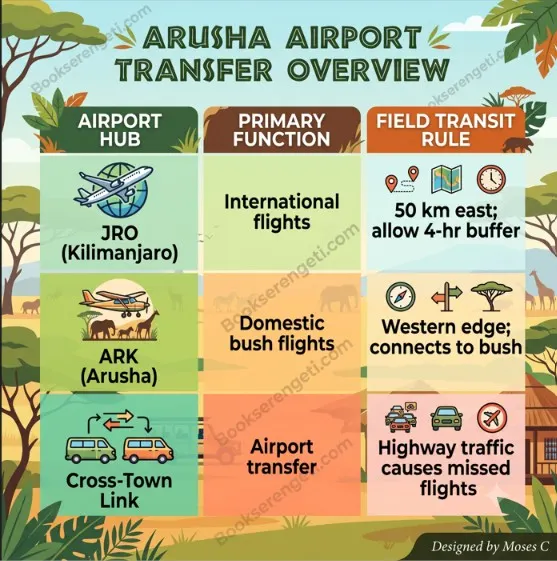
The biggest mistake international travelers make when planning their arrival comes from not realizing that Arusha has two separate airports. The confusion causes logistical delays every month.
Major international airlines like KLM, Qatar Airways, and Ethiopian Airlines land at Kilimanjaro International Airport (JRO), roughly 50 kilometers east of Arusha city. Almost all small domestic bush flights into the Serengeti, however, depart from Arusha Airport (ARK), a small domestic airstrip on the far western edge of the city.
Last year an independent group landed at JRO at 7:30 AM and booked a separate bush flight out of ARK at 9:00 AM, assuming they could simply hop between terminals. They had not reckoned with the traffic bottlenecks and slow-moving trucks on the single-lane highway across town, and by the time they cleared customs and got their bags into a taxi, the cross-city drive had eaten nearly two hours under a hard morning sun. They missed the flight, lost their non-refundable lodge permits for the night, and paid an extra USD 500 to rebook emergency seats with Auric Air the next day — spending their first day of safari breathing highway exhaust instead of watching the Big Five.
Ruben M. is a licensed safari guide with 10 years of experience, and he regularly advises that you budget a minimum of four hours between your international landing time and any domestic bush connection. Better yet, spend your first night resting at a quiet lodge in Arusha to adjust to the time zone, then catch an early morning flight the next day. That extra buffer gives your bags time to be sorted properly and keeps the trip on track if your international flight runs late.
A couple of money notes while you are passing through: skip the currency desks at Kilimanjaro and bring enough US dollars to change at a safari lodge instead, where the rate is far kinder. Carry as many small-denomination bills as you can, too — camps are wise to the “sorry, no change” routine when it comes time to tip. And a local courtesy worth knowing: never hand over money or a gift with your left hand, which is traditionally reserved for bathroom hygiene.
Step-by-Step Transit Milestones
It helps to know the real-world markers you cross along the way. Driving from Arusha straight to the Central Serengeti is a grueling 7 to 8 hours of continuous travel. One honest warning before you read the timings: don’t trust Google Maps for these routes — it badly underestimates them, and some operators quietly trim the numbers to make an itinerary look tighter on paper than it actually drives. The figures below are the real ones. If you are working out how to plan a serengeti safari from the ground up, your overland route will generally cross these milestones:
Milestone 1: The Arusha Departure
Your journey begins early in the morning. Your land cruiser will pick you up from your hotel and head west along the paved main road, passing small banana farms and Maasai villages.
Milestone 2: Clearing Loduare Gate
This is the main southern entrance checkpoint managed by the Ministry of Natural Resources and Tourism (MNRT). The drive from Arusha to Loduare Gate takes roughly 2.5 to 3 hours along a smooth, paved highway. Here, your guide will step out to register your vehicle permits while you use the facility restrooms.
Milestone 3: Winding Up the Crater Rim
The road turns into a steep, unpaved track that climbs through dense tropical rainforest. Moving from Loduare Gate up to the Ngorongoro Crater Rim takes about 45 minutes of driving on a dirt surface with a steep incline. The air quickly turns cool and misty, and you will catch spectacular views of the volcanic caldera below before heading back down the other side.
Milestone 4: The Naabi Hill Gate Checkpoint
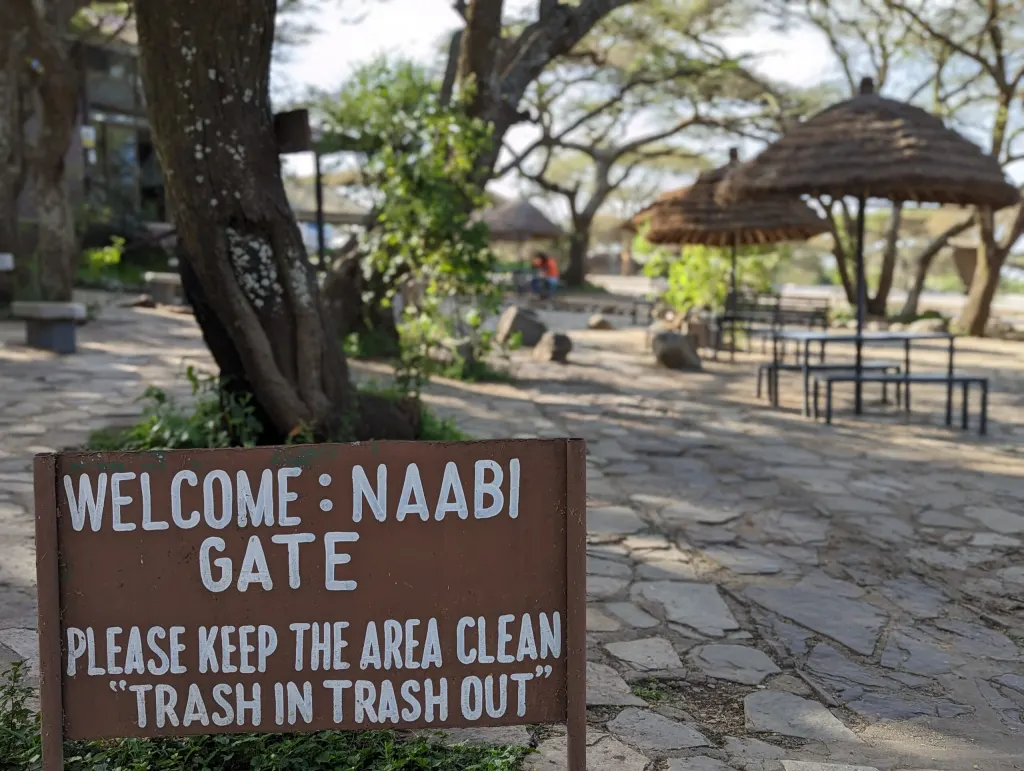
Driving from the crater rim down to Naabi Hill Gate takes about 2 to 2.5 hours across the open desert along the bumpy “corrugation track” surfaces. This is the stretch travelers warn about most — a few hours of relentless corrugation where the cruiser rattles without let-up, and the fine dust finds its way in even with the windows shut. If you are at all prone to motion sickness, take a tablet before you set off; plenty of guests simply dose up and doze through it, especially on the return leg. The gate itself is the official entrance to the Serengeti, built around a small volcanic hill rising out of the flat plains. Your guide will log into the digital Tanzania National Parks Authority (TANAPA) system to activate your park conservation permits, while you can take a short walk up the stone path to look out over the grasslands.
Milestone 5: The Final Bush Track Transfer
Once past the gate barrier arms, the paved surfaces disappear completely. Moving from Naabi Hill to the central camps of Seronera takes about 1.5 to 2 hours of slow tracking, serving as your first official game drive. Your land cruiser will drop its tire pressure to handle the rough corrugation tracks, and you will begin tracking wildlife immediately as you drive toward your camp. Try to time it so you reach camp by around 3pm — the late-afternoon and early-evening light over the plains is the best part of the day, and arriving early lets you settle in and enjoy it.
Savanna Transit FAQ
Can we book a direct flight from Dar es Salaam or Zanzibar to the park?
Yes, local air carriers operate daily scheduled flights that connect the beach resorts of Zanzibar or the airport in Dar es Salaam directly with the Serengeti. These flights typically stop briefly in Arusha or Lake Manyara to drop off passengers before landing on the dirt strips inside the park. This is an excellent way to combine a beach holiday with a wildlife safari without doing any long overland driving. For budget travelers there is also a slower, scenic backdoor the polished guides ignore: take the ferry from Stone Town across to Dar es Salaam, then the overnight train up to Arusha — a sleeper berth runs around 45,000 shillings, roughly £15 — with Kilimanjaro visible from Moshi if the cloud lifts. From Arusha you book a budget safari package the usual way.
Is there a quieter gate than Naabi Hill?
If you are coming in from the Mwanza side in the west, yes. Start early from Mwanza and you can clear the Ndabaka gate not long after it opens around 8am, usually with no paperwork queue — a welcome contrast to the busy Naabi Hill gate on the Ngorongoro side, where vehicles pile up by midday. It is the natural way in if your route runs through the Western Corridor.
What happens if animals walk onto the dirt runways inside the park?
This is a common occurrence in the bush. Before any aircraft is cleared to touch down on a remote dirt runway, the local park rangers must drive a vehicle down the center line to clear grazing wildebeest, zebras, or Thomson’s gazelles off the track. The pilots are highly experienced and will circle the runway from above until the ground crew confirms the dirt track is entirely clear of wildlife.
Can I camp cheaply up by the northern river crossings?
Not really, and it surprises a lot of budget travelers. There are no public campsites in the northern Serengeti near the river region; the closest public site is at Lobo in the northeast, roughly two hours’ drive from the crossings. Even the most basic budget migration camps up there tend to start around USD 200 a night, so the plan to rough it for next to nothing does not stretch as far north as people hope.
Are there luggage storage facilities at the local airports?
Yes, if you are doing a combined fly-in safari and have large, rigid suitcases that cannot fit inside a bush plane’s cargo pod, you can store your excess baggage safely at your hotel in Arusha or inside our main operations office. You can pack your three days of safari clothing into a small, soft-sided duffel bag for the wilderness portion of your trip, and then collect your main holiday suitcases once you return to town.
Is it safe to travel along these unpaved roads during the wet season?
During the heavy rainy months of April and May, secondary dirt tracks through the low-lying valleys can become muddy and slick. Our customized 4×4 land cruisers utilize heavy-duty off-road suspension setups and front-mounted recovery winches to handle these changing track conditions. However, we alter our routing during these weeks to stick to the elevated, hard-packed ridge tracks, which keeps your vehicle safe and prevents you from getting stuck in deep mud pools.
Organize Your Transit Plan with Local Experts
A smooth journey to the savanna comes down to honest pacing and real field experience. Avoid generic automated booking websites that do not understand cross-town traffic challenges or seasonal road conditions. Connect directly with our Arusha operations team through our Tailored Serengeti Itinerary Planner to check vehicle openings and lock in your professional team for the upcoming season.
Editorial & Fact Check Validation: Reviewed by Moses C. – Veteran Wildlife Safari Guide & Operations Manager at BookSerengeti.com.
Welcome to bookserengeti.com
Thank you for visiting us! We're excited to help you plan an unforgettable safari adventure across Kenya.
Latest Safari Posts
Serengeti Migration Safari Packages: 2026/2027 Cost & Itinerary Guide
Serengeti Wildlife Safari Packages: 2026/2027 Price, Big Five & Routes
Serengeti Group Joining Safari Package: 2026/2027 Price & Route Guide